Basal Cell Carcinoma Pathology: 8 Subtypes & IHC Markers
Comprehensive histopathological analysis of basal cell carcinoma, the most common skin cancer, detailing variants, features, and differentials.
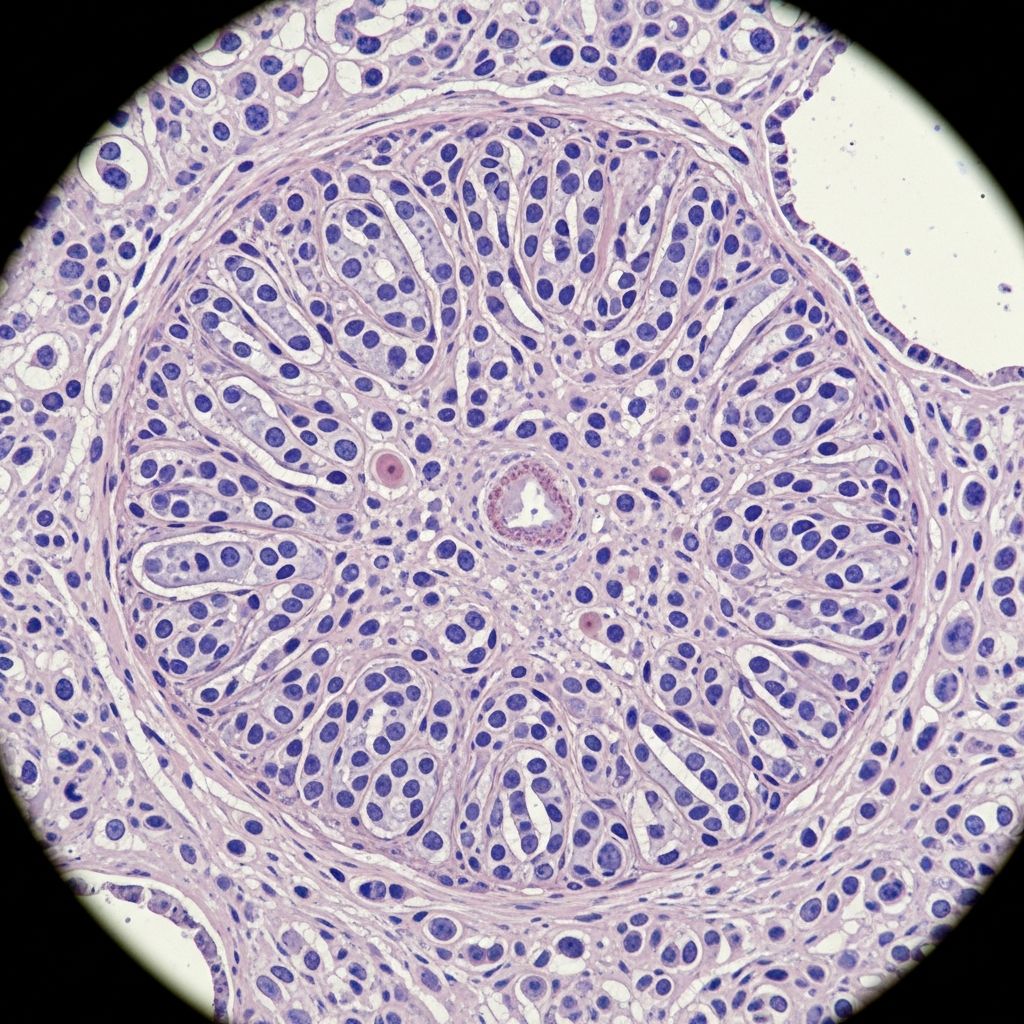
Basal cell carcinoma (BCC) represents the most prevalent form of nonmelanoma skin cancer, manifesting as a locally invasive tumour with diverse clinical presentations. Originating from basal keratinocytes in the epidermis, BCC exhibits slow growth but can cause significant local tissue destruction if untreated. Pathologically, it is characterised by basaloid epithelial proliferations with distinctive architectural and cytological features.
Histopathology
The hallmark of
BCC
at low-power magnification is a basaloid epithelial tumour emerging from the epidermis. This proliferation forms nests or islands of uniform basaloid cells, typically showing peripheral palisading—a single layer of elongated cells aligned at the tumour periphery with hyperchromatic nuclei oriented parallel to the basement membrane. A critical diagnostic clue is the retraction artefact, manifesting as a cleft between the tumour nests and the surrounding stroma due to shrinkage during tissue processing (Figure 1).Within the tumour islands, central areas display crowded nuclei, increased nuclear-to-cytoplasmic ratios, and scant cytoplasm. Mitotic figures, apoptotic bodies (necrotic debris), and occasional dystrophic calcification are common. The stroma often appears mucinous or myxoid, rich in glycosaminoglycans, aiding differentiation from mimics (Figure 4).
Connection to the epidermis is frequent, with tumour buds extending downward. In advanced cases, ulceration, inflammation, and perineural invasion may occur, correlating with aggressive behaviour.
Histopathology images
- Figure 1: Low-power view of nodular BCC showing basaloid nests with peripheral palisading and stromal clefting arising from epidermis.
- Figure 2: High-power detail of palisading nuclei and retraction artefact.
- Figure 3: Central crowding with mitoses and apoptotic bodies.
- Figure 4: Mucinous stroma surrounding basaloid islands.
- Figure 5: Superficial BCC with multifocal epidermal buds confined to papillary dermis.
- Figure 6: Pigmented BCC with melanin deposits and melanophages.
- Figure 7-9: Micronodular BCC with small infiltrating nests.
- Figure 10-11: Infiltrating BCC with cords and strands invading dermis.
- Figure 12: Rare sebaceous differentiation in BCC.
These images illustrate the spectrum of BCC histopathology, from classic nodular forms to aggressive infiltrative patterns.
Histopathology description
Superficial basal cell carcinoma
This subtype features multifocal, small nests of atypical basaloid cells budding directly from the basal layer of the epidermis, confined to the superficial papillary dermis without deep invasion (Figure 5). It often presents as red, scaly plaques on the trunk, mimicking eczema. Histologically, the buds lack retraction artefacts in some cases, and connection to epidermis is preserved.
Nodular basal cell carcinoma
The classic form, comprising solid nodules of basaloid cells extending into dermis or subcutis. Nodules show prominent peripheral palisading, stromal clefting, and central necrosis (ghost cells). Cartilage invasion is rare. Clinically, these appear as pearly papules with telangiectasia (Figure 1).
Pigmented basal cell carcinoma
Identical to nodular BCC but with abundant melanin pigment within tumour cells, increased intra-tumoural melanocytes, and melanophages in stroma (Figure 6). This variant is more common in darker skin types and may mimic melanoma clinically.
Micronodular basal cell carcinoma
Composed of multiple tiny (<0.15 mm) basaloid nests with minimal stromal reaction, leading to subtle infiltration. This aggressive subtype recurs frequently due to underestimation of margins (Figures 7-9).
Basosquamous carcinoma
A contentious entity blending BCC and squamous cell carcinoma (SCC) features. Histologically, basaloid areas transition to squamoid cells with larger cytoplasm, loss of palisading, but absent keratinisation. BerEP4 positive, EMA negative, favouring BCC over pure SCC.
Related Stories



Infiltrating basal cell carcinoma
Characterised by irregular cords, strands, and trabeculae of basaloid cells infiltrating deeply, often with desmoplastic stroma. High recurrence risk due to poor circumscription (Figures 10-11).
Metatypical basal cell carcinoma
Now rarely used term for BCC with atypical, larger pale cells showing partial squamoid differentiation, loss of clefting/palisading. Behaves aggressively.
Sebaceous differentiation
Infrequent finding of sebaceous vacuolated cells within BCC nests (Figure 12). Distinguished from sebaceoma by basaloid dominance and palisading.
Differential diagnosis
BCC must be differentiated from other basaloid adnexal tumours:
| Feature | BCC | Trichoepithelioma | Basaloid SCC |
|---|---|---|---|
| Stroma | Mucinous, clefting | Cellular, papillary mesenchymal bodies | Desmoplastic, no clefts |
| Palisading | Prominent | Focal | Absent |
| Cytology | High N/C, mitoses | Retractile nuclei | Keratinisation, atypia |
| IHC | BerEP4+, BCL2 diffuse | BCL2 basal, CD34 stroma | EMA+, p63 high |
Trichoepithelioma: Smaller nests, stromal papillary mesenchymal bodies, less atypia, BCL2 highlights only basal layer.
Sebaceoma: More mature sebocytes, lacks BCC’s infiltrative growth.
Fibroepithelioma of Pinkus: Anastomosing strands of basaloid cells in vascular stroma, considered BCC variant.
Immunohistochemistry
BCC shows positivity for cytokeratins (CK5/6, CK14), especially follicular types. BerEP4 (EpCAM) is diffusely positive in most BCCs, negative in adnexal tumours. EMA is usually negative. BCL2 is diffusely positive (vs. peripheral in trichoepithelioma). CD10 positive in tumour and stroma; Ki67 proliferation index high. p63 and CK17 support squamous/basal differentiation. These markers aid in challenging cases.
Frequently Asked Questions
What is the most important histological feature of BCC?
Peripheral palisading with stromal retraction cleft.
Which BCC subtype has the highest recurrence risk?
Micronodular and infiltrative subtypes due to subtle infiltration.
How does BCC differ from trichoepithelioma on IHC?
BCC: diffuse BCL2, BerEP4+; Trichoepithelioma: peripheral BCL2, stromal CD34.
Is pigmented BCC more aggressive?
No, pigmentation does not affect prognosis; behaviour mirrors nodular BCC.
Can BCC show squamous differentiation?
Yes, in basosquamous/metatypical forms, but lacks full keratinisation.
This FAQ section addresses common queries for pathologists and clinicians.
Expanding on BCC pathology, the tumour’s origin traces to mutations in the Hedgehog pathway, particularly PTCH1 gene, leading to uncontrolled proliferation. UV exposure drives most sporadic cases, with fair skin increasing susceptibility. Histologically, regression foci—eosinophilic stroma with absent basaloid nests—indicate host response and better prognosis.
Infiltrative BCC often elicits desmoplasia, with fibroblastic stroma mimicking sclerosing BCC. Perineural invasion, seen in 1-5% of cases, raises concerns for recurrence and mandates wider excision. Rare variants include keratotic BCC with surface cornification and matricoma-like areas.
For superficial BCC, multifocality challenges topical therapies like imiquimod, which induce inflammation mimicking histologically. Mohs micrographic surgery excels for high-risk subtypes, allowing margin control with preserved tissue.
Demographics influence presentation: in skin of colour, nodular/pigmented BCC predominate on sun-exposed sites, with lower incidence but similar pathology. Prognosis remains excellent with early intervention; metastasis is exceedingly rare (<0.1%).
Pathologists must correlate histology with clinical findings, as actinic keratosis or seborrhoeic keratosis can overlie BCC. Digital dermoscopy aids pre-biopsy suspicion, revealing arborising vessels and blue-white veil.
References
- Basal cell carcinoma pathology — DermNet NZ. 2023. https://dermnetnz.org/topics/basal-cell-carcinoma-pathology
- Basal Cell Carcinoma – StatPearls — NCBI Bookshelf / Bolognia JL, et al. (eds). 2023-10-15. https://www.ncbi.nlm.nih.gov/books/NBK482439/
- Basal cell carcinoma — DermNet NZ. 2023. https://dermnetnz.org/topics/basal-cell-carcinoma
- Genetics of basal cell carcinoma — DermNet NZ. 2023. https://dermnetnz.org/topics/genetics-of-basal-cell-carcinoma
- Basal cell carcinoma images — DermNet NZ. 2023. https://dermnetnz.org/images/basal-cell-carcinoma-images
- Basal cell carcinoma in skin of colour — DermNet NZ. 2023. https://dermnetnz.org/topics/basal-cell-carcinoma-in-skin-of-colour
Similar Articles








Read full bio of Sneha Tete