Baseline Series Of Patch Test Allergens: Comprehensive Guide
Essential guide to standard allergens used in patch testing for diagnosing allergic contact dermatitis effectively.
The baseline series of patch test allergens represents a standardized set of the most common contact allergens used to diagnose
allergic contact dermatitis (ACD)
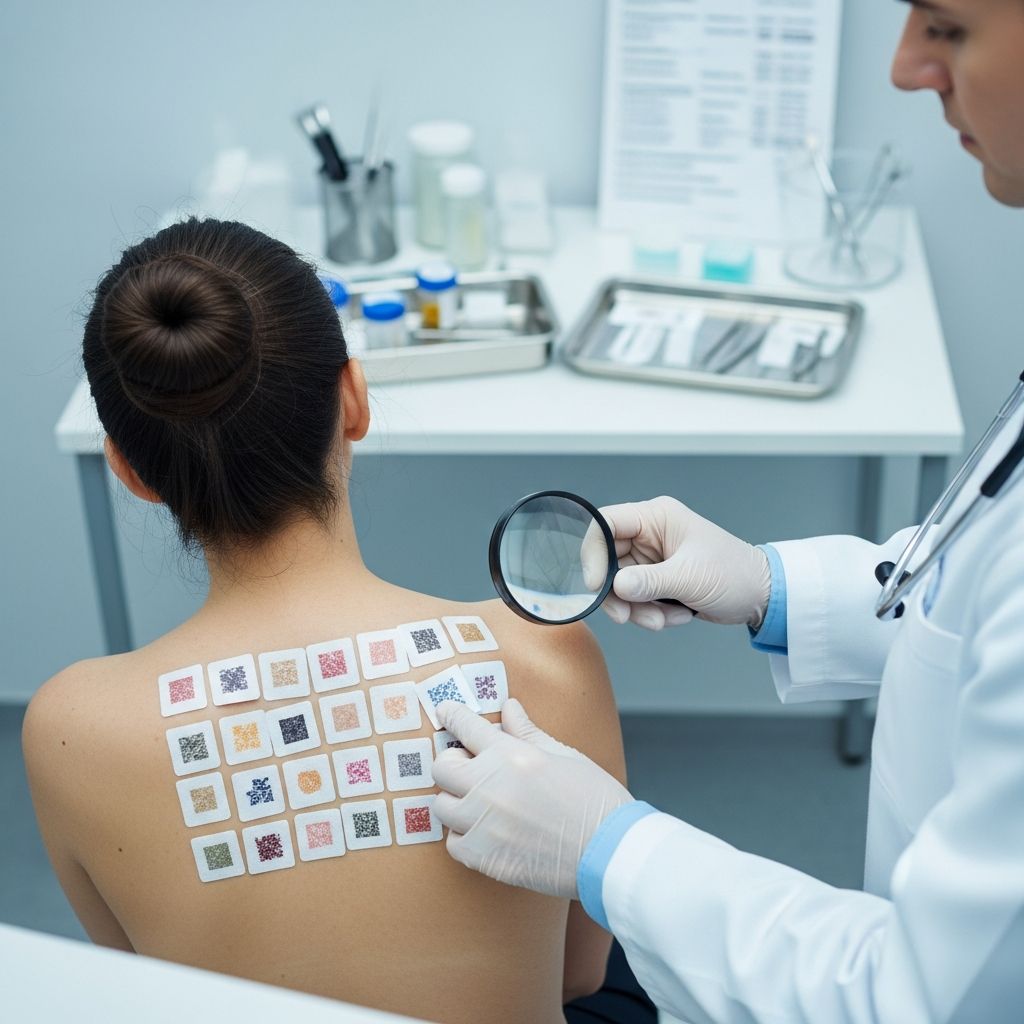
, a delayed hypersensitivity reaction affecting millions worldwide. This series detects over 70% of relevant allergens in patients with suspected ACD, enabling targeted avoidance strategies to prevent recurrences. Patch testing involves applying small amounts of these allergens to the skin, typically the upper back, and monitoring for reactions over several days.What is Patch Testing?
Patch testing is a diagnostic procedure performed by dermatologists to identify specific substances causing ACD. Unlike immediate hypersensitivity tests like skin prick tests, patch tests detect
type IV delayed hypersensitivity reactions
, which develop 48-96 hours after exposure. Allergens are placed in chambers on hypoallergenic tape and applied to the patient’s back for 48 hours. Readings are taken at day 2 (D2), day 3-4 (D3/D4), and late readings around day 7 (D7) to capture evolving reactions.The procedure begins with a clinical history and examination to select appropriate candidates: those with persistent eczema unresponsive to treatment, occupational dermatitis, or relapsing rashes despite irritant avoidance. Patients must avoid systemic corticosteroids and potent topicals for 2-4 weeks prior to testing to prevent false negatives.
Who Should Undergo Patch Testing?
- Patients with chronic, therapy-resistant hand or foot eczema.
- Individuals with facial, eyelid, or lip dermatitis suggesting cosmetics or metals.
- Occupational exposures to chemicals, resins, or rubbers.
- Children and adults with widespread or recurrent ACD.
Contraindications include active widespread dermatitis, immunosuppression, or inability to adhere to post-test care. Children can be tested using the same concentrations as adults, though reduced series may be used due to limited skin area.
The European Baseline Series (EBS)
The European Baseline Series (EBS), recommended by the European Society of Contact Dermatitis (ESCD), comprises 30-35 core allergens updated periodically based on prevalence data. An allergen qualifies for inclusion if it shows 60.5% positivity in consecutive patch-tested patients and demonstrates clinical relevance. The 2015-2019 EBS includes metals, fragrances, preservatives, and rubber chemicals, reflecting common exposures in Europe.
Recent studies from 2019-2021 in 748 Slovenian patients tested a 40-allergen series, including the 2015 EBS plus 10 additions. Key findings: nickel sulfate topped positivity at 14.4%, followed by fragrances and balsam of Peru.
Common Allergens in the Baseline Series
The baseline series targets ubiquitous allergens from personal care, occupational, and environmental sources. Here’s a breakdown:
| Allergen | Concentration/Vehicle | Common Sources | Prevalence Notes |
|---|---|---|---|
| Nickel sulfate | 5% pet. | Jewelry, coins, tools | Most common; 14.4% positivity |
| Cobalt chloride | 1% pet. | Metals, dyes, cement | Frequent co-reaction with nickel |
| Fragrance mix I | 8% pet. | Perfumes, cosmetics | High relevance in facial dermatitis |
| Balsam of Peru (Myroxylon pereirae) | 25% pet. | Fragrances, spices, citrus | Cross-reacts with fragrances |
| Formaldehyde | 1-2% aq. | Preservatives, textiles, glues | Increased reactions at 2% noted |
| Methylisothiazolinone (MI) | 0.2% aq. | Wet wipes, paints, shampoos | Rising prevalence |
| Thiomersal | 0.1% pet. | Eye drops, vaccines | Less common now |
| p-Phenylenediamine (PPD) | 1% pet. | Hair dyes, rubbers | Occupational risk |
| Colophonium | 20% pet. | Adhesives, plasters | Leg ulcer patients |
| Parabens mix | 12% pet. | Preservatives in creams | Declining use |
Related Stories



This table summarizes core EBS allergens; full lists vary by region (e.g., NAC-80 in North America includes 80 allergens). Positivity rates: metals (nickel, cobalt, chromate) account for 20-30%, fragrances/preservatives 15-20%.
Additional Allergens and Updates
Beyond the core EBS, supplemental series address specific exposures: hairdressing (e.g., toluene-2,5-diamine), dental, or plant series. Recent data suggest additions like
cocamidopropyl betaine 1% aq.
(shampoos, 1.2% positivity),disperse blue mix 106/124 1% pet.
(textiles),2-bromo-2-nitropropane-1,3-diol 0.5% pet.
(preservative),Compositae mix II 5% pet.
(plants), anddiazolidinyl urea 2% pet.
(formaldehyde releaser) due to 60.5% rates.North American series emphasize isocyanates and bakelite resins for occupational ACD. Series evolve: MI was added post-2010 surge from leave-on products.
How Patch Testing is Performed
- Day 1: Clean back, apply 10-12 allergen patches per strip (e.g., True Test or Finn Chambers). Instruct avoidance of water/sweat.
- Day 2: Remove patches at home or clinic (48h occlusion).
- Day 3-4: First reading for erythema, vesicles, or infiltration.
- Day 5-7: Late reading; 20-30% reactions peak here (crescendo pattern).
Standardized vehicles: petrolatum (pet.) for lipophiles, aqueous (aq.) for water-solubles. Each chamber holds ~15-20mg allergen.
Reading and Interpreting Reactions
International Contact Dermatitis Research Group (ICDRG) scale:
- ?+: Doubtful; faint erythema.
- +: Weak positive; erythema, papules.
- ++: Strong; vesicles, edema.
- +++: Extreme; bullae, ulceration.
- IR: Irritant; no infiltrate.
- N: Negative.
Positive 1+ on D3 or D6/7. Evolution: crescendo (increasing, e.g., fragrances), decrescendo (fading, metals), plateau. Clinical relevance assessed by history: current, past, occupational, or concommitant (co-reacting). False positives from irritation minimized by morphology and repeat testing.
Potential Reactions and Complications
- Common: Transient hyperpigmentation (weeks), itch at site.
- Rare: Persistent dermatitis, autoeczematization (flare of old sites), infection.
- Active sensitization: New allergy from test dose (e.g., high PPD).
Post-test care: bland emollients, avoid scratching/topicals. Most resolve in 2-4 weeks.
Clinical Relevance and Management
Positive results guide avoidance: substitute products, protective gloves, hypoallergenic alternatives. Relevance types:
- Current: Matches eruption site/source.
- Past: History of reaction.
- Occupational: Work-related.
Patch testing improves quality of life; economic studies show cost savings via reduced flares. Multidisciplinary follow-up for complex cases.
Frequently Asked Questions (FAQs)
Q: How accurate is patch testing?
A: Highly accurate for type IV allergies, detecting 70-80% culprits with baseline series; supplemented for higher yield.
Q: Can patch testing cause allergies?
A: Rare active sensitization risk with potent allergens like PPD; benefits outweigh.
Q: When are late readings necessary?
A: Essential; captures 20% crescendo reactions, per ESCD guidelines.
Q: Is patch testing safe for children?
A: Yes, same concentrations; reduced series if needed.
Q: What if all tests are negative?
A: Consider irritant dermatitis, endogenous eczema, or additional series/patient products.
Future Directions
Ongoing surveillance refines series: rising biocides (MI/MCl), textiles (disperse dyes). Digital patch tests and AI interpretation emerging. Global harmonization (EBS vs. NACDG) improves care.
References
- Patch testing with the European baseline series and 10 added allergens: Sensitization profile, usefulness of late readings and co-reactivity patterns 60 Acta Dermato-Venereologica (NIH/PMC). 2022. https://pmc.ncbi.nlm.nih.gov/articles/PMC9796124/
- Baseline series of patch test allergens 60 DermNet NZ. Accessed 2026. https://dermnetnz.org/imagedetail/10654-baseline-series-of-patch-test-allergens
- Patch Testing for Skin Allergies: Procedure & Results 60 Cleveland Clinic. 2023-01-28. https://my.clevelandclinic.org/health/diagnostics/patch-test
- Patch Testing 60 SkinDC (academic-affiliated). 2024. https://skindcderm.com/patch-testing/
- Patch Testing: A Best Practice Guide 60 British Dermatological Nursing Group (BDNG). 2017-02-13. https://bdng.org.uk/wp-content/uploads/2017/02/FINAL130117.pdf
- American Contact Dermatitis Society Core Allergen Series: 2020 60 ACDS. 2020. https://www.contactderm.org/UserFiles/file/American_Contact_Dermatitis_Society_Core_Allergen.2-1_v1.pdf
Similar Articles








Read full bio of Sneha Tete