Bazex-Dupré-Christol Syndrome: Genetics, Symptoms & Treatment
Rare X-linked genodermatosis with hypotrichosis, follicular atrophoderma, and early-onset basal cell carcinomas.
Bazex-Dupré-Christol Syndrome
Bazex-Dupré-Christol syndrome (BDCS) is a rare genodermatosis characterised by the triad of congenital hypotrichosis, follicular atrophoderma, and subsequent development of multiple basal cell carcinomas (BCCs). Categorized as an ectodermal dysplasia with hereditary tumours, it follows an X-linked dominant inheritance pattern, leading to more severe manifestations in males.
What is Bazex-Dupré-Christol syndrome?
Bazex-Dupré-Christol syndrome, also known as follicular atrophoderma-basal cell carcinoma syndrome, represents a unique ectodermal dysplasia predisposing individuals to skin appendage abnormalities and neoplasms. First described in 1966 by French dermatologists Albert Bazex, Jean Dupré, and André Christol, the condition manifests with sparse scalp hair from birth, ice-pick-like depressions in hair-bearing skin, and early-onset BCCs, typically on the face.
Reported in approximately 20 families worldwide, BDCS affects males and females equally but shows no male-to-male transmission due to its X-linked nature. Sporadic cases occur, though rarely. Unlike acrokeratosis paraneoplastica (another ‘Bazex syndrome’), BDCS has no paraneoplastic association; it is purely genetic.
Who gets Bazex-Dupré-Christol syndrome (epidemiology)?
BDCS is exceedingly rare, with fewer than 150 cases documented globally across diverse ethnicities, including recent reports from Indian families. Prevalence remains unknown due to underdiagnosis, as symptoms may appear nonsimultaneously—hypotrichosis at birth, atrophoderma in childhood, and BCCs in adolescence or adulthood.
- Age of onset: Congenital for hypotrichosis; childhood for atrophoderma; puberty/adolescence for BCCs.
- Sex distribution: Equal incidence, but males exhibit greater severity due to hemizygosity.
- Geographic/ethnic predisposition: None; cases span Europe, Asia, and North America.
Females may display milder or mosaic phenotypes due to X-inactivation, while affected males consistently show full expression.
Background and genetics (aetiology)
BDCS arises from mutations disrupting ectodermal development and tumour suppression. It is inherited in an X-linked dominant manner, localizing to chromosome Xq24-q27. Affected females transmit to 50% of offspring (all daughters of affected males inherit it).
Recent genetic studies identify pathogenic variants in the ACTRT1 gene (actin-related protein T1), encoding a non-coding mRNA essential for primary cilia assembly—microtubule-based organelles regulating Hedgehog signaling, critical for skin and hair follicle homeostasis. Loss of ARP-T1 leads to cilia depletion, hyperactivating Hedgehog pathway and promoting BCC formation, akin to Gorlin syndrome.
Earlier reports implicated UBE2A, but ACTRT1 is now confirmed. No other loci identified; sporadic cases likely represent de novo mutations.
| Feature | Details |
|---|---|
| Inheritance | X-linked dominant |
| Locus | Xq24-q27 |
| Gene | ACTRT1 (primary); UBE2A (historical) |
| Pathophysiology | Cilia dysfunction → Hedgehog overactivation → BCCs |
| Penetrance | Complete in males; variable in females |
Clinical features of Bazex-Dupré-Christol syndrome
BDCS presents a progressive phenotype, often unrecognized at birth. Core triad defines diagnosis, with additional ectodermal and neoplastic features.
Hypotrichosis
Congenital sparse or absent scalp hair, eyebrows, and eyelashes. Remaining hairs are thin, light-colored, brittle, and twisted (‘pili canaliculi’ under microscopy). Body and pubic hair may be reduced; beard sparse in males.
Follicular atrophoderma
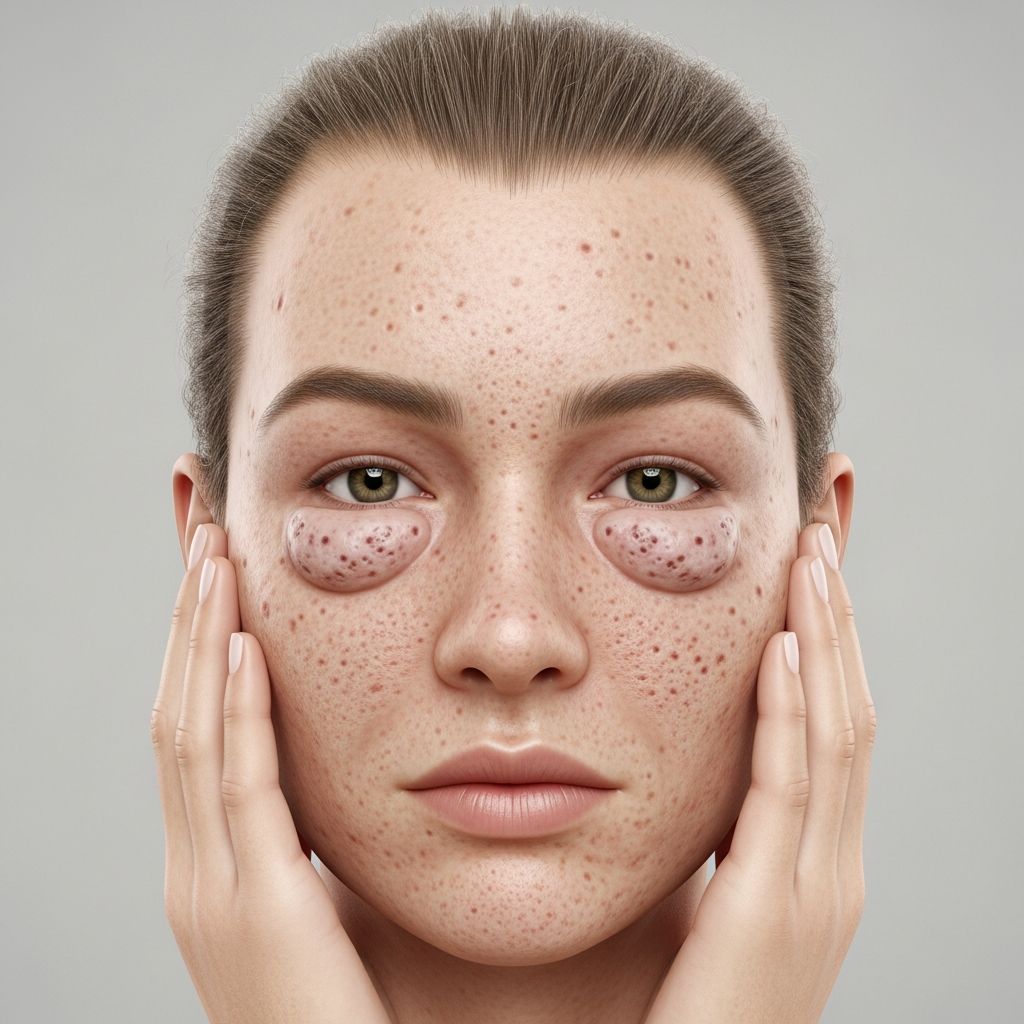
Hallmark: 1-2 mm ice-pick pits on dorsae of hands, feet, elbows, knees, and face (perioral, nasolabial folds). Visible from infancy, palpable as comedone-like depressions. Histology shows cystic infundibular dilatation.
Basal cell carcinomas/nevi
Multiple BCCs emerge in teens/20s, favoring face (nose, cheeks, eyelids). Nodular, superficial, or pigmented subtypes; aggressive locally but non-metastatic. Trichoepitheliomas and milia common precursors.
Other features
- Milia: Pearly cysts on face, ears, extremities.
- Ichthyosis: Fine scaling on limbs.
- Hypohidrosis: Reduced sweating, heat intolerance.
- Nail dystrophy: Ridging, onychoschizia.
- Neurological: Rare intellectual disability, seizures.
- Ocular: Ectropion, coloboma (infrequent).
Males: Severe hypotrichosis, profuse BCCs. Females: Variable, skewed X-inactivation.
Diagnosis of Bazex-Dupré-Christol syndrome
Clinical diagnosis hinges on triad presence, family history, and early/familial BCCs. Search for subtle atrophoderma with tangential lighting.
- Histopathology: Atrophoderma—dilated follicles; BCC—standard palisading basaloid islands; hypotrichosis—small follicles.
- Genetic testing: Confirms ACTRT1 variants; useful for counseling.
- Differentials: Gorlin syndrome (odontogenic cysts, palmar pits), Rombo syndrome (milia, hypotrichosis), Muir-Torre (sebaceous tumors).
| Major | Minor |
|---|---|
| • Follicular atrophoderma • Congenital hypotrichosis • Multiple facial BCCs <30 years | • Milia/trichoepitheliomas • Family history X-linked • ACTRT1 mutation |
Management and treatment of Bazex-Dupré-Christol syndrome
Multidisciplinary: dermatology, genetics, oncology. Focus on surveillance, symptom palliation, BCC prevention.
BCC management
- Early lesions: Topical 5-FU, imiquimod, photodynamic therapy (PDT).
- Advanced: Mohs micrographic surgery (ideal for recurrent facial BCCs).
- Systemic: Hedgehog inhibitors (vismodegib, sonidegib) for unresectable disease.
Skin care
- Emollients for ichthyosis/hypohidrosis.
- Retinoids (topical/systemic) for atrophoderma/BCC chemoprevention—monitor lipids/liver.
- Milia: Extraction, cryotherapy.
- Hair: Wigs/cosmetics; minoxidil ineffective.
Surveillance
- Annual full skin exams from puberty.
- Baseline ophthalmology, neurology if indicated.
- Genetic counseling: 50% risk from carrier mothers.
No curative therapy; lifelong monitoring prevents morbidity. BCCs not linked to visceral cancers.
Frequently Asked Questions (FAQs)
What causes Bazex-Dupré-Christol syndrome?
Mutations in the ACTRT1 gene on the X chromosome disrupt cilia function, leading to Hedgehog pathway dysregulation and the characteristic skin and hair abnormalities.
Is Bazex-Dupré-Christol syndrome fatal?
No, it is not life-threatening. Complications arise from numerous BCCs, managed effectively with vigilant care. No internal malignancy risk.
Can Bazex-Dupré-Christol syndrome be cured?
No cure exists, but symptoms are controllable. Genetic therapies under research may offer future hope.
How is it inherited?
X-linked dominant: All daughters of affected males inherit it; 50% offspring of affected females.
When do basal cell carcinomas appear?
Typically adolescence/early adulthood, earlier than sporadic BCCs. Annual screening recommended.
References
- Bazex-Dupré-Christol syndrome: review of clinical and molecular aspects — AlSabbagh Manahel M, Baqi Mariam A. International Journal of Dermatology. 2018-05-28. https://pubmed.ncbi.nlm.nih.gov/29808590/
- Bazex‐Dupré‐Christol syndrome: review of clinical and molecular aspects — AlSabbagh Manahel M, Baqi Mariam A. International Journal of Dermatology. 2018-05-28. https://onlinelibrary.wiley.com/doi/abs/10.1111/ijd.14065
- Bazex-Dupré-Christol syndrome — DermNet NZ. Accessed 2026. https://dermnetnz.org/topics/bazex-dupre-christol-syndrome
- Bazex–Dupré–Christol syndrome — National Cancer Institute. Accessed 2026. https://www.cancer.gov/publications/dictionaries/cancer-terms/def/bazex-dupre-christol-syndrome
- Disease Overview: Bazex-Dupre-Christol syndrome — National Organization for Rare Disorders (NORD). Accessed 2026. https://rarediseases.org/mondo-disease/bazex-dupre-christol-syndrome/
Similar Articles








Read full bio of Sneha Tete