Becker Naevus Complete Guide: Causes, Features, And Treatment
Comprehensive guide to Becker naevus: causes, diagnosis, associated syndromes, and treatment options for this common epidermal birthmark.
A
Becker naevus
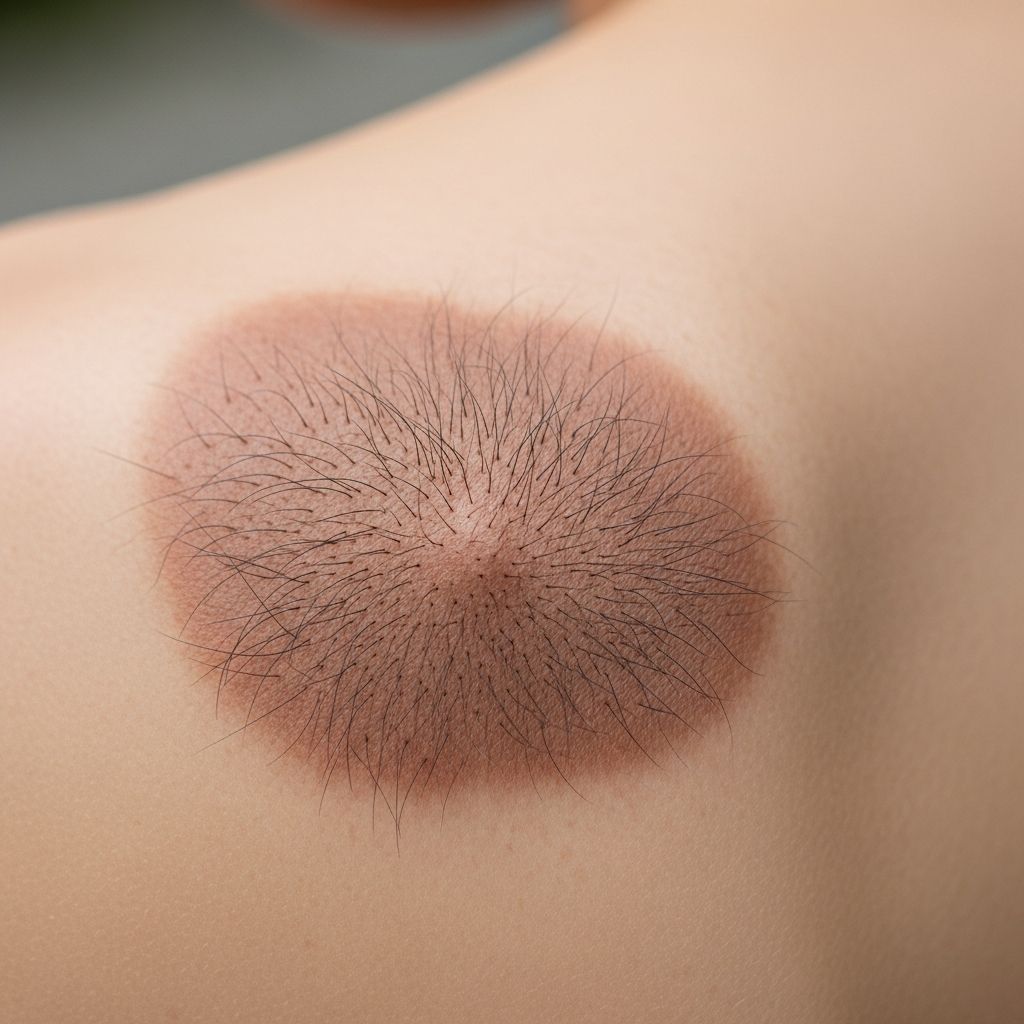
(nevus in American English) is a late-onset epidermal naevus or birthmark characterised by a large brown patch that occurs mostly in males. Also referred to as Becker melanosis and Becker pigmentary hamartoma, it represents an overgrowth of the epidermis (upper layers of the skin), pigment cells (melanocytes), and hair follicles. It develops during childhood or adolescence, usually on the shoulders or upper trunk but occasionally found elsewhere.Who gets Becker naevus?
Becker naevus affects males much more often than females, with a reported male-to-female ratio ranging from 6:1 to over 20:1 in various studies. It typically arises during the first two decades of life, most commonly around puberty (10–17 years), though cases have been documented in infancy and adulthood. The precise incidence is unknown, but it is considered one of the more common epidermal naevi. Genetic factors may play a role, as familial cases have been reported, suggesting possible autosomal dominant inheritance with variable expressivity.
What is the cause of a Becker naevus?
The exact aetiology remains unclear, but Becker naevus is classified as a type of epidermal naevus resulting from a postzygotic mutation (somatic mosaicism) affecting genes involved in melanocyte and hair follicle development, such as those in the androgen receptor pathway. Postzygotic mutations lead to clonal proliferation of epidermal cells, melanocytes, and pilosebaceous units, explaining the hyperpigmentation and hypertrichosis. Hormonal influences, particularly androgens during puberty, likely exacerbate the lesion’s development and hair growth. Unlike other epidermal naevi, Becker naevus does not strictly follow Blaschko’s lines, distinguishing it from mosaic conditions.
What are the clinical features of Becker naevus?
- Large, well-defined, hyperpigmented macule or patch, often with irregular borders mimicking continents on a map
- Slightly raised or verrucous surface texture in some cases
- Hypertrichosis (increased hairiness) developing months to years after pigmentation, more prominent in males
- Size ranging from several centimetres to over 20 cm in diameter
- Most common locations: shoulder, upper chest, upper back (pectoral, scapular, or shoulder girdle regions)
- Less common sites: face, neck, abdomen, buttocks, thighs, or scalp
- Slow enlargement during adolescence, stabilising in adulthood
- Occasional acneiform eruptions or smooth muscle hamartoma components causing a peau d’orange appearance
The lesion is usually unilateral and single but can be multiple or bilateral in rare instances. Pigmentation may darken with sun exposure, and hair growth increases with age or hormonal changes.
Diagnosis
Diagnosis is primarily clinical, based on the characteristic appearance of a large hyperpigmented patch with hypertrichosis in a typical location during adolescence. Dermoscopy reveals a pigment network with perifollicular hypopigmentation, aiding differentiation from congenital melanocytic naevi or café-au-lait macules.
Differential diagnosis
| Condition | Key Distinguishing Features |
|---|---|
| Congenital melanocytic naevus | Present at birth, uniform colour, may have uniform hair; biopsied if nodular |
| Café-au-lait macule | Smooth borders, uniform light brown, no hypertrichosis |
| Linear and whorled naevus flammeus (naevus vascularis mixtus) | Telangiectatic, follows Blaschko lines, no hypertrichosis |
| Epidermal naevus | Non-pigmented, thickened, follows Blaschko lines |
| Malignant melanoma | Changing size/colour, irregular borders, ulceration (rare in Becker naevus) |
Related Stories



Histopathology, if performed, confirms the diagnosis but is rarely needed unless malignancy is suspected.
Histopathology
Biopsy shows epidermal acanthosis (thickening), elongation of rete ridges, hyperpigmentation of the basal layer, and increased melanocytes. The dermis features prominent hair follicles, smooth muscle bundles (hamartoma in 50% of cases), and fontinal macrophages. Collagen hamartoma has been rarely reported. No melanocytic proliferation or atypia is seen, ruling out melanoma.
Becker naevus syndrome
Becker naevus syndrome (BNS) is a rare association of Becker naevus with ipsilateral developmental anomalies, occurring in <5% of Becker naevus cases, more often in females. It is part of the epidermal naevus syndrome spectrum.
Associated features
- Breast hypoplasia: Most common (ipsilateral agenesis or hypoplasia, especially relevant in females)
- Skeletal anomalies: Scoliosis, shoulder girdle hypoplasia, limb length discrepancy, fused ribs, spina bifida
- Muscular defects: Pectoralis major aplasia, lipoatrophy
- Other: Supernumerary nipples, odontomaxillary dysplasia, mental retardation (rare), cardiac defects (e.g., mitral valve prolapse), delayed puberty
BNS requires screening, particularly in females for early intervention to prevent functional impairment.
Management
Treatment is cosmetic, as Becker naevus is benign with no malignant potential (despite rare coincidental melanomas).
Observation
Reassurance suffices for asymptomatic lesions.
Camouflage
- Medical-grade camouflage makeup (e.g., Covermark, Dermablend)
- Sunless tanning lotions to blend pigmentation
Laser therapy
- Q-switched lasers (ruby, Nd:YAG): Targets pigment; 50–75% fading after 5–10 sessions, hypertrichosis recurs
- Pulsed dye laser: For vascular components or erythema
- CO2 or Er:YAG ablative lasers: For verrucous areas, risk of scarring
- Long-pulsed Nd:YAG: Effective for hair reduction
Laser is most successful before hair growth; multiple sessions needed, recurrence common.
Other
- Shaving, electrolysis, or eflornithine for hypertrichosis
- Topical retinoids or hydroquinone: Minimal efficacy
- Surgical excision: For small lesions; grafting for large areas
- Spironolactone: Early use in females to prevent breast hypoplasia in BNS
Prevention
No known prevention; sun protection prevents darkening.
Follow-up
Annual monitoring for changes suggestive of malignancy (rare); screen for BNS features.
Investigation of associated conditions
- Clinical exam for asymmetry, breast/skeletal anomalies
- Imaging: X-ray (scoliosis, ribs), ultrasound/MRI (breast, muscle)
- Echocardiogram if cardiac suspicion
Patient FAQs about Becker naevus
What is Becker naevus? A benign brown birthmark with excess hair, usually on the shoulder/chest, appearing in teens.
Is it cancerous? No, but monitor for changes.
Will it go away? It persists but stabilises; lasers can lighten it.
Does it affect my child? Rare familial cases; mostly sporadic.
What about Becker naevus syndrome? Rare; check for breast/skeletal issues, especially in girls.
References
- Becker nevus syndrome – National Organization for Rare Disorders — NORD. Accessed 2026. https://rarediseases.org/mondo-disease/becker-nevus-syndrome/
- Becker’s Nevus Syndrome – PMC – NIH — National Library of Medicine. 2014. https://pmc.ncbi.nlm.nih.gov/articles/PMC4103296/
- Becker Nevus Syndrome: A Rare Entity but Important to Recognize — Journal of Clinical and Aesthetic Dermatology. 2020. https://jcadonline.com/becker-nevus-syndrome-a-rare-entity/
- Becker’s Nevus | Skin Lesion | Contour Dermatology — Contour Dermatology. Accessed 2026. https://contourderm.com/beckers-nevus/
- Becker Nevus: Large Hyperpigmented Patch With Hypertrichosis — Dermatology Advisor. Accessed 2026. https://www.dermatologyadvisor.com/ddi/becker-nevus-hyperpigmented-patch-hypertrichosis/
- Becker naevus – DermNet — DermNet NZ. Accessed 2026. https://dermnetnz.org/topics/becker-naevus
Similar Articles








Read full bio of medha deb