Behçet Disease: Symptoms, Causes, Diagnosis, And Treatment
Comprehensive guide to Behçet disease: symptoms, diagnosis, treatment, and management of this multisystem vasculitis.
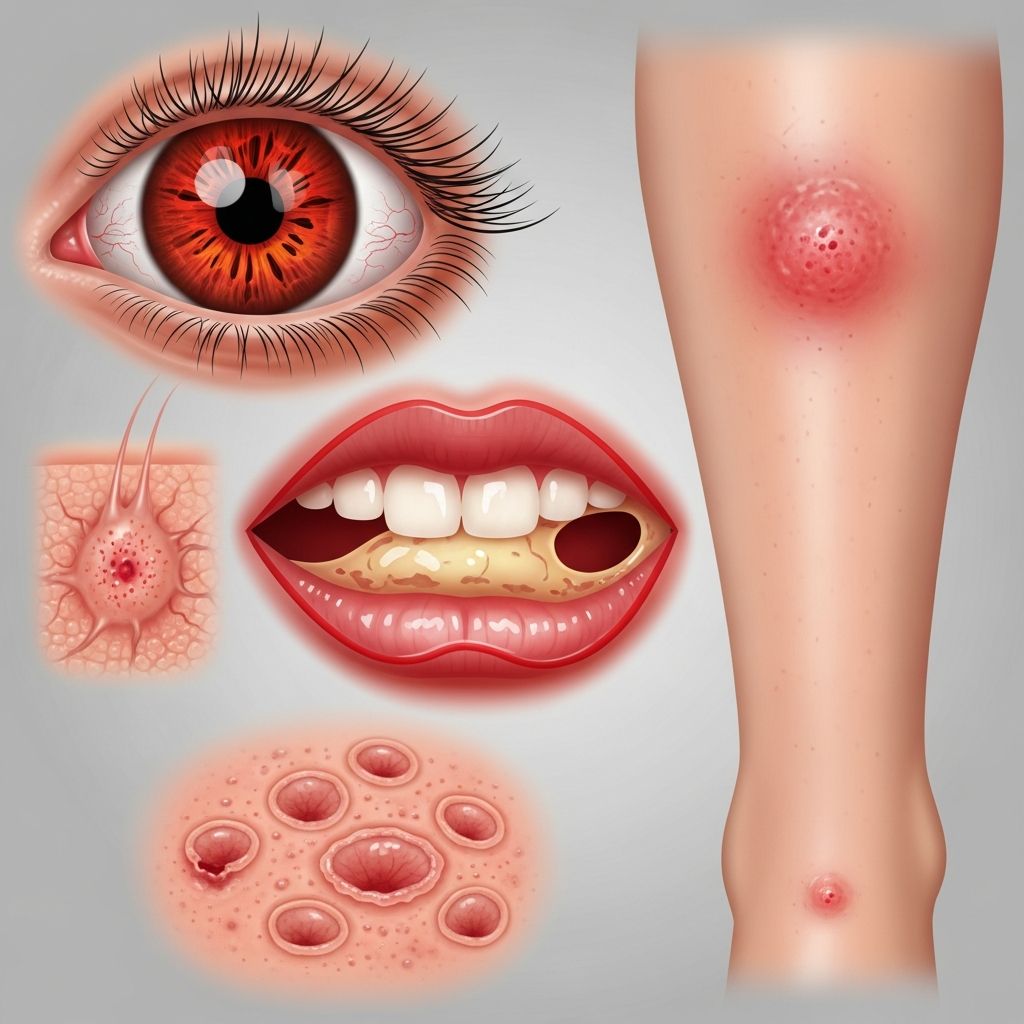
Behçet disease is a rare, chronic, relapsing multisystem inflammatory disorder characterized by vasculitis affecting small, medium, and large vessels, leading to recurrent oral and genital ulcers, ocular inflammation, skin lesions, and potentially life-threatening vascular, neurological, or gastrointestinal complications. First described by Turkish dermatologist Hulusi Behçet in 1937, it predominantly affects individuals along the ancient Silk Road from the Mediterranean to East Asia, with highest prevalence in Turkey (up to 420 per 100,000). The disease follows a relapsing-remitting course, with mucocutaneous symptoms often appearing first, followed by ocular or systemic involvement years later.
What is Behçet disease?
Behçet disease, also known as Behçet syndrome, represents a systemic vasculitis with endothelial inflammation causing thrombosis, aneurysms, and tissue ischemia across multiple organs. It combines features of autoimmune and autoinflammatory diseases, triggered by genetic predisposition (notably HLA-B51 allele) and environmental factors like infections in susceptible individuals. Unlike typical vasculitides, it involves both arteries and veins, with autopsy revealing subclinical large-vessel disease in up to one-third of cases. The pathology stems from neutrophil hyperactivity, cytokine storms (IL-1, IL-6, TNF-α), and T-cell dysregulation, leading to the hallmark pathergy reaction where minor trauma induces hyperreactive inflammation. Globally, incidence peaks in young adults (20-40 years), with a male predominance in severe cases, particularly vascular and neurological manifestations.
Who gets Behçet disease?
Behçet disease exhibits strong geographic variation, termed the ‘Silk Road disease’ due to prevalence along historical trade routes: Turkey (80-370/100,000), Iran, Middle East, Japan, and Korea show highest rates, while rare in Northern Europe and Americas (<1/100,000). HLA-B51 positivity confers 5-6 fold risk, especially in endemic areas. It typically onset in 20-40 year-olds, equal male-female in Western countries but male-skewed (up to 9:1) for severe disease in Turkey. Familial clustering occurs in 10-20% of cases, suggesting polygenic inheritance beyond HLA. No clear risk from smoking or occupation, but streptococcal infections may trigger flares. Young males face highest mortality from vascular rupture or neuro-Behçet.
What causes Behçet disease?
The precise etiology remains unknown, but Behçet disease arises from interplay of genetic susceptibility, dysregulated innate immunity, and environmental triggers. HLA-B51 (odds ratio 5.78) is the strongest genetic link, associated with earlier onset and eye disease, though present in only 50-80% of patients. Genome-wide studies identify ERAP1, IL10, and IL23R variants implicating antigen processing and Th17 pathways. Neutrophil hyperactivation causes pathergy; heat-shock proteins from oral bacteria (Streptococcus sanguis) may cross-react with human homologs. Endothelial dysfunction leads to thrombosis without traditional risk factors. Infectious triggers like HSV or parvovirus are hypothesized but unproven; no single pathogen isolated. Disease course worsens early with mucocutaneous flares, stabilizing after 10-20 years in many.
What are the clinical features of Behçet disease?
Clinical manifestations span mucocutaneous, ocular, articular, vascular, neurological, and gastrointestinal systems, with >90% experiencing recurrent oral aphthae.
Mucocutaneous lesions
Oral ulcers (major aphthae >1cm, minor, or herpetiform) occur in >95%, recurring >3/year, painful, on lips/tongue, healing with scars. Genital ulcers affect 70-90% (scrotal in males, vulvar/labial in females), deeper and scarred. Skin findings include erythema nodosum (50%), pseudofolliculitis (shaving-rash papules), acneiform lesions, and pathergy (papule 24-48h post-needle prick, positive in 60% Turkish patients).
Ocular lesions
Uveitis (anterior/posterior/panuveitis) strikes 50-70%, bilateral, with hypopyon, causing pain, redness, vision loss if untreated; retinal vasculitis leads to blindness in 20-25%.
Musculoskeletal lesions
Related Stories



Arthralgia/arthritis (45-60%) affects knees, ankles, wrists, elbows non-erosively for weeks. Enthesitis, myositis, and sacroiliitis mimic spondyloarthropathy.
Vascular lesions
Seen in 25-40%, venous thrombosis (DVT, SVC) predominates; arterial aneurysms (pulmonary/aortic, 3-5%) rupture fatally. Pulmonary artery involvement causes hemoptysis.
Neurological lesions (neuro-Behçet)
Affects 5-50%, parenchymal (brainstem meningoencephalitis, T2 hyperintense lesions with enhancement) or non-parenchymal (headache, aseptic meningitis). Mimics MS but lacks oligoclonal bands; atrophy follows chronic course.
Gastrointestinal lesions
Ileocecal ulcers (50% of GI cases) cause pain, bleeding, perforation.
Other features
- Thrombophlebitis, epididymitis, amyloidosis (rare)
- Fatigue, fever in flares
Pathology of Behçet disease
Biopsies reveal leukocytoclastic vasculitis, perivascular lymphocytes/neutrophils; ulcers show epithelial necrosis. Vascular walls exhibit endothelial swelling, fibrin thrombi. Ocular fluids contain elevated cytokines. MRI in neuro-Behçet shows brainstem T2 hyperintensities with vasogenic edema, resolving post-therapy.
Diagnosis of Behçet disease
Clinical diagnosis uses International Study Group (1990) or ICBD (2014) criteria: recurrent oral ulcers plus 2 of genital ulcers, ocular lesions, skin lesions, pathergy. Exclude IBD, SLE, infections. Pathergy test: positive pustule 48h post-prick. Labs normal except elevated ESR/CRP in flares; HLA-B51 supportive. Imaging: fluorescein angiography for uveitis, MRV for thrombosis, brain MRI for neuro-Behçet.
| ICBD 2014 Criteria | Points |
|---|---|
| Ocular lesions | 2 |
| Genital aphthosis | 2 |
| Skin lesions | 1 |
| Neurological | 1 |
| Vascular | 1 |
| Pathergy | 1 |
≥4 points diagnostic.
Treatment of Behçet disease
No cure; manage flares, prevent complications.
Mild mucocutaneous
Topical steroids, colchicine (1-1.5mg/d, reduces ulcers 60%), dapsone.
Ocular/GI/joint
Systemic corticosteroids (prednisolone 0.5-1mg/kg), azathioprine (2.5mg/kg), cyclosporine.
Severe vascular/neuro
Anti-TNF (infliximab/adalimumab first-line), cyclophosphamide, high-dose steroids. Aspirin for thrombosis.
| Severity | Treatment |
|---|---|
| Mild-moderate | Colchicine, topical CS |
| Moderate-severe | Azathioprine, biologics |
| Vascular | Anti-TNF, anticoagulation |
Complications of Behçet disease
Blindness (25%), aneurysm rupture (leading death), stroke, bowel perforation, chronic neuro-disability.
Prognosis of Behçet disease
Mortality 1-5%, highest young males with vascular disease. Remission after 10-20 years in 50-90%; early immunosuppression improves vision preservation.
Patient education and self-management
- Avoid trauma (pathergy)
- Sun protection, stress reduction
- Regular ophthalmology monitoring
- Immunosuppression infection risks
Frequently Asked Questions
Is Behçet disease contagious?
No, it is an autoinflammatory disorder, not infectious.
Can Behçet disease be cured?
No cure, but treatments induce long-term remission.
Does Behçet affect fertility?
Genital ulcers may, but most conceive normally.
How is pathergy tested?
Sterile needle prick; papule at 48h positive.
Is HLA-B51 required for diagnosis?
No, supportive only.
References
- Behcet disease | STROKE MANUAL — Stroke Manual. Accessed 2026. https://www.stroke-manual.com/behcet-disease/
- Behçet Disease – Musculoskeletal and Connective Tissue Disorders — Merck Manual Professional Edition. Accessed 2026. https://www.merckmanuals.com/professional/musculoskeletal-and-connective-tissue-disorders/vasculitis/beh%C3%A7et-disease
- Behçet’s Factsheet 2 Patient Guide — Behçet’s UK. 2022-07. https://behcetsuk.org/wp-content/uploads/2022/10/2.-Behcets-Patient-Guide-v3.1-Jul22.pdf
- Behçet’s Syndrome Brochure — Vasculitis Foundation. 2023. https://vasculitisfoundation.org/wp-content/uploads/2024/03/2023-BW-VF-Behcets-Brochure.pdf
- Behçet’s Syndrome — NORD (National Organization for Rare Disorders). Accessed 2026. https://rarediseases.org/rare-diseases/behcets-syndrome/
- Behcet’s Disease: An In-Depth Review about Pathogenesis — PMC (PubMed Central). 2022. https://pmc.ncbi.nlm.nih.gov/articles/PMC8740277/
- Behcet disease – Diagnosis and treatment — Mayo Clinic. Accessed 2026. https://www.mayoclinic.org/diseases-conditions/behcet-disease/diagnosis-treatment/drc-20351331
Similar Articles








Read full bio of medha deb