Benign Melanocytic Lesions: What You Need To Know
Comprehensive guide to benign melanocytic naevi, from common moles to rare variants, including diagnosis and melanoma risk factors.
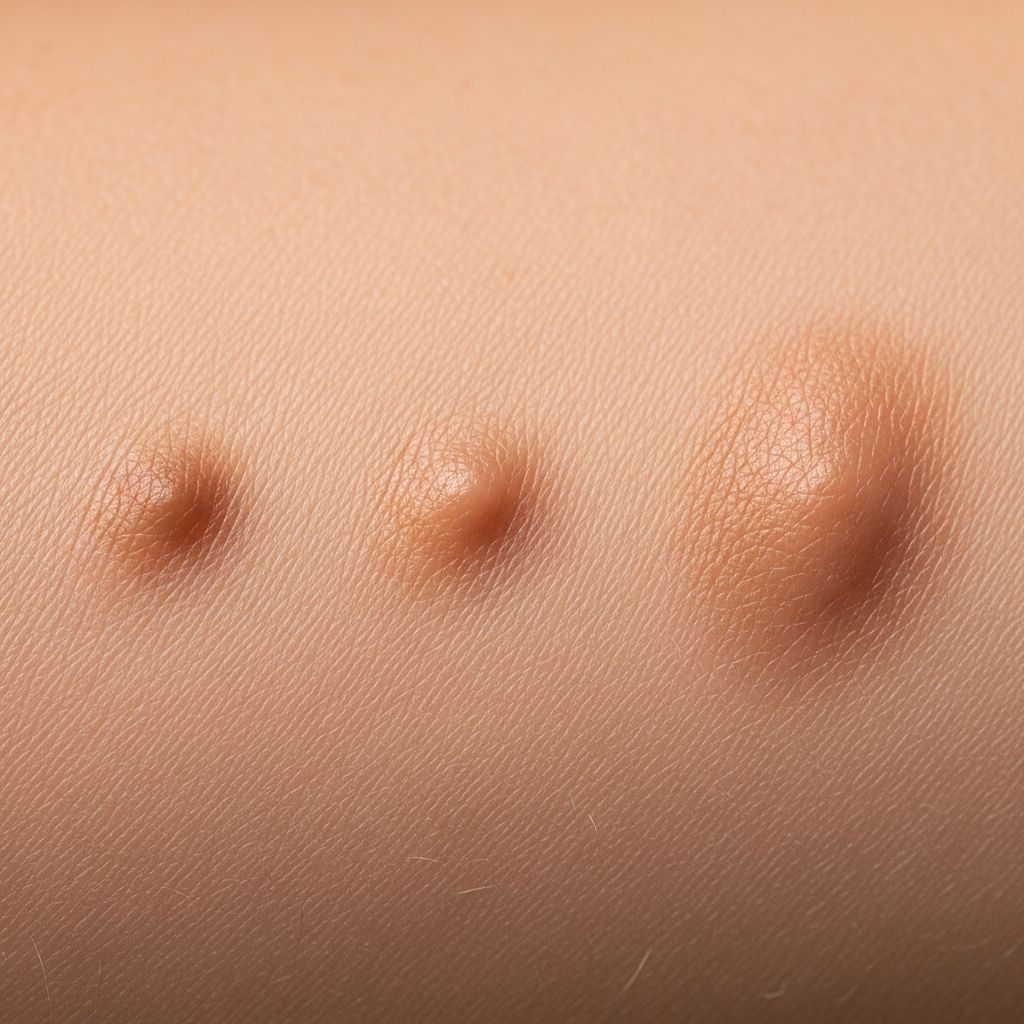
Proliferation of melanocytes may result in congenital or acquired benign melanocytic naevi. These present as persisting macules, papules, plaques, and nodules. Most melanocytic lesions are pigmented, but dermal naevi often appear skin-coloured or pink. Darker skin types typically have darker moles, and sun exposure increases the number of lesions, though they are not limited to sun-exposed areas.
Common Acquired Melanocytic Naevi
Acquired melanocytic naevi, commonly known as moles, develop after birth and are classified into three main types based on their anatomical location and clinical appearance: junctional, compound, and intradermal naevi. These are the most frequent benign melanocytic lesions encountered in clinical practice.
Junctional Melanocytic Naevi
Junctional naevi occur at the dermo-epidermal junction. They present as flat, well-circumscribed, round or ovoid macules, typically measuring 2-6 mm in diameter. Their colour ranges from light to dark brown, often uniform. These are common in children and young adults and may darken with sun exposure.
Compound Melanocytic Naevi
Compound naevi have nests of melanocytes in both the epidermis and dermis. Clinically, they appear as slightly raised, dome-shaped papules or nodules, often with a brown hue and sometimes hairy. They are frequently found on the trunk and limbs.
Intradermal Melanocytic Naevi
Intradermal naevi are confined to the dermis. They present as elevated, flesh-coloured or light brown papules or nodules, often with surface hair. These are common in adults and may have a warty or smooth surface.
| Type | Height | Colour |
|---|---|---|
| Junctional | Flat | Brown-black |
| Compound | Dome-shaped | Flesh-coloured or brown |
| Intradermal | Slightly elevated | Light brown-brown |
This table summarizes the key clinical differences among the common types of benign melanocytic naevi.
Congenital Melanocytic Naevi
Congenital naevi are present at birth. They may be macular but often become thickened (‘cobblestoned’) and hairy, especially post-adolescence in males. Small congenital naevi are common, but giant congenital naevi (covering large body areas) carry a significantly increased risk of melanoma (5-10%) within the lesion or in central nervous system melanocytes, necessitating lifelong surveillance.
Café-au-Lait Macules and Speckled Lentiginous Naevus
Café-au-lait macules are flat, coffee-coloured patches. Solitary lesions are common and benign, but six or more suggest type 1 neurofibromatosis or other syndromes like Albright syndrome. A speckled lentiginous naevus (naevus spilus) combines a café-au-lait macule with darker speckled lesions. There are two types: one with junctional naevi and another with dermal nests. These lesions are usually 1-4 cm and stable.
Halo Naevi
Halo naevi (Sutton’s naevi) are common in teenagers, particularly on tanned skin. A white ring surrounds a normal mole (Stage 1), which fades (Stage II), the mole disappears (Stage III), and the halo resolves (Stage IV), often over years. Types include junctional, compound, and dermal. Multiple halos link to vitiligo; rarely to metastatic melanoma. Histology shows lichenoid infiltrate. Halos can surround atypical naevi, blue naevi, or non-melanocytic lesions like seborrhoeic keratoses.
Spitz Naevi
Spitz naevi are dome-shaped papules or nodules on the face or limbs of children and adolescents. They grow rapidly over months, appearing red or deeply pigmented, mimicking melanoma. In adults, excision is often performed to exclude malignancy. Histologically, they feature symmetrical compound naevi with maturing epithelioid melanocytes in the dermis. Atypical Spitz naevi require wide excision and follow-up due to diagnostic challenges. Spitz naevi harbour H-RAS mutations, unlike B-RAF/N-RAS in common naevi/melanoma.
Related Stories



Types of Spitz naevi include:
- Classic Spitz naevus: Symmetrical, often pink-red.
- Pigmented spindle cell naevus (Reed naevus): Dark brown-black papules on extremities, with spindle melanocytes.
- Atypical Spitz tumour: Uncertain malignant potential.
Blue Naevi
Blue naevi are harmless, dark blue papules due to deep dermal melanocytes. Common on dorsal hands/feet, buttocks, or face. Variants include combined naevus (with common acquired naevus) and deep penetrating naevus. Multiple blue naevi feature in Carney complex with lentigines, myxomas.
Atypical Naevi
Atypical (dysplastic or Clark’s) naevi are larger (>4 mm), irregular in colour/shape/border, resembling melanoma. They predispose to melanoma, especially in dysplastic naevus syndrome (autosomal dominant, family history). Histology requires lentiginous pattern, fibroplasia, and lymphocytic infiltrate. Atypical mole syndrome involves >100 naevi and >5 atypical ones. Special sites (mucosal, acral, flexural) may appear atypical but are not more malignant.
Differentiating Benign from Malignant Lesions
Use the ABCDE rule to assess moles for melanoma risk:
- A: Asymmetry – one half unlike the other.
- B: Borders – jagged or blurred.
- C: Colour variation – multiple colours.
- D: Diameter >6 mm.
- E: Evolution – changes over time.
Symmetrical pigmentation and benign dermoscopic features (e.g., parallel furrow patterns in naevi vs. ridge patterns in melanoma) aid diagnosis.
Frequently Asked Questions (FAQs)
What are benign melanocytic lesions?
Benign melanocytic lesions are non-cancerous proliferations of melanocytes presenting as moles or naevi, including junctional, compound, intradermal, and rarer types like Spitz or halo naevi.
Do all moles need removal?
No, most benign naevi require no treatment unless symptomatic, changing, or suspicious. Monitor with ABCDE criteria.
Are congenital naevi dangerous?
Small ones are low-risk; giant congenital naevi have 5-10% melanoma risk, needing surveillance.
What is a Spitz naevus?
A rapidly growing, dome-shaped lesion in children mimicking melanoma, confirmed histologically as benign.
How to spot atypical naevi?
Look for size >4 mm, irregular borders, varied colours, especially with family melanoma history.
Management and Surveillance
Benign naevi need no intervention unless irritated or suspicious. Educate on sun protection to prevent new lesions. High-risk patients (atypical naevus syndrome, giant congenital naevi) require regular dermatological monitoring. Excision for diagnostic uncertainty, with generous margins for atypical Spitz. Dermoscopy improves accuracy.
Total word count: 1678 (excluding HTML tags, metadata, and references).
References
- Benign melanocytic nevus — Wikipedia. 2023. https://en.wikipedia.org/wiki/Benign_melanocytic_nevus
- Benign mole (melanocytic naevi) — MySkinDoctor. Accessed 2026. https://www.myskindoctor.co.uk/benign-mole-melanocytic-naevi/
- Common skin lesions. Benign melanocytic lesions — DermNet NZ. Accessed 2026. https://dermnetnz.org/cme/lesions/benign-melanocytic-lesions
- Benign skin lesions – Part 2. Melanocytic lesions — Medicine Today. 2012-07. https://medicinetoday.com.au/system/files/pdf/medicine_today/article/MT2012-07-066-TATE.pdf
- Benign melanocytic naevi — Primary Care Dermatology Society. Accessed 2026. https://www.pcds.org.uk/clinical-guidance/moles
- Congenital Melanocytic Nevi — StatPearls, NCBI Bookshelf, NIH (.gov). 2023. https://www.ncbi.nlm.nih.gov/books/NBK563168/
- Clinical and Histopathologic Characteristics of Melanocytic Lesions — JAMA Dermatology. 2020. https://jamanetwork.com/journals/jamadermatology/fullarticle/2728099
Similar Articles








Read full bio of medha deb