Benign Paroxysmal Positional Vertigo: BPPV
Understanding BPPV: Causes, symptoms, diagnosis, and effective treatment options.
Understanding Benign Paroxysmal Positional Vertigo (BPPV)
Benign paroxysmal positional vertigo (BPPV) is one of the most common causes of vertigo, accounting for over half of all peripheral vertigo cases. This inner ear disorder causes brief episodes of dizziness and a spinning sensation, typically triggered by specific changes in head position. Despite its potentially alarming symptoms, BPPV is generally harmless and responds well to treatment. Understanding this condition, its triggers, and available management strategies can help individuals manage symptoms effectively and reduce anxiety about their episodes.
What Is BPPV?
BPPV is characterized by sudden, brief episodes of vertigo—a sensation that you or your surroundings are spinning or moving. The condition is called “benign” because it is not life-threatening or associated with serious underlying disease. “Paroxysmal” refers to the sudden onset of symptoms, and “positional” describes how the symptoms are triggered by changes in head position. While BPPV can be frightening and uncomfortable, it is usually self-limiting and often disappears on its own or with simple maneuvers.
The disorder affects people of all ages but is more common in older adults, particularly women. Approximately 20% of patients presenting to healthcare providers with vertigo complaints have BPPV, though this figure may be an underestimation due to frequent misdiagnosis. Many individuals experience recurrent episodes, with some experiencing their first episode suddenly and unexpectedly.
The Anatomy Behind BPPV
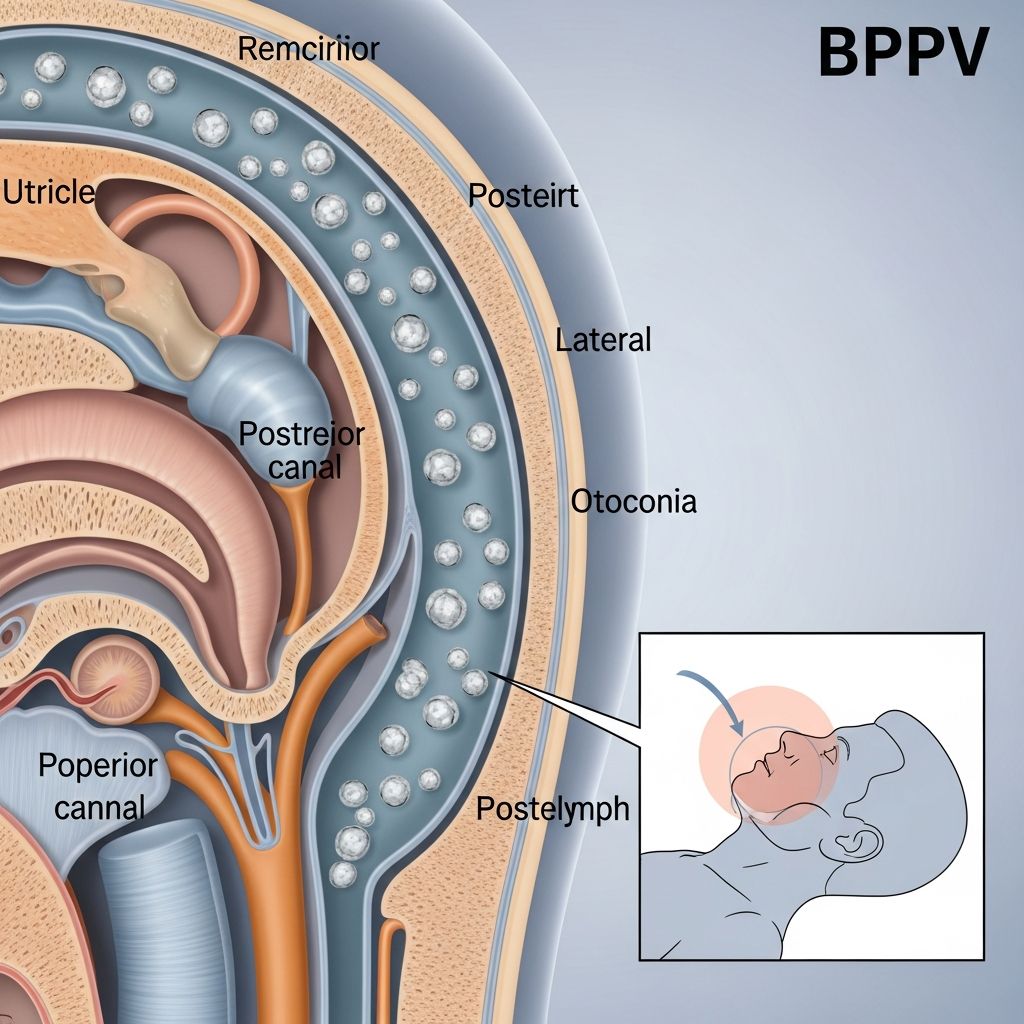
To understand BPPV, it helps to know how the inner ear maintains balance. The inner ear contains fluid-filled tubes called semicircular canals, which are part of the vestibular system. These canals contain specialized hair cells that detect movement and changes in head position. When you move your head, fluid moves through these canals, and the hair cells send signals to your brain about your body’s position and movement, helping you maintain balance.
Within these canals are tiny calcium carbonate crystals called otoconia or canaliths. In a healthy inner ear, these crystals remain embedded in a gelatinous material within a structure called the utricle and saccule. However, when these crystals become dislodged and move into the semicircular canals, they can trigger the symptoms of BPPV. The posterior semicircular canal is the most common location where these displaced crystals cause problems, though they can affect other canals as well.
Causes and Risk Factors
Primary Causes
In many cases, the exact cause of BPPV remains unknown, a condition called idiopathic BPPV. When a specific cause can be identified, head trauma is the most common culprit. Even minor bumps or injuries to the head can dislodge the calcium crystals in the inner ear, leading to BPPV symptoms that may develop immediately or emerge gradually over time.
Beyond head injury, several other factors contribute to crystal displacement. Age-related deterioration of the inner ear is thought to be responsible for many cases, particularly in older adults. The supporting structures that hold the crystals in place weaken over time, making crystal displacement more likely.
Risk Factors
Multiple risk factors increase the likelihood of developing BPPV:
– Increasing age, particularly in individuals over 50- Female gender (approximately twice as common in women)- Vestibular neuronitis or labyrinthitis (inner ear infections)- Migraines and migraine-associated vertigo- Previous inner ear surgery- Meniere disease- Osteoporosis or other conditions affecting calcium metabolism- Prolonged positioning, such as extended periods in a dentist’s chair or on one’s back
Related Stories



Understanding these risk factors can help individuals recognize situations where they might be more vulnerable to developing BPPV symptoms.
Symptoms of BPPV
Primary Symptoms
The hallmark symptom of BPPV is vertigo—a sensation that you or your environment is spinning or moving. This vertigo can range from mild to severe and typically lasts just a few seconds to approximately one minute, though occasionally it may persist for up to a few minutes. Episodes often start suddenly and may be accompanied by the following symptoms:
– Dizziness and loss of balance or unsteadiness- Nausea and vomiting- Blurred vision or a sensation that objects are jumping or moving- Lightheadedness
Episode Characteristics
BPPV episodes are almost always triggered by specific head movements or position changes. Common triggers include rolling over in bed, getting out of bed, tilting your head to look up or down, turning your head quickly, or looking backward. The intensity and duration of symptoms can vary significantly between individuals and even between episodes in the same person.
Importantly, individuals with BPPV typically do not experience dizziness all the time. Between episodes, patients often have few or no symptoms when remaining still. However, some individuals report an ongoing “foggy or cloudy” feeling even between acute episodes. The variability in symptom expression depends on several factors, including the speed of head movement, the volume of calcium crystals displaced, and individual sensitivity to motion.
Symptom Duration and Recurrence
Episodes of BPPV can disappear for extended periods—sometimes weeks, months, or even years—before recurring. Some individuals experience a single episode that resolves completely, while others have recurring episodes throughout their lifetime. Nausea or queasiness may persist briefly even after the spinning sensation has passed.
Underlying Mechanisms: Canalithiasis vs. Cupulolithiasis
Scientists have identified two primary theories explaining how BPPV develops, and evidence suggests both mechanisms can occur:
Canalithiasis
Canalithiasis is the more common mechanism, accounting for the majority of BPPV cases. In this condition, calcium crystals are freely mobile within the semicircular canals. When the head changes position, these loose crystals move through the canal, dragging the fluid within (called endolymph) behind them. As the endolymph moves, it stimulates hair cells of the cupula, triggering vertigo and involuntary eye movements (nystagmus). When the head remains still, the crystals settle, the endolymph stops moving, and symptoms resolve. Eventually, the crystals dissolve or return to the vestibule where they belong.
Cupulolithiasis
In cupulolithiasis, calcium crystals become stuck or attached to the cupula, the gelatinous structure containing the hair cells. This mechanism typically accounts for more persistent BPPV cases that do not respond well to positioning-based treatments. The attached crystals continuously stimulate the hair cells, potentially causing more prolonged or treatment-resistant symptoms.
Diagnosis of BPPV
Clinical Evaluation
Healthcare providers diagnose BPPV through a combination of patient history and physical examination. During the evaluation, your provider will ask about symptom onset, triggering movements, episode duration, associated symptoms, and medical history, particularly any head injuries or ear problems.
Diagnostic Maneuvers
The Dix-Hallpike maneuver is the gold standard diagnostic test for BPPV affecting the posterior canal. During this test, you sit on an examination table with your head turned 45 degrees to one side. Your provider then quickly lowers your head back while it remains turned, allowing it to hang below the table level. If BPPV is present, this maneuver typically triggers vertigo and characteristic eye movements (nystagmus) within a few seconds, confirming the diagnosis.
For suspected horizontal canal BPPV, the supine roll test may be performed instead. This involves turning your head from side to side while lying on your back to observe for triggered symptoms and eye movements.
Additional Testing
In most cases, the clinical examination is sufficient for diagnosis. However, additional testing may include videonystagmography (VNG), which uses infrared cameras to track eye movements, or magnetic resonance imaging (MRI) if your provider suspects other underlying conditions contributing to your symptoms.
Treatment Options
Canalith Repositioning Procedures
The Epley maneuver is the primary treatment for posterior canal BPPV and is highly effective, providing relief in approximately 80-90% of cases. This series of specific head and body movements guides the displaced calcium crystals back into the vestibule where they belong. Your healthcare provider or physical therapist performs the procedure, which typically takes just a few minutes. Many individuals experience immediate symptom relief after a successful maneuver.
For horizontal canal BPPV, the Semont maneuver or barbecue roll maneuver may be recommended instead. These alternative positioning procedures use different movement patterns to reposition crystals in the horizontal canal.
Self-Treatment Maneuvers
Once you learn the positioning maneuver from a healthcare provider, you may perform it at home. Some individuals find that practicing the maneuver at the first sign of symptoms helps prevent full episodes from developing. However, professional administration remains the most reliable approach.
Medication
While no medication directly treats BPPV, your provider may recommend medications to manage associated symptoms, particularly nausea and dizziness during acute episodes. Common options include antihistamines like meclizine or promethazine, which can reduce vertigo and nausea. These medications are typically used short-term during acute episodes rather than for long-term management.
Vestibular Rehabilitation Therapy
Physical therapists specializing in vestibular disorders can teach you exercises designed to improve balance and reduce sensitivity to movement. These exercises may be particularly helpful if you have residual dizziness or balance problems after the acute BPPV episode resolves.
Surgical Options
Surgery is rarely necessary for BPPV but may be considered in cases that do not respond to conservative treatment. Procedures such as posterior canal plugging or selective semicircular canal occlusion prevent fluid movement in the affected canal, eliminating vertigo symptoms. These procedures are reserved for persistent, severe BPPV that significantly impacts quality of life.
Prognosis and Natural Course
Most cases of BPPV have a favorable prognosis. Many individuals experience complete resolution of symptoms without any treatment, as the displaced crystals eventually dissolve or reposition naturally. However, until successful treatment occurs, symptoms can recur. In some cases, months or even years pass before another episode develops.
The natural history of BPPV typically follows one of several patterns: some individuals experience a single episode and never have symptoms again, others have multiple episodes separated by symptom-free periods, and some develop chronic recurrent BPPV. Early diagnosis and appropriate treatment can accelerate symptom resolution and improve quality of life.
When to Seek Medical Care
While BPPV itself is not dangerous, seeking prompt medical evaluation is important for accurate diagnosis and appropriate management. Contact your healthcare provider if you experience sudden vertigo, especially if accompanied by severe nausea or balance problems. Seek emergency care if vertigo is accompanied by chest pain, difficulty speaking, severe headache, or weakness, as these symptoms may indicate a more serious condition requiring immediate attention.
Living with BPPV
Practical Strategies
Understanding your triggers is essential for managing BPPV effectively. If you notice that specific movements consistently trigger symptoms, try to avoid sudden head movements and change positions slowly and deliberately. Many people find that sleeping in a more upright position or placing an extra pillow behind their head reduces nighttime symptoms.
Activity Modifications
While BPPV should not prevent you from normal activities, making minor adjustments can reduce symptom frequency. Move slowly when changing positions, be cautious when looking up or down, and consider avoiding rapid head turns until symptoms resolve.
Frequently Asked Questions About BPPV
Q: Is BPPV dangerous?
A: No, BPPV is not dangerous or life-threatening, though episodes can be frightening and uncomfortable. The vertigo and associated symptoms typically resolve quickly, and the condition does not cause permanent damage to the inner ear or hearing loss directly attributable to BPPV.
Q: Can BPPV be cured permanently?
A: While individual episodes can be successfully treated with repositioning maneuvers, BPPV may recur in some individuals. Many people experience complete, permanent resolution after treatment, while others may have occasional recurrent episodes throughout their lives.
Q: How long does an episode of BPPV last?
A: Most BPPV episodes last less than one minute, though some may persist for several minutes. The intense spinning sensation typically subsides quickly once the head remains still.
Q: Can I treat BPPV at home?
A: After learning the appropriate repositioning maneuver from a healthcare provider or physical therapist, you may perform it at home. However, professional diagnosis and initial treatment are recommended to ensure the correct maneuver is used for your specific type of BPPV.
Q: What triggers BPPV episodes?
A: BPPV is almost always triggered by specific head position changes, such as rolling over in bed, getting out of bed, looking up or down, or turning your head quickly. Identifying your personal triggers can help you avoid episodes.
Q: Will BPPV affect my hearing?
A: BPPV itself does not directly cause hearing loss. However, if BPPV develops secondary to other inner ear conditions like Meniere disease, hearing changes may occur as part of the underlying disorder rather than from BPPV specifically.
References
- Benign Paroxysmal Positional Vertigo — Merck Manuals. Accessed December 2025. https://www.merckmanuals.com/home/ear-nose-and-throat-disorders/inner-ear-disorders/benign-paroxysmal-positional-vertigo
- Benign Paroxysmal Positional Vertigo — NCBI Bookshelf / StatPearls. Updated 2024. https://www.ncbi.nlm.nih.gov/books/NBK470308/
- Benign Paroxysmal Positional Vertigo (BPPV) – Symptoms and Causes — Mayo Clinic. Accessed December 2025. https://www.mayoclinic.org/diseases-conditions/vertigo/symptoms-causes/syc-20370055
- Benign Paroxysmal Positional Vertigo – Symptoms, Causes, Treatment — National Organization for Rare Disorders. Accessed December 2025. https://rarediseases.org/rare-diseases/benign-paroxysmal-positional-vertigo/
- Benign Positional Vertigo — Penn Medicine. Accessed December 2025. https://www.pennmedicine.org/conditions/benign-positional-vertigo
- Benign Paroxysmal Positional Vertigo (BPPV) — Better Health Channel Victoria. Accessed December 2025. https://www.betterhealth.vic.gov.au/health/conditionsandtreatments/benign-paroxysmal-positional-vertigo-bppv
- Benign Paroxysmal Positional Vertigo (BPPV) — Cedars-Sinai. Accessed December 2025. https://www.cedars-sinai.org/health-library/diseases-and-conditions/b/benign-paroxysmal-positional-vertigo.html
Similar Articles








Read full bio of Sneha Tete