13 Best Dumbbell Shoulder Exercises for Maximum Gains
Master effective dumbbell shoulder exercises to build strength, size, and stability.
13 Best Dumbbell Shoulder Exercises for Building Strength and Size
Building impressive shoulders requires a strategic approach to training, and dumbbells offer an exceptional tool for achieving this goal. Unlike barbells, dumbbells provide greater freedom of movement, allowing you to modify your range of motion, work around potential weak points, and reduce the risk of overuse injuries. This flexibility makes dumbbells an ideal choice for developing well-rounded shoulder strength and size.
Dumbbells engage your stabilizer muscles more intensively than fixed barbells, forcing your core and supporting musculature to work harder throughout each movement. This additional stabilization requirement not only builds shoulder muscle but also strengthens your entire torso. Whether you’re a beginner looking to establish proper shoulder mechanics or an advanced lifter seeking to break through plateaus, dumbbell shoulder exercises offer versatility and effectiveness that barbell-only training cannot match.
The following guide presents thirteen of the most effective dumbbell shoulder exercises, each with detailed instructions and practical benefits to help you construct a comprehensive shoulder-building program.
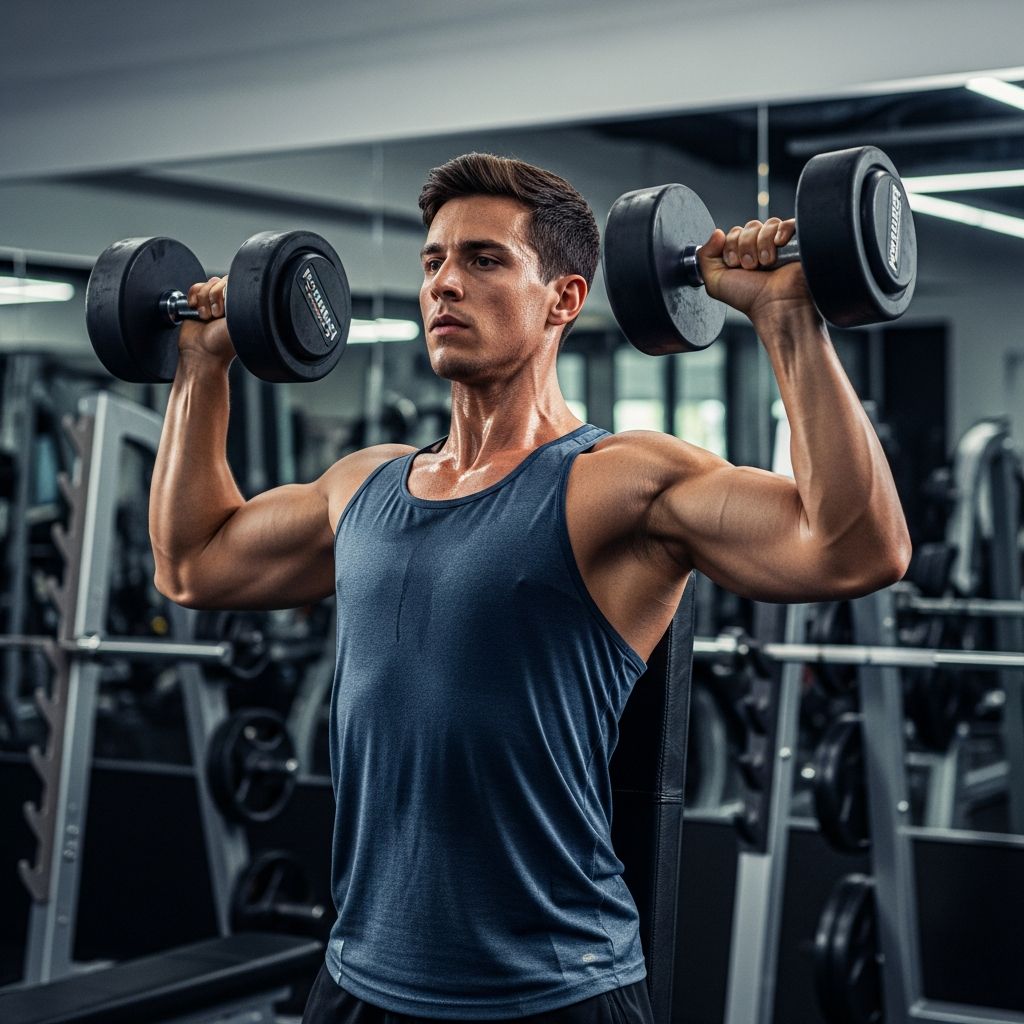
1. Standing Shoulder Press
Why It Works: The standing shoulder press is the foundational dumbbell exercise for building shoulder strength and size. This movement represents the original dumbbell shoulder-builder, combining simplicity with undeniable effectiveness. By pressing dumbbells overhead while standing, you’re forced to stabilize your entire body, which creates a downstream effect on your entire physique. Your core, glutes, and stabilizer muscles must work together to maintain an upright posture throughout the movement.
How to Perform It:
- Clean a pair of dumbbells onto your shoulders, positioning them at shoulder height
- Take a deep breath and squeeze your glutes, creating tension throughout your entire body
- With no assistance from your legs, press both dumbbells straight overhead until your arms are fully extended
- Lower the weights under slow, controlled movement back to your shoulders
- Keep your ribcage locked down and avoid over-arching at the lower back
- Repeat for your prescribed number of reps
2. Dumbbell Push Press with Slow Eccentric
Why It Works: This variation combines the explosive power of a push press with the muscle-building benefits of slow eccentric loading. The dip from your legs provides momentum to move heavier weight, while the controlled lowering phase (taking 3-4 seconds) maximizes time under tension and muscle damage, leading to greater growth stimulus.
How to Perform It:
- Clean the dumbbells onto your shoulders with palms facing inward
- Take a breath and brace your core completely
- Dip at the knees, using leg drive to help press your dumbbells overhead
- Once locked out overhead, slowly lower the weights back down to shoulder level over a 3-4 second count
- Reset and repeat for your next rep
3. Dumbbell Z-Press
Why It Works: The Z-press is an exceptional strict shoulder builder that works wonders for your entire torso. By eliminating hip assistance, your body is forced to maintain a strong, upright position while stabilizing the torso without any leg drive. This movement is particularly valuable when you’re limited to lighter weights, as it demands pure pressing strength from your shoulders and core.
Related Stories



How to Perform It:
- Take a seat on the floor with your legs outstretched
- Push the backs of your knees into the floor
- Hold a pair of dumbbells on your shoulders at the starting position
- Take a breath and brace your core, keeping your torso completely upright
- Press your dumbbells overhead in a controlled manner
- Lower under control back to your shoulders and repeat
4. Upright Row
Why It Works: Although some trainers express concern about injury risks with barbell upright rows, dumbbells allow greater freedom of movement to work around potential issues. The dumbbell variation lets you keep weights under control and work within your natural movement pattern. This exercise effectively targets the deltoids and upper back muscles.
How to Perform It:
- Stand tall holding a pair of dumbbells at your waist, positioned in front of your body
- Keeping your trunk tight, pull the dumbbells up towards your chin
- Drive your elbows up and back, maintaining control throughout
- Slowly lower the weights back down to your waist under complete control
- Avoid excessive movement in your torso and resist dropping the dumbbells quickly
5. High-Incline Shoulder Press
Why It Works: The high-incline shoulder press adjusts the pressing angle to place greater emphasis on your shoulders compared to a flat-bench press. The incline shifts the mechanical advantage, requiring your deltoids to work harder throughout the movement while reducing stress on your chest muscles.
How to Perform It:
- Set an incline bench to a high angle (around 60-75 degrees)
- Sit back against the bench with dumbbells at shoulder height
- Press the dumbbells overhead in a controlled motion
- Lower back to shoulder level and repeat
6. Single-Arm Dumbbell Lateral Raise
Why It Works: This unilateral variation builds balanced shoulder development while forcing each side to work independently. Single-arm raises eliminate compensation patterns, ensuring both shoulders develop equally and strengthening stabilizer muscles.
How to Perform It:
- Hold onto a rack or something solid for support and lean sideways away from the rack
- Hold a dumbbell in your opposite hand at your side
- Avoiding momentum from the hips, raise your dumbbell laterally until parallel to the ground
- Pause briefly at the top position
- Slowly lower the dumbbell back to your side under complete control
- Repeat for prescribed reps on both sides
7. Single-Arm Push Press
Why It Works: The single-arm variation creates greater instability and core demand, forcing stabilizer muscles to work harder. This asymmetrical loading builds unilateral strength and addresses any strength imbalances between sides.
How to Perform It:
- Clean a dumbbell onto one shoulder
- Dip at the knees and use your legs to help press the dumbbell overhead
- Lower under slow control back to your shoulder
- Repeat prescribed reps on one side, then switch to the opposite arm
8. Arnold Press
Why It Works: Named after Arnold Schwarzenegger, this pressing variation allows you to work the deltoids through a massive range of motion, making it more challenging than standard overhead presses. The rotating movement pattern targets all three heads of the deltoid more effectively, delivering superior muscle development and shoulder size.
How to Perform It:
- Hold dumbbells at shoulder height with palms facing toward you
- As you press overhead, rotate your palms away from you
- At the top position, your palms should face forward
- Lower back down while rotating your palms back toward you
- Return to the starting position and repeat
9. Dumbbell Raise Complex
Why It Works: This three-pronged complex delivers a tremendous shoulder workout in one multi-movement session, similar in effectiveness to the Arnold press. By combining front raises, lateral raises, and high raises with varied dumbbells, you efficiently target all three deltoid heads while maximizing workout density and time efficiency.
How to Perform It:
- Hold dumbbells at your sides with palms facing inward
- Raise the weights up in front of you to shoulder level with thumbs pointing up
- Complete 12 to 15 reps of front raises
- Raise the weights out to your sides at 90 degrees, bending your elbows as you lift
- Complete the same number of lateral raise reps
- Switch to a lighter pair of dumbbells
- Raise them out to your sides and up to ear level with straight arms and thumbs pointing up
- Hold this position for 30 seconds, squeezing your glutes to support your body
10. Dumbbell Neutral Grip Overhead Press
Why It Works: This pressing variation works the deltoids in your shoulders, particularly the medial and anterior deltoids, while increasing your shoulder mobility and muscle size. The neutral grip reduces stress on your shoulder joints while maintaining pressing strength.
How to Perform It:
- Hold a dumbbell in each hand at shoulder level with palms facing each other and elbows pointing forward
- Brace your core completely
- Press the weights straight overhead
- Hold for a second at the top position
- Return to the starting position with control
- Repeat for prescribed reps
11. Dumbbell Deadlift/Shrug Combo
Why It Works: This powerful compound movement works the traps, shoulders, and entire upper body. The combination of deadlift mechanics with an explosive shrug maximizes muscle activation across multiple muscle groups in a single exercise.
How to Perform It:
- Hold dumbbells at your sides and stand with feet shoulder-width apart
- Bend your hips back to squat down until the weights reach knee level
- Explode upward using leg drive and shrug hard at the top position
- Reset your feet before beginning the next rep
12. Incline Bench Dumbbell Row
Why It Works: This rowing variation builds posterior shoulder strength and rear deltoid development, providing essential balance to pressing movements. The incline bench reduces momentum potential, forcing your muscles to do the work.
How to Perform It:
- Straddle an incline bench seat and lie chest down
- Hold a dumbbell in each hand with palms facing inward
- Keep both feet on the floor
- Retract your shoulder blades and row both dumbbells parallel to your hips
- Lower back to the starting position with control
- Repeat for prescribed reps
13. Single-Arm Incline Press
Why It Works: This unilateral pressing movement builds balanced shoulder development while the incline angle emphasizes deltoid involvement. Single-arm variations force your core to resist rotation, building functional strength alongside shoulder muscle.
How to Perform It:
- Lie on an incline bench with your left glute and left shoulder blade on the bench
- Position your right glute and right shoulder blade off the bench
- Hold a dumbbell in your right hand
- Either extend your opposite arm or hold onto the bench just above your head
- Lower the weight until your elbow aligns with your shoulder
- Press the weight up until your arm is fully extended
- Lower with control to the starting position
- Complete prescribed reps, then switch sides
Key Principles for Shoulder Development
Regardless of which exercises you choose, several fundamental principles will maximize your shoulder development. First, maintaining slight external rotation throughout all shoulder movements protects your joints and distributes stress more effectively. This is easier to manage with dumbbells than barbells, as they allow natural rotation patterns.
Second, proper breathing and core bracing during pressing movements stabilizes your spine and enables stronger contractions. Take a deep breath before initiating each rep and maintain tension throughout the movement.
Third, controlling the eccentric (lowering) phase of each repetition maximizes muscle damage and growth stimulus. Resist the urge to drop weights quickly; instead, lower them with deliberate control over 2-3 seconds.
Finally, progressive overload remains essential for continued growth. Gradually increase weight, reps, or sets over time to continuously challenge your muscles and drive adaptation.
Programming Recommendations
For optimal shoulder development, perform shoulder-focused workouts once or twice per week. Rest 60 seconds between each set to allow adequate recovery while maintaining training density. Combine 2-3 pressing movements with 1-2 isolation exercises such as lateral raises or rowing variations to build both strength and size.
Beginners should start with the standing shoulder press and dumbbell raises to establish proper movement patterns. Intermediate and advanced lifters can incorporate more complex variations like the Arnold press and Z-press to continue progressing.
Frequently Asked Questions
Q: What weight should I use for dumbbell shoulder exercises?
A: Start with a weight that allows you to complete all prescribed reps with good form while feeling challenging in the final 1-2 reps. For pressing movements, this typically means 8-12 reps at near-maximum effort. For isolation exercises like lateral raises, lighter weights allow for better control and mind-muscle connection.
Q: How often should I train shoulders with dumbbells?
A: Train shoulders 1-2 times per week, allowing at least 48 hours between sessions. This frequency allows adequate recovery while providing sufficient stimulus for growth and strength development.
Q: Can I build big shoulders with just dumbbells?
A: Yes, dumbbells alone are sufficient to build impressive shoulders. The variety of pressing and isolation movements available, combined with progressive overload, provides everything needed for substantial shoulder development.
Q: Why is external rotation important in shoulder training?
A: Maintaining external rotation protects your rotator cuff and shoulder joint from impingement. It distributes stress more favorably across shoulder structures and reduces injury risk while maintaining pressing strength.
Q: Should I warm up before performing dumbbell shoulder exercises?
A: Yes, always warm up before heavy shoulder work. Perform 5-10 minutes of light cardio followed by arm circles and light dumbbell movements to increase blood flow and prepare your shoulder joints for heavier work.
References
- Best Dumbbell Shoulder Exercises — Men’s Health UK. 2024. https://www.menshealth.com/uk/fitness/a61944804/best-dumbbell-shoulder-exercises/
- 50 Best Shoulder Exercises of All Time to Build Cannonball Delts — Men’s Journal. 2024. https://www.mensjournal.com/health-fitness/best-shoulder-exercises
- This Dumbbell Workout Can Safely Build Boulder Shoulders — Men’s Health. 2024. https://www.menshealth.com/fitness/a33338128/dumbbell-shoulder-workout-exercises/
- 34 Best Dumbbell Exercises for Building Muscle — Men’s Health UK. 2024. https://www.menshealth.com/uk/building-muscle/a755117/the-10-best-dumbbell-exercises/
- 22 Exercises to Build Boulder Shoulders — Men’s Health. 2024. https://www.menshealth.com/fitness/g19547846/best-shoulder-exercises/
- Build Bigger Shoulders With This 10-Minute Workout — Men’s Health. 2024. https://www.menshealth.com/fitness/a19532919/super-shoulders-complex/
- 25 Best Shoulder Exercises for Men — Men’s Fitness. 2024. https://www.mensfitness.com/training/10-exercises-work-your-shoulders-exhaustion
Similar Articles








Read full bio of medha deb