Birt-Hogg-Dubé Syndrome: 2025 Guide To Diagnosis & Management
Rare genetic disorder causing skin fibrofolliculomas, lung cysts, pneumothorax risk, and renal tumours—genetic insights and management.
What is Birt-Hogg-Dubé syndrome?
Birt-Hogg-Dubé syndrome (BHDS), also known as Birt-Hogg-Dubé syndrome or BHD syndrome, is a rare autosomal dominant genodermatosis characterised by skin fibrofolliculomas, pulmonary cysts, spontaneous pneumothorax, and renal tumours. First described in 1977 by Canadian physicians Arthur Birt, Georgina Hogg, and William Dubé, BHDS typically manifests in adulthood with multiple benign hair follicle tumours, particularly on the face, neck, and upper trunk.
The syndrome arises from germline mutations in the FLCN gene on chromosome 17p11.2, which encodes folliculin, a tumour suppressor protein involved in the mTOR signalling pathway. Prevalence is estimated at 1:200,000 in Western populations, though underdiagnosis is likely due to variable expressivity. Affected individuals face a 15–30% lifetime risk of renal cell carcinoma (RCC), often bilateral and multifocal, alongside a 25–40% risk of pneumothorax.
Clinical diagnosis requires either genetic confirmation or specific major/minor criteria: ≥10 fibrofolliculomas or trichodiscomas (major), or ≥5 fibrofolliculomas/trichodiscomas plus lung cysts or renal tumours, with affected relatives.
Who gets Birt-Hogg-Dubé syndrome?
BHDS affects all ethnic groups with equal gender distribution, exhibiting high but incomplete penetrance. Skin lesions emerge after age 20 (mean onset 32 years), increasing in number with age; up to 25% of carriers remain asymptomatic. Familial clustering is common, with vertical transmission.
- Age: Adulthood (20–40 years for skin; lungs/kidneys later)
- Sex: Equal
- Epidemiology: Rare; ~1:200,000; underdiagnosed
What causes Birt-Hogg-Dubé syndrome?
Heterozygous germline pathogenic variants in FLCN (c.1285dupG most common) cause folliculin haploinsufficiency, leading to dysregulated cell growth, cyst formation, and oncogenesis via mTOR activation. Loss of the wild-type allele (second hit) drives tumorigenesis. Over 200 mutations identified; no clear genotype-phenotype correlation, though certain variants associate with higher RCC risk.
What are the clinical features of Birt-Hogg-Dubé syndrome?
Skin lesions
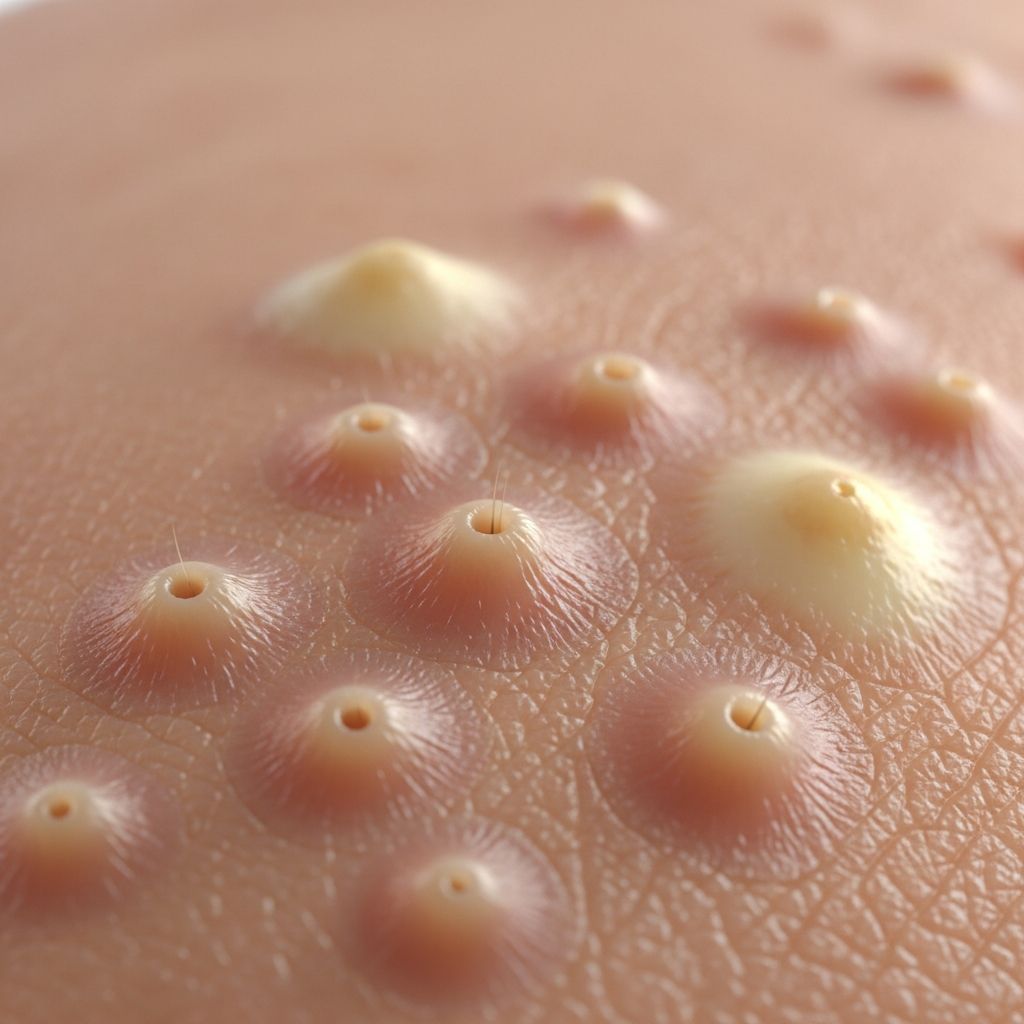
Fibrofolliculomas (most common), trichodiscomas, and acrochordons appear as 2–4 mm smooth, dome-shaped, whitish-yellow papules on the nose, cheeks, ears, neck, and upper trunk. Numbers range from few to hundreds, increasing over time; oral mucosal lesions occur rarely. Histology shows thin epithelial strands from hair follicles with fibrous stroma.
Pulmonary features
Bilateral, basally located, thin-walled cysts (median 5–10 per lung) predispose to spontaneous pneumothorax (24–38% lifetime risk, often recurrent and bilateral). Symptoms include acute dyspnoea and chest pain; cysts are irregular, multiloculated.
Renal tumours
16–29% develop RCC by age 70 (median 46 years), typically bilateral (65%), multifocal (77%), hybrid oncocytic/chromophobe (50%), chromophobe (35%), or oncocytoma (17%). Metastatic potential is low but present; clear cell/papillary RCC rarer.
Other features
Rare associations include parotid oncocytomas, thyroid adenomas, lipomas, and colorectal polyps (not increased cancer risk).
Diagnosis of Birt-Hogg-Dubé syndrome
Diagnosis combines clinical, radiological, and genetic findings.
Clinical criteria
- Definitive: FLCN mutation
- Probable: ≥10 fibrofolliculomas/trichodiscomas age >40 years
- Possible: ≥5 fibrofolliculomas/trichodiscomas age >40 + lung cysts/renal tumour/family history
Related Stories



Investigations
| Modality | Purpose |
|---|---|
| Skin biopsy | Confirm fibrofolliculoma/trichodiscoma |
| Chest CT | Detect cysts/pneumothorax |
| Abdominal MRI/CT | Screen renal masses |
| FLCN sequencing | ~90–95% detection rate |
Family screening recommended for first-degree relatives.
Differential diagnosis
| Condition | Distinguishing features |
|---|---|
| Cowden syndrome | Trichilemmomas, oral papillomas, PTEN mutation |
| Tuberous sclerosis | Angiofibromas, ash-leaf spots, TSC1/2 mutations |
| Multiple trichoepitheliomas | Fewer lesions, CYLD mutation |
| Follicular infundibulum tumour | Solitary, no systemic features |
Complications of Birt-Hogg-Dubé syndrome
- Pneumothorax: Recurrent (70% bilaterally); treat with chest tube, pleurodesis if >1 episode
- Renal cancer: Slow-growing but requires surveillance; metastases rare (<5%)
- Reduced life expectancy: Primarily from RCC/pneumothorax if unmanaged
Birt-Hogg-Dubé syndrome management
Skin
Cosmetic treatments: CO2/Er:YAG laser ablation, electrodessication, topical retinoids (limited efficacy).
Pulmonary
- Conservative: Smoking cessation, diving avoidance
- Acute: Oxygen, chest tube
- Recurrent: Video-assisted thoracoscopic surgery (VATS) bullectomy + pleurodesis
Renal surveillance
Annual MRI (preferred, no radiation) from age 20–21; partial nephrectomy for tumours >3 cm; ablation for smaller lesions.
Genetic counselling
Prenatal/preimplantation testing; cascade screening for relatives.
Guidelines for Birt-Hogg-Dubé syndrome
- European BHD Consortium: MRI age 20+, chest CT once then PFTs
- NCCN: Biennial MRI age 18–40, annual >40
Emerging therapies
mTOR inhibitors (everolimus) show promise in preclinical models; clinical trials ongoing for RCC prevention.
Frequently Asked Questions (FAQs)
What is the prognosis for Birt-Hogg-Dubé syndrome?
Excellent with surveillance; RCC mortality <5% if detected early. Pneumothorax manageable.
Is Birt-Hogg-Dubé syndrome hereditary?
Yes, autosomal dominant; 50% risk to offspring.
When should screening start?
Age 18–21 for renal MRI, pulmonary evaluation.
Are skin lesions cancerous?
No, benign; treated for cosmesis only.
Can pneumothorax be prevented?
No, but surgery reduces recurrence post-first episode.
References
- Birt-Hogg-Dube Syndrome – StatPearls — NCBI Bookshelf. 2023-08-07. https://www.ncbi.nlm.nih.gov/books/NBK448061/
- Birt-Hogg-Dubé Syndrome — Children’s Hospital Colorado. 2024. https://www.childrenscolorado.org/conditions-and-advice/conditions-and-symptoms/conditions/birt-hogg-dube/
- Birt-Hogg-Dubé Syndrome — NORD (Rare Diseases). 2023-11-15. https://rarediseases.org/rare-diseases/birt-hogg-dube-syndrome/
- Birt-Hogg-Dubé Syndrome: Symptoms, Treatments — Healthgrades. 2024. https://resources.healthgrades.com/right-care/symptoms-and-conditions/birt-hogg-dube-syndrome
- Birt-Hogg-Dubé syndrome — MedlinePlus Genetics (NIH). 2023. https://medlineplus.gov/genetics/condition/birt-hogg-dube-syndrome/
- Birt-Hogg-Dubé syndrome (BHD) — American Cancer Society. 2024-05-20. https://www.cancer.org/cancer/risk-prevention/genetics/family-cancer-syndromes/birt-hogg-dube-syndrome.html
- Protocol for diagnosis, genetic testing and surveillance — ERN-GENTURIS. 2023. https://www.genturis.eu/l=deu/Assets/BHD-syndrome-Pocket-Guide—ERN-GENTURIS.pdf
- Birt-Hogg-Dubé Syndrome (PDQ®) — National Cancer Institute. 2025-01-15. https://www.cancer.gov/publications/pdq/information-summaries/genetics/bhd-syndrome-hp-pdq
Similar Articles








Read full bio of medha deb