Black Henna Tattoo Reaction: 3 Stages, Symptoms & Treatment
Understand the risks, symptoms, and treatments of allergic reactions to black henna tattoos containing PPD.
What is black henna tattoo reaction?
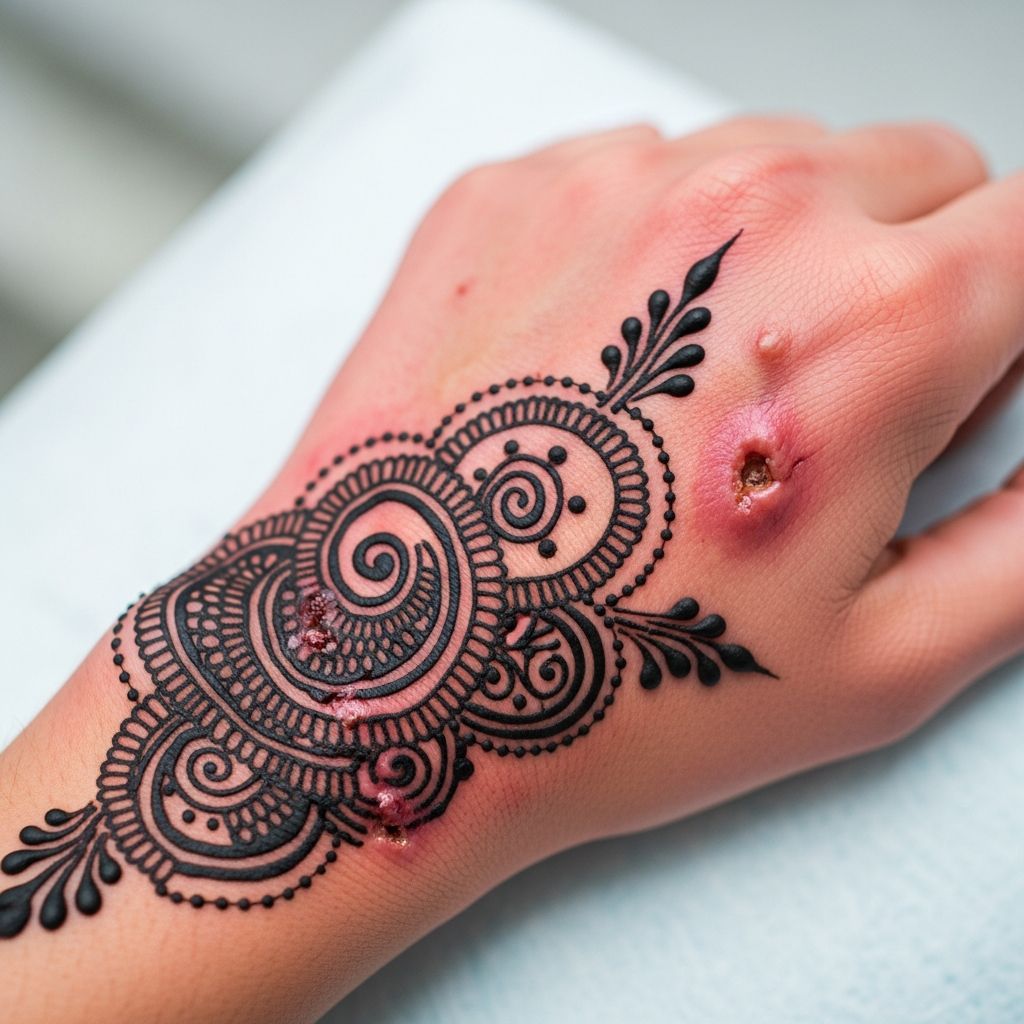
Black henna tattoo reactions refer to severe allergic contact dermatitis triggered by temporary tattoos falsely marketed as ‘black henna’. These reactions stem primarily from para-phenylenediamine (PPD), a potent allergen added to natural henna (Lawsonia inermis) to produce a dark black colour that develops rapidly on the skin. Unlike pure henna, which yields a reddish-brown stain and rarely causes issues, black henna mixtures can induce intense inflammation, blistering, and long-term complications like scarring and chemical leukoderma.
These temporary tattoos are popular at festivals, beaches, and tourist spots, often applied by unlicensed artists using unregulated pastes. The reaction typically manifests as a type IV delayed hypersensitivity, appearing days after application, though prior sensitisation can accelerate onset. Globally, reports highlight increasing cases, especially in children, with lifelong implications for PPD exposure in hair dyes and other products.
Who gets black henna tattoo reactions?
Anyone can develop a reaction, but susceptibility increases with prior PPD exposure. Approximately 1 in 40 individuals experience severe responses to black henna. Children and first-time users are common victims due to amusement parks and vacation henna applications.
- Individuals with history of atopy or allergies to dyes, rubber, or sulfonamides
- Previous henna users showing mild reactions
- Those exposed to PPD in hair colouring
- People with glucose-6-phosphate dehydrogenase (G6PD) deficiency (rare hemolysis risk with pure henna)
Cross-reactivity occurs with related chemicals like benzocaine, azo dyes, and para-aminosalicylic acid, heightening risk. Sensitisation persists lifelong, making future hair dye use hazardous.
What causes black henna tattoo reactions?
The culprit is PPD, a coal-tar derivative banned or restricted in cosmetics for skin use in many countries due to toxicity. Natural henna contains lawsone, a mild sensitiser in <1% of users, but PPD concentrations in black henna can reach 15-30%, far exceeding safe hair dye levels (≤2%).
Other additives like eucalyptus oil, coffee, or lemon juice rarely contribute but exacerbate irritation. Application on sun-exposed skin worsens inflammation via photoallergy. Repeated applications accelerate sensitisation, as seen in case reports of children reacting faster on second exposure.
What are the clinical features of black henna tattoo reaction?
Reactions emerge 1-10 days post-application, following a classic pattern:
- Day 1-3: Pruritus, erythema, and oedema outlining the design.
- Day 4-7: Vesicles and bullae form, leading to painful blisters filled with serous fluid.
- Weeks later: Erosions crust, heal with hyper- or hypopigmentation, and potential scarring.
Symptoms include intense itch, burning pain, and swelling; lymph nodes may enlarge. Severe cases mimic erythema multiforme or show lichenoid patterns. Long-term: permanent white patches (leukoderma) or keloids.
| Stage | Symptoms | Duration |
|---|---|---|
| Early | Redness, itch, swelling | 1-3 days |
| Peak | Blisters, weeping | 4-10 days |
| Resolution | Crusting, pigment changes, scars | Weeks-months |
Diagnosis
Clinical pattern suffices: design-shaped dermatitis post-henna. Patch testing confirms PPD allergy (positive in 90% cases), using 1% PPD in petrolatum, read at 48-96 hours. Histology shows spongiosis, exocytosis, and dermal infiltrate. Differential includes natural henna allergy, infection, or phototoxicity.
Related Stories



Treatment of black henna tattoo reaction
Management focuses on symptom relief and complication prevention:
- Topical: Potent corticosteroids (e.g., clobetasol 0.05%) twice daily for 7-14 days; emollients for barrier repair.
- Systemic: Oral antihistamines (loratadine 10mg daily) for itch; severe cases need prednisone 0.5-1mg/kg tapered over 2 weeks.
- Wound care: Blister puncture if tense, antiseptic cover to prevent infection.
- Photoprotection: Sunscreen SPF50+ on healing skin to avoid pigment shifts.
Most resolve in 2-4 weeks, but pigment/scars may persist months. Q-switched lasers aid leukoderma removal.
Complications
Scarring occurs in 20-50% severe cases; leukoderma mimics vitiligo. Secondary bacterial infection (Staph/Strep) prolongs healing. Lifelong PPD sensitisation precludes hair dyes, affecting 2-4% population. Rarely, anaphylaxis or systemic absorption.
Prevention of black henna tattoo reaction
Avoid black henna entirely; opt for natural red henna or jagua. Demand ingredient lists; refuse if ‘black’ promised.
- Patch test 48 hours prior on inner arm.
- Avoid sun exposure 48 hours post-application.
- Educate children: ‘No black tattoos!’
- For hair dye users: disclose henna history.
Regulations lag; EU caps PPD at 2% for hair, bans skin use.
Black henna tattoo reaction in children
Paediatric cases rise, e.g., 6-year-old with arm reaction post-amusement park. Blisters punctured, treated with clobetasol/antiseptic. Higher scarring risk due to thin skin; parents must monitor.
Patch testing for black henna allergy
Standard series includes PPD 1%; positive reactions strong (+++/+++), cross-reacting with dyes. Test site: back, occlude 48h, read D2/D4.
Outlook
Acute phase heals 80% without scars if treated early; pigment normalises in 6-12 months. Sensitisation permanent—avoid PPD products lifelong.
Images
(Description: Clinical photos show erythematous, vesicular tattoo outline progressing to crusted erosions and hypopigmented scars. Source: peer-reviewed cases.)
Frequently asked questions (FAQs)
Q: Is black henna safe?
A: No. It contains high PPD levels causing severe reactions in 2.5% users; stick to natural henna.
Q: How soon does reaction start?
A: 1-10 days; faster (24h) if previously sensitised.
Q: Can it scar permanently?
A: Yes, blisters lead to atrophic scars or leukoderma in severe cases.
Q: What if I react to hair dye later?
A: Black henna sensitises to PPD; patch test always, disclose history.
Q: How to remove black henna safely?
A: Lasers for pigment/leukoderma; avoid home remedies.
References
- Henna tattooing dermatitis: consider an additive as the culprit — de Groot AC. PMC. 2007-05-01. https://pmc.ncbi.nlm.nih.gov/articles/PMC1920722/
- Temporary Henna Tattooing: a Case of Contact Dermatitis — The Open Dermatology Journal. 2016-04-29. https://opendermatologyjournal.com/VOLUME/10/PAGE/82/FULLTEXT/
- Henna: What You Need to Know — WebMD Medical Reference. 2023-08-15. https://www.webmd.com/skin-problems-and-treatments/what-is-henna
- Tattoos: 7 unexpected skin reactions and what to do about them — American Academy of Dermatology. 2024-01-10. https://www.aad.org/public/everyday-care/skin-care-basics/tattoos/tattoo-skin-reactions
- The dangers of ‘black henna’ temporary tattoos — British Skin Foundation. 2022-06-20. https://www.britishskinfoundation.org.uk/the-dangers-of-black-henna-temporary-tattoos
- Efficient removal of black henna tattoos — Ferrari B et al. Pediatric Dermatology. 2020-03-15. https://onlinelibrary.wiley.com/doi/10.1111/pde.14349
Similar Articles








Read full bio of Sneha Tete