Blaschko Lines: Essential Guide to Diagnosis and Treatment
Invisible patterns of embryonic skin cell migration revealed by genetic and acquired skin disorders.
Author: Reviewed by Dr. Amanda Oakley, Dermatologist, 2024. Last updated: 15 April 2025.
Blaschko lines, also known as the lines of Blaschko, represent pathways of epidermal cell migration and proliferation during fetal skin development. These invisible lines become apparent when certain inherited or acquired skin conditions follow their distinct patterns, distinguishing them from dermatomes, vascular, or nervous structures.
First described by Alfred Blaschko in 1901, these lines highlight cutaneous mosaicism, where genetically distinct cell populations coexist in the skin. Understanding them is essential for diagnosing mosaic skin disorders.
What are Blaschko lines?
Blaschko lines are a nonrandom developmental pattern of the skin, differing from dermatomes which follow nerve distributions. They arise from the clonal proliferation of embryonic skin cells along specific migration routes during early embryogenesis.
These lines are invisible under normal conditions but manifest as linear, whorled, or patchy lesions in mosaic disorders. They do not correspond to known vascular, lymphatic, or neural pathways, instead reflecting the intrinsic growth of the epidermis.
In cutaneous mosaicism, genetic mutations in a subset of skin cells lead to visible patterns along these lines. This is particularly evident in X-linked disorders due to random X-chromosome inactivation (lyonization) in females.
History
Alfred Blaschko, a German dermatologist, presented the concept at the 7th Congress of German Dermatological Society in 1901. He mapped patterns from over 140 patients with nevi and linear dermatoses onto body diagrams, revealing consistent distributions unrelated to dermatomes.
Independently, American dermatologist Douglas Montgomery described similar ‘streams’ of tissue growth in linear nevi that same year. Subsequent research linked these lines to mosaicism and genetic phenomena like twin spotting and paradominant inheritance.
Who gets Blaschko lines?
Blaschko lines appear in anyone with a mosaic skin condition, congenital or acquired. They are more noticeable in:
- Individuals with genetic mosaicism from postzygotic mutations.
- Females with X-linked dominant disorders due to lyonization.
- Chimeras or those with twin spotting.
- Patients with polygenic or autosomal disorders showing type 1 or 2 segmental manifestations.
Prevalence depends on the underlying disorder; for example, incontinentia pigmenti predominantly affects females.
What do Blaschko lines look like?
Blaschko lines follow characteristic patterns:
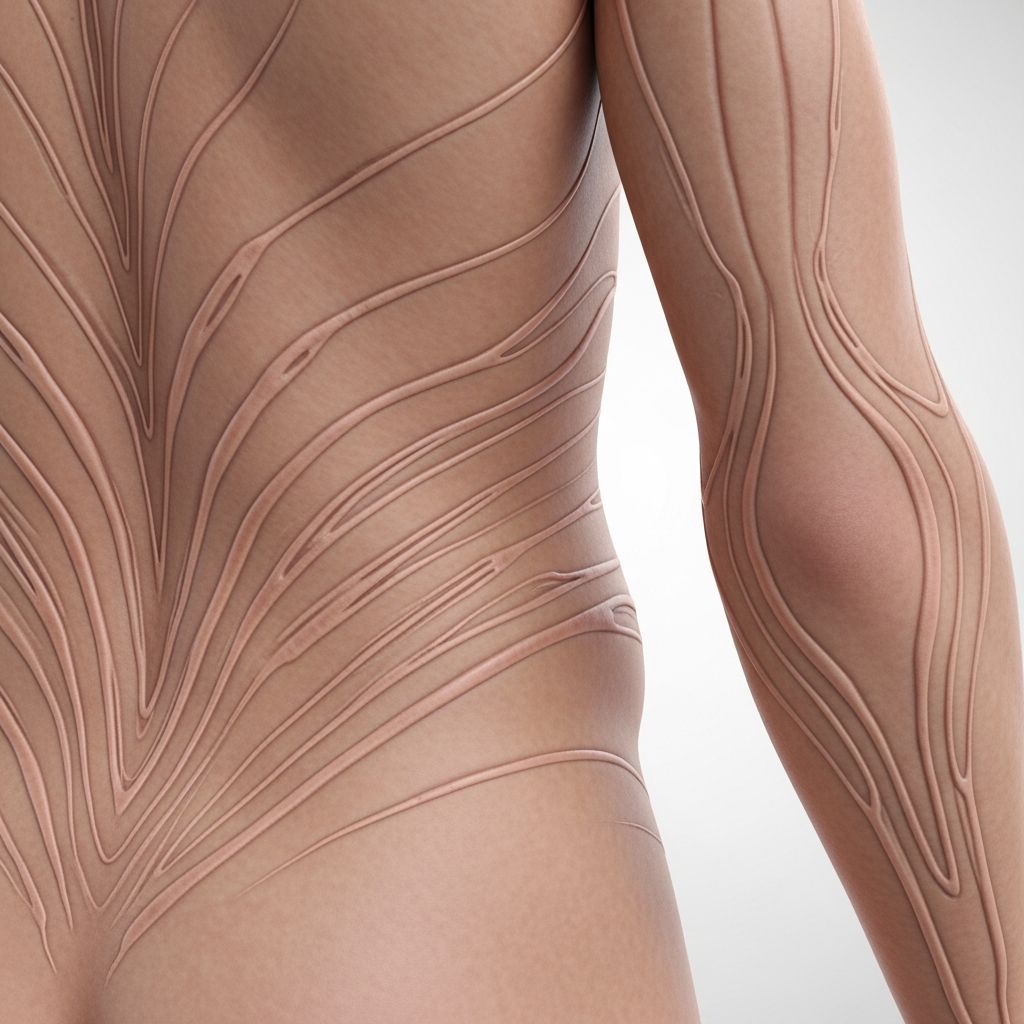
- V-shaped on the upper spine and back.
- S-shaped whorls on the abdomen and sides.
- Inverted U-shaped from breasts to upper arms.
- Linear and perpendicular down the front and back of limbs.
- Complex wave-like or helical on the head and neck.
- They never cross the anterior truncal midline but parallel it.
Lesions appear as streaks, patches, whorls, or lines, often unilateral, with hyperpigmentation, hypopigmentation, atrophy, or inflammation depending on the condition.
How do Blaschko lines occur (embryology)?
During embryogenesis, neural crest cells migrate to form the skin. Mutations occurring early enough result in two cell populations: mutated and normal. These proliferate clonally, following predetermined pathways visualized as Blaschko lines.
Related Stories



The exact mechanism remains unclear but involves functional X-chromosome mosaicism, where inactivated X chromosomes lead to patchy expression in skin. In autosomal disorders, paradominant traits or loss of heterozygosity may play roles.
Histologically, affected areas show spongiotic dermatitis, interface changes, or pigmentary alterations mirroring the clinical pattern.
Which skin conditions follow Blaschko lines?
Numerous conditions manifest along Blaschko lines, categorized as follows:
| X-linked dominant skin disorders | Epithelial naevi |
|---|---|
| Incontinentia pigmenti | Naevus sebaceus |
| Focal dermal hypoplasia (Goltz syndrome) | Inflamed linear epidermal naevus (porokeratosis) |
| X-linked chondrodysplasia punctata | Linear epidermal naevus |
| Linear basal cell naevus |
| Pigmentary disorders | Disorders with polygenic background |
|---|---|
| Hypomelanosis of Ito | Lichen striatus |
| Linear and whorled nevoid hypermelanosis | Adult (acquired) blaschkitis |
| Segmental vitiligo or melasma | Linear psoriasis |
| Phyloid or block-like patterns | Relapsing Blaschko dermatitis |
Other examples include epidermal nevus, Bart syndrome, extragenital lichen sclerosus, and unilateral nevoid telangiectasia.
Diagnosis
Diagnosis relies on clinical pattern recognition along Blaschko lines, supported by:
- Family history for genetic conditions.
- Wood lamp examination for pigmentary changes.
- Skin biopsy showing mosaicism features like spongiosis or lichenoid changes.
- Genetic testing for suspected syndromes (e.g., IKBKG mutation in incontinentia pigmenti).
Differentiate from dermatomal (zosteriform) or Langer lines patterns. Clinicopathologic correlation is key.
Treatment
Treatment targets the underlying condition:
- Topical therapies: Corticosteroids or calcineurin inhibitors for inflammatory types like lichen striatus.
- Lasers: Pulsed dye or excimer for vascular or pigmentary lesions.
- Surgical: Excision for localized nevi.
- Systemic: For multisystem syndromes (e.g., retinoids in epidermal nevi).
- Many resolve spontaneously, especially inflammatory variants.
Prognosis varies; benign for most, but some (e.g., Goltz) involve extracutaneous issues.
Related topics
- Cutaneous mosaicism
- Dermatomes
- Incontinentia pigmenti
- Lichen striatus
- Naevus sebaceus
Frequently asked questions
Are Blaschko lines visible in everyone?
No, they are invisible unless a mosaic skin condition makes them apparent through lesions or pigment changes.
Do Blaschko lines follow nerves?
No, they differ from dermatomes and do not align with neural, vascular, or lymphatic structures.
Can Blaschko lines appear later in life?
Yes, in acquired conditions like adult blaschkitis or segmental vitiligo.
Are they harmful?
The lines themselves are normal; harm depends on the underlying disorder, which may be benign or syndromic.
How are they diagnosed?
By pattern recognition, biopsy, and genetic tests if needed.
References
- Blaschko lines and other patterns of cutaneous mosaicism — Happle R. Clin Dermatol. 2011. https://pubmed.ncbi.nlm.nih.gov/21396561/
- Blaschko lines — DermNet NZ. 2024. https://dermnetnz.org/topics/blaschko-lines
- Blaschko’s lines — Wikipedia (sourced from primary dermatology literature). 2024. https://en.wikipedia.org/wiki/Blaschko’s_lines
- Blaschko’s lines — Primary Care Dermatology Society (PCDS). 2021-08-26. https://www.pcds.org.uk/clinical-guidance/blaschkos-lines
- What are the lines of Blaschko? — Dr. Oracle AI Dermatology. 2024. https://www.droracle.ai/articles/159953/what-are-the-lines-of-blaschko
- Blaschko’s Lines — Contour Derm. 2024. https://contourderm.com/blaschkos-lines/
Similar Articles








Read full bio of Sneha Tete