Blister Agents: Essential Guide To History, Exposure, Treatment
Exploring the history, effects, and medical management of vesicant agents used in chemical warfare.
Blister agents, also known as vesicants, are chemical warfare agents that cause severe chemical burns, leading to painful blisters on skin, eyes, and mucous membranes. These agents, primarily sulfur mustard and lewisite, have been used historically in conflicts and pose significant risks due to their persistence and delayed effects.
What are blister agents?
Blister agents are toxic chemicals that penetrate skin and mucous membranes, alkylating DNA and proteins to disrupt cellular function, resulting in inflammation, necrosis, and blister formation. Unlike nerve agents, they have lower immediate lethality (2-3% fatality rate) but cause prolonged morbidity.
Key characteristics include:
- Dispersed as liquids, vapors, aerosols, or dust.
- Denser than air, persisting in environments for hours to days.
- Absorbed via inhalation, dermal contact, or ocular exposure.
- Examples: Sulfur mustard (H, HD), nitrogen mustard (HN), lewisite (L), phosgene oxime (CX).
History
Blister agents were first deployed on a large scale during World War I. On July 12, 1917, German forces released sulfur mustard at Ypres, Belgium, injuring over 20,000 Allied soldiers and causing 1,000-4,000 deaths. This ‘Yperite’ earned its name from the location.
In the Iran-Iraq War (1980-1988), Iraq used approximately 1,800 metric tons of sulfur mustard, resulting in over 125,000 Iranian casualties, with 40,000 veterans suffering long-term effects like chronic respiratory issues and cancer.
Other uses include Italy’s deployment in Ethiopia (1935-1940) and alleged applications in the Syrian Civil War. Production was banned under the 1993 Chemical Weapons Convention, with global stockpiles largely destroyed, though risks from legacy sites persist.
Chemistry and types
Blister agents are organosulfur or organoarsenic compounds acting as alkylating agents.
| Agent | Chemical Formula | Key Properties |
|---|---|---|
| Sulfur mustard (HD) | (ClCH₂CH₂)₂S | Oily liquid, garlic odor, delayed effects (2-48 hours), highly lipophilic. |
| Lewisite (L) | (CH₃)AsCl₂ | Colorless oily liquid, geranium odor, immediate pain, arsenic-based. |
| Nitrogen mustard (HN) | (ClCH₂CH₂)₃N | Similar to sulfur mustard but more volatile, used medically as chemotherapy. |
| Phosgene oxime (CX) | (Cl₂C=NOH) | Urticant, causes nettle rash without true blisters, immediate urticaria. |
Sulfur mustard, the most common, hydrolyzes slowly in water but persists in soil. Lewisite reacts with thiol groups, inhibited by British Anti-Lewisite (BAL).
Mechanism of action
These agents are bifunctional alkylators forming cross-links in DNA, inhibiting replication and transcription. They trigger inflammation via cytokine release and cause microbullae through epidermal-dermal separation.
- Skin: Lipophilic penetration maximizes damage in moist, glandular areas (axillae, genitalia, flexures).
- Eyes: Conjunctival edema, corneal ulceration.
- Respiratory: Bronchial erosion, pulmonary edema at high doses.
- Systemic: Bone marrow suppression, immunosuppression.
Clinical features
Skin lesions
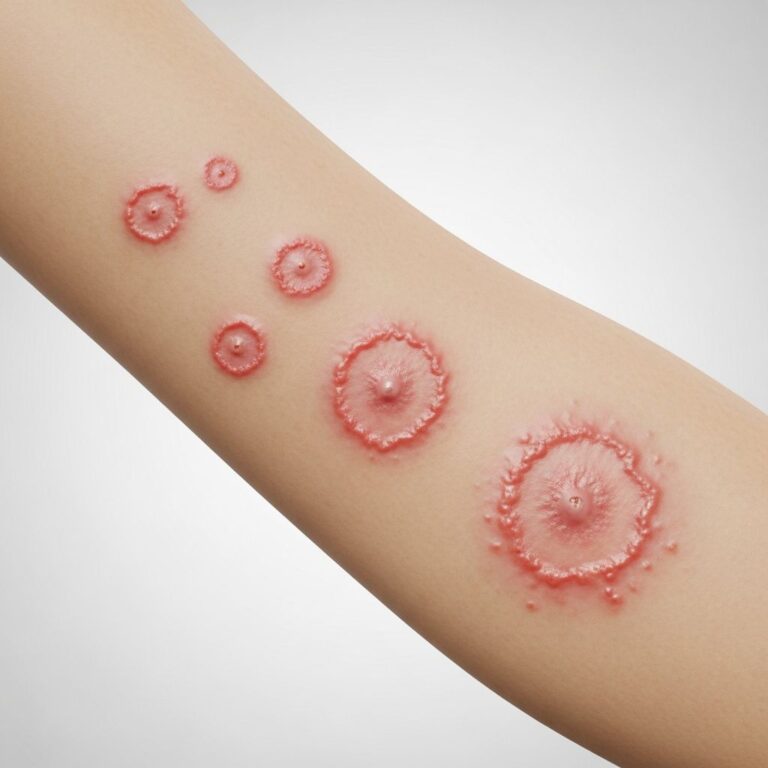
Delayed onset: Erythema (2-24 hours), vesicles progressing to bullae filled with yellow fluid. Lesions evolve to necrosis, hyperpigmentation, and scarring. First-degree (erythema), second-degree (bullae), third-degree (ulceration).
Ocular effects
Mild: Blepharospasm, lacrimation. Severe: Chemosis, corneal burns, symblepharon, potential blindness.
Respiratory effects
Inhalation causes laryngitis, bronchitis, ARDS. High doses lead to suffocation.
Systemic effects
Leukopenia (days 4-10), infection risk, sepsis. Long-term: Malignancies (skin, lung, leukemia), chronic bronchitis.
Differential diagnosis
- Thermal burns: Immediate pain, no odor.
- Other CWAs: Nerve agents cause miosis/salivation; choking agents immediate dyspnea.
- Infectious: Varicella (crops), coxsackie (vesicles).
Related Stories



Investigations
Diagnosis is clinical, supported by:
- Thiocholine esterase levels (not for vesicants).
- Biopsy: Epidermal necrosis, microblisters.
- Immunohistochemistry: DNA adducts.
- Environmental sampling: GC-MS for agent detection.
Treatment and management
No antidote; supportive care is key. Decontaminate within minutes: Remove clothes, irrigate with copious water/soap (avoid bleach on lewisite).
Skin
- Blisters: Intact if possible; debride if ruptured. Silver sulfadiazine, mupirocin.
- Pain: Opioids, NSAIDs.
Eyes
Irrigate with saline; topical steroids, mydriatics. Ophthalmology consult.
Respiratory
Oxygen, bronchodilators, ventilation if needed.
Specific
Lewisite: Dimercaprol (BAL) intramuscularly.
Monitor CBC for myelosuppression; prophylactic antibiotics debated.
Complications
- Acute: Secondary infection, fluid loss, respiratory failure (5%).
- Chronic: Scarring, keratopathy, bronchiectasis, cancers (dose-related).
Prevention
Personal protective equipment (PPE): CBRN suits, respirators. Detection: M8/M9 paper, CAM.
Vaccines absent; training emphasizes rapid decontamination. Stockpile destruction per CWC.
Historical context and legacy
Post-WWI, agents caused 1.3 million casualties (90,000 deaths). Iran-Iraq: 100,000+ affected. Survivors face lifelong disabilities, straining healthcare.
Frequently Asked Questions (FAQs)
What is the most common blister agent?
Sulfur mustard (HD), used extensively in WWI and Iran-Iraq War.
How soon do symptoms appear?
Sulfur mustard: 2-48 hours (delayed). Lewisite/phosgene oxime: Immediate.
Are blister agents lethal?
Low direct lethality (2-5%), but high morbidity and long-term risks like cancer.
What is the treatment for lewisite exposure?
BAL (dimercaprol) as antidote, plus decontamination and supportive care.
Can blister agents be detected?
Yes, via color-changing papers or spectrometry, but clinical diagnosis primary.
References
- What are the most common types of chemical warfare agent (CWA)? — Argon Electronics. 2023. https://www.argonelectronics.com/blog/what-are-the-most-common-types-of-chemical-warfare-agent-cwa
- Blister agent — Wikipedia (informed by primary sources). 2023. https://en.wikipedia.org/wiki/Blister_agent
- What are blister agents? — HDIAC, DoD. 2025-10-04. https://hdiac.dtic.mil/primers/what-are-blister-agents/
- Chemical Warfare Agents — US EPA (.gov). 2023. https://www.epa.gov/emergency-response/chemical-warfare-agents
- Blister Agents Guide — OSHA (.gov). 2023. http://www.osha.gov/emergency-preparedness/guides/blister-agent
- Emergencies Chemical Blister Agent — NYC.gov (.gov). 2023. https://www.nyc.gov/site/doh/health/emergency-preparedness/emergencies-chemical-blister-agent.page
- Lewisite | Chemical Emergencies — CDC (.gov). 2023. https://www.cdc.gov/chemical-emergencies/chemical-fact-sheets/lewisite.html
Similar Articles








Read full bio of Sneha Tete