Blood-Brain Barrier: Protection, Function, and Medical Applications
Understanding the blood-brain barrier: Your brain's essential defense system against harmful substances.
What Is the Blood-Brain Barrier?
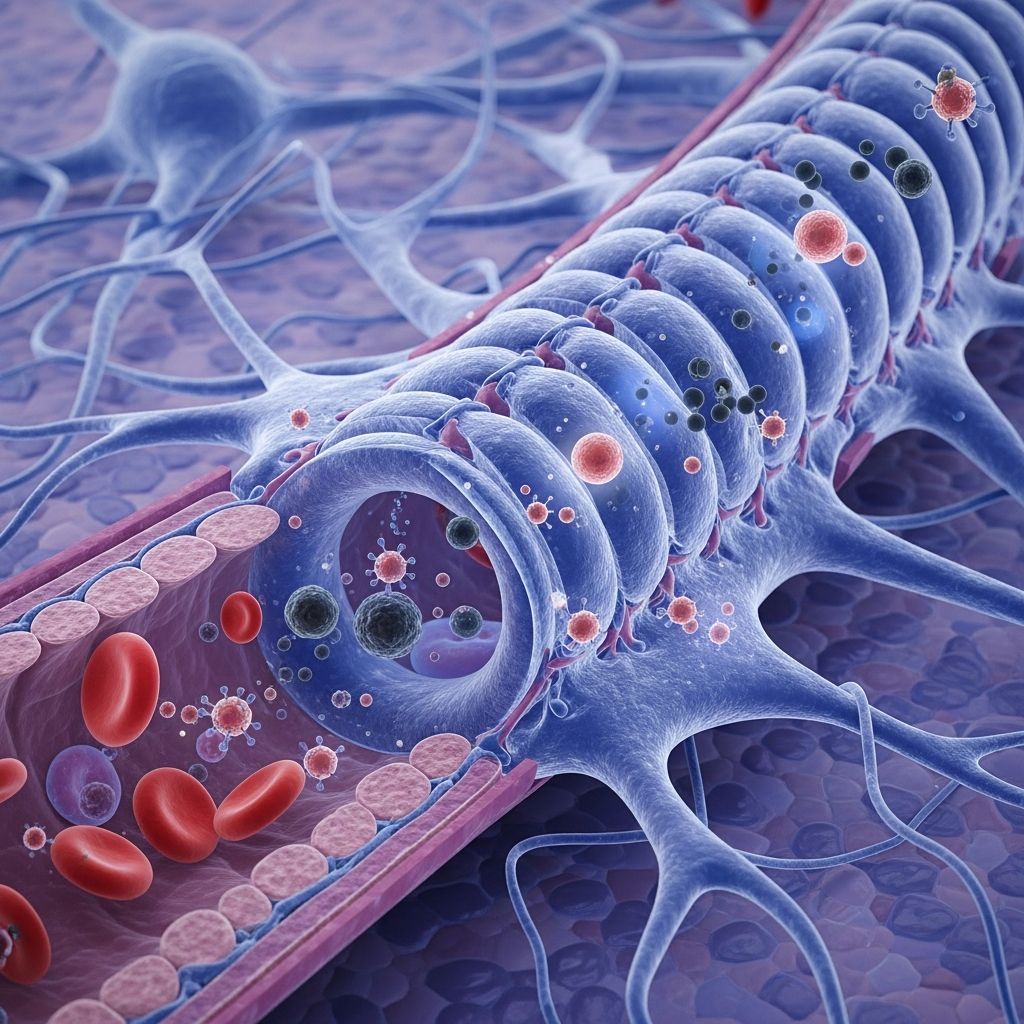
Your blood-brain barrier (BBB) is a highly specialized protective layer of cells that lines the inner surfaces of blood vessels throughout your brain. This critical biological structure acts as a sophisticated filter, serving as your brain’s primary defense mechanism against potentially harmful substances, pathogens, and other damaging agents while simultaneously maintaining the delicate chemical balance necessary for optimal brain function. The BBB represents one of the most important protective systems in your entire body, playing an essential role in how your brain and nervous system operate on a daily basis.
The blood-brain barrier is composed of specialized endothelial cells that form an exceptionally tight barrier, preventing most unwanted substances from entering the brain tissue while allowing beneficial chemicals and nutrients to pass through. This selective permeability is what makes the BBB such a remarkable biological achievement—it must be restrictive enough to keep toxins out, yet permeable enough to allow necessary nutrients and medications to reach brain cells.
Understanding the Structure of the Blood-Brain Barrier
The foundation of the blood-brain barrier lies in its unique cellular architecture. Inside your blood vessels, there is a specialized layer of cells called the endothelium. However, the endothelium within your brain is fundamentally different from endothelial cells found in other parts of your body. In the brain, endothelial cells are tightly packed together with virtually no space between them, creating an almost impenetrable barrier that prevents unwanted substances from slipping through.
These tightly interlocked endothelial cells possess lipid-based outer membranes, which is crucial to understanding how the BBB functions. This lipid composition is the key to the barrier’s selective permeability—it allows certain molecules to pass through while actively rejecting others based on their chemical properties and molecular size.
How Molecules Pass Through the Blood-Brain Barrier
The blood-brain barrier operates on sophisticated molecular principles that determine which substances can enter the brain and which cannot. Not all molecules are treated equally by this protective system. The BBB’s selectivity depends on several factors:
Small molecules: Some substances can cross the BBB if they are small enough to fit through specialized transport mechanisms. These molecules can sometimes squeeze through the tight junctions or utilize carrier proteins to facilitate their passage.
Lipid-soluble molecules: Substances that are lipid-soluble possess a remarkable ability to pass through the BBB without being rejected. Since the cell membranes of the BBB are lipid-based, these molecules can dissolve directly through the membrane barrier. This property is why many medications and drugs can penetrate brain tissue—their lipid solubility allows them to cross the barrier relatively easily.
Large molecules: Larger molecules, including many important nutrients, cannot slip between the tightly interlocking endothelial cells due to their size. These substances are physically too large to fit through the gaps between cells, and the tight junctions prevent any passage.
Water-soluble molecules: Water-soluble molecules face a different challenge. Because the BBB’s cell membranes are lipid-based, they actively repel water-soluble substances. Water and water-based molecules cannot easily dissolve through a lipid membrane, making them unable to cross the barrier on their own.
Related Stories



Mechanisms for Transporting Essential Molecules
Despite the BBB’s restrictive nature, your brain still requires many large and water-soluble molecules to function properly, including essential nutrients, proteins, and amino acids. When these molecules need to cross the BBB, they require specialized transportation assistance. Your body has evolved sophisticated active transport systems that work like molecular shuttles, physically moving these necessary substances across the barrier against the concentration gradient. This energy-dependent process ensures that your brain receives all the nutrients it needs to maintain optimal function.
Factors That Can Weaken the Blood-Brain Barrier
While the blood-brain barrier is highly secure and remarkably effective, it is not imperfect. Several conditions and factors can compromise its integrity and reduce its effectiveness as a protective filter. Understanding these vulnerabilities is crucial for medical professionals treating brain conditions.
Inflammation: One of the primary factors that can weaken the BBB is inflammation. When inflammatory processes occur in the brain or surrounding tissues, they can damage the tight junctions between endothelial cells, creating gaps through which harmful substances can enter.
Disease conditions: Various neurological and systemic conditions can compromise BBB function. In multiple sclerosis, for example, the barrier becomes compromised very early in the disease course, allowing pro-inflammatory cells to infiltrate the central nervous system and initiate a cascade of neurological damage.
Other pathological factors: Beyond inflammation and disease, various other conditions can make the BBB less effective at its job. A compromised BBB can allow harmful substances or pathogens to enter brain tissue, potentially causing significant neurological damage.
Interestingly, a weakened BBB is not always entirely disadvantageous. In some cases, reduced BBB integrity can actually make certain medications, such as penicillin-type antibiotics, more effective at treating brain infections by allowing these drugs to penetrate brain tissue more easily.
The Clinical Implications of the Blood-Brain Barrier
The blood-brain barrier is a key consideration in treating numerous conditions affecting both the brain and the body. Healthcare providers must carefully consider BBB properties when designing treatment strategies, as many medications and therapies can be affected by this barrier.
One significant clinical challenge involves treating brain cancers and infections. Many medications that could effectively treat cancers or infections within the brain simply cannot make it through the BBB to reach the affected tissue. This is especially problematic for glioblastoma multiforme and other invasive brain tumors, where intact BBB regions around the primary tumor can prevent molecularly targeted agents from reaching cancer cells in invasive areas.
Innovative Approaches to Cross the Blood-Brain Barrier
To overcome BBB limitations, researchers and clinicians have developed creative strategies and specialized formulations. One particularly innovative approach is the “Trojan horse” method, where medications are specially formulated to piggyback on immune cells or other molecules that can naturally cross the BBB. By attaching therapeutic compounds to these naturally permeable carriers, physicians can effectively smuggle medications into the brain despite the barrier’s protective mechanisms.
Emerging Technology: Focused Ultrasound
One of the most promising emerging technologies in neuroscience involves using magnetic resonance imaging-guided focused ultrasound to temporarily weaken the BBB. This non-invasive technique could revolutionize how we approach brain diseases. By carefully applying ultrasound waves, researchers can temporarily open the BBB in specific locations, allowing molecules to either escape from the brain into the bloodstream or allowing medications to penetrate into brain tissue.
This technology has exciting potential applications across multiple conditions. It might allow biomarkers and disease-related molecules to escape the brain, making them easier to detect in blood tests. This could enable earlier diagnosis and detection of serious conditions such as brain cancer, Alzheimer’s disease, and Parkinson’s disease. Additionally, focused ultrasound-induced BBB opening could allow therapeutic medications to penetrate tumors or diseased brain tissue that would otherwise be inaccessible.
However, it is important to note that this research is still in its early stages. While the preliminary results are encouraging, considerably more research will be necessary to determine whether this technology can be safely and effectively translated into clinical practice for treating various brain conditions.
Historical Development of BBB Understanding
Our current understanding of the blood-brain barrier developed gradually over more than a century. Early researchers, including Shtern and Gautier, theorized about a barrier separating the brain from circulating blood. Their groundbreaking hypotheses were later confirmed through electron microscope images first captured in the 1960s and 1970s. These detailed electron microscopy studies revealed the precise structure of the BBB in both animal and human brains, providing visual confirmation of theoretical predictions and laying the foundation for modern neuroscience.
Current Research and Future Directions
While experts have accumulated substantial knowledge about the blood-brain barrier, more research remains necessary to fully understand all aspects of how it works. Advanced research continues to investigate the mechanisms underlying BBB disruption in diseases like multiple sclerosis, with significant funding from organizations like the National Institute of Neurological Disorders and Stroke supporting comprehensive studies.
Researchers are utilizing unique preclinical models and advanced imaging technologies to better characterize vascular changes occurring in various neurological conditions. These investigations aim to design strategies for earlier intervention and develop new therapeutic approaches. Comprehensive tissue banks from patients with neurological conditions provide opportunities to test preclinical findings directly in human disease contexts, bringing researchers closer to translating discoveries into effective medical treatments.
Why the BBB Matters for Your Brain Health
Your blood-brain barrier is fundamentally critical to maintaining optimal brain health. It provides a constant protective barrier against harmful substances that could damage delicate neural tissue. At the same time, it maintains the precise ionic and chemical balance that your brain requires to function properly. This delicate equilibrium enables all the complex processes that allow you to think, remember, move, and experience the world around you.
The BBB also limits the entry of inflammatory hematogenous cells and plasma proteins that could damage the central nervous system. This selective restriction prevents most pathogens and immune cells from entering the brain under normal circumstances, though in pathological conditions, compromised BBB integrity can allow inflammatory cells to infiltrate the brain and cause damage.
Frequently Asked Questions About the Blood-Brain Barrier
Q: What exactly is the blood-brain barrier made of?
A: The blood-brain barrier is composed of tightly packed endothelial cells that line the inside of brain blood vessels. These cells have lipid-based outer membranes and form tight junctions with minimal gaps between them, creating a highly selective barrier.
Q: How does the BBB decide what can pass through?
A: The BBB’s selectivity is based on several factors including molecular size, lipid solubility, and presence of specific transport proteins. Small lipid-soluble molecules pass easily, while large or water-soluble molecules generally cannot cross without assistance.
Q: Can the BBB be permanently damaged?
A: The BBB can be temporarily or chronically compromised by inflammation, disease, or injury, but it often has some capacity for repair. However, chronic conditions like multiple sclerosis can cause sustained BBB dysfunction.
Q: Why is the BBB important for treating brain diseases?
A: The BBB’s protective function makes it challenging to deliver medications to brain tissue. Understanding and potentially crossing the BBB safely is essential for developing effective treatments for brain cancers, infections, and neurological disorders.
Q: Is focused ultrasound BBB opening safe for patients?
A: Focused ultrasound technology shows promise, but research is still in early stages. More clinical studies are needed to establish its safety profile and efficacy in treating various brain conditions before widespread clinical application.
Q: Can any substance cross the blood-brain barrier?
A: No. The BBB is highly selective. Most large molecules, hydrophilic compounds, and pathogens cannot cross naturally. Only small molecules, lipid-soluble substances, and those with specific transport mechanisms can pass through.
Q: How does inflammation weaken the BBB?
A: Inflammation can damage the tight junctions between endothelial cells and trigger molecular processes that reduce barrier integrity, allowing unwanted substances and immune cells to enter brain tissue.
References
- Blood-Brain Barrier (BBB): What It Is and Function — Cleveland Clinic. 2024. https://my.clevelandclinic.org/health/body/24931-blood-brain-barrier-bbb
- An in vitro Blood-brain barrier model combining shear stress and pharmacological interactions — National Center for Biotechnology Information. 2012. https://pmc.ncbi.nlm.nih.gov/articles/PMC4122330/
- Function of the Blood-Brain Barrier and Restriction of Drug Delivery to Invasive Glioma Cells — National Center for Biotechnology Information. 2012. https://pmc.ncbi.nlm.nih.gov/articles/PMC3533422/
- $2.4M NIH Grant to Study Relationship Between Inflammation, Blood-Brain Barrier in MS — Cleveland Clinic Lerner Research Institute. 2019-08-29. https://www.lerner.ccf.org/news/article/?title=%242.4M+NIH+Grant+to+Study+Relationship+Between+Inflammation%2C+Blood-Brain+Barrier+in+MS
- Focused Ultrasound to Open the Blood-Brain Barrier in Recurrent Glioblastoma — Cleveland Clinic Consult QD. 2024. https://consultqd.clevelandclinic.org/focused-ultrasound-to-open-the-blood-brain-barrier-in-recurrent-glioblastoma-podcast
- Cleveland Clinic’s Comprehensive Review of Focused Ultrasound Brain Treatments — Focused Ultrasound Foundation. 2024. https://www.fusfoundation.org/posts/cleveland-clinics-comprehensive-review-of-focused-ultrasound-brain-treatments/
Similar Articles








Read full bio of Sneha Tete