Blue Light Cystoscopy: Comprehensive Guide For Patients
Discover how blue light cystoscopy revolutionizes bladder cancer detection with enhanced imaging for better outcomes and fewer recurrences.
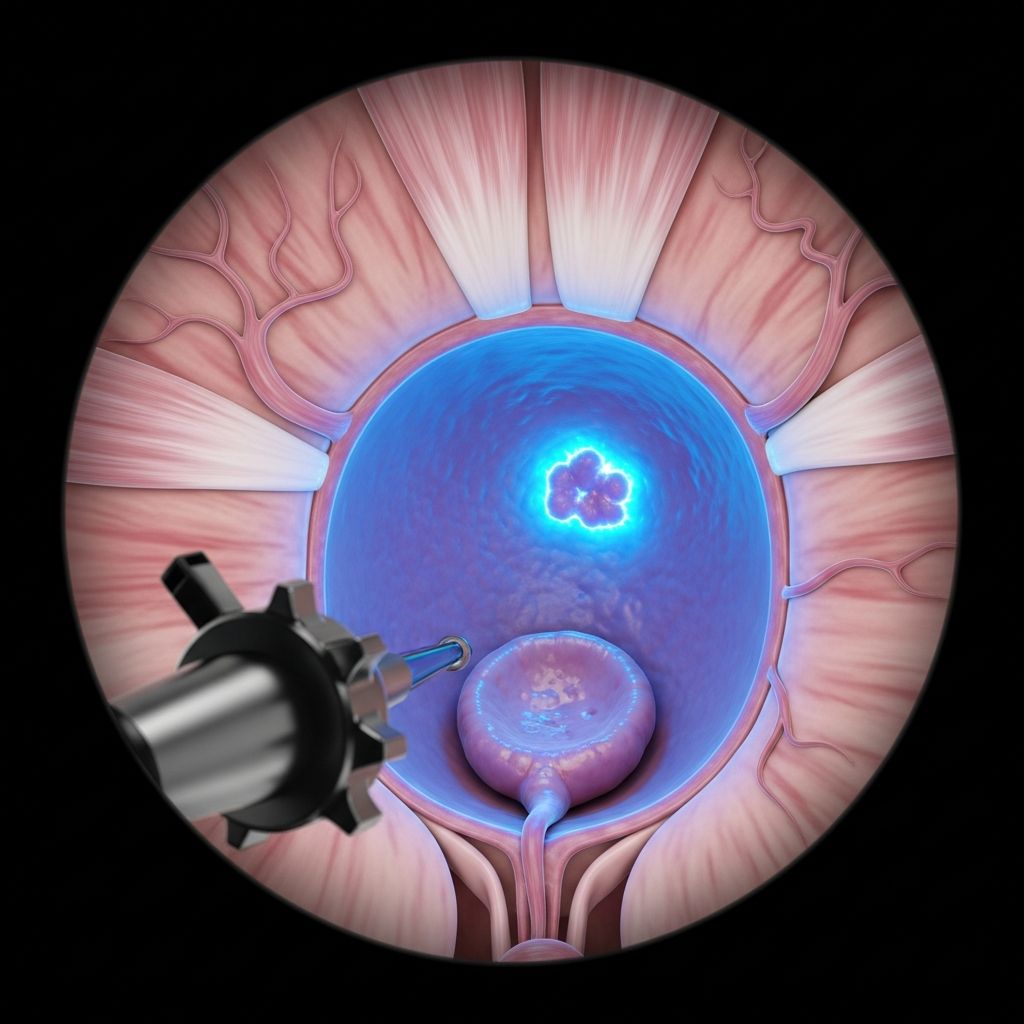
Blue light cystoscopy represents a significant advancement in detecting and treating non-muscle invasive bladder cancer (NMIBC). This technique combines a fluorescent imaging agent with specialized lighting to make cancerous tissues glow, allowing for more precise identification and removal compared to traditional white light methods.
Understanding Bladder Cancer and Detection Challenges
Bladder cancer often presents as NMIBC, where tumors are confined to the inner lining of the bladder. These cases have high recurrence rates, up to 70% within the first year, making thorough detection critical. Standard cystoscopy uses white light to visualize the bladder lining via a thin scope inserted through the urethra. However, it misses flat lesions like carcinoma in situ (CIS), which appear subtle and blend with healthy tissue.
Blue light cystoscopy addresses this by enhancing visibility. It improves detection of CIS by 20-40% and all papillary lesions by about 15-20%, leading to more complete tumor resections during transurethral resection of bladder tumor (TURBT).
The Science Behind the Glow
The procedure relies on photodynamic diagnosis. A heme precursor, hexaminolevulinate (HAL), marketed as Cysview, is instilled into the bladder one hour prior. Cancer cells preferentially absorb HAL, converting it to protoporphyrin IX (PpIX), a fluorescent compound that accumulates in malignant mitochondria due to altered enzyme activity.
Under blue-violet light (380-450 nm), PpIX emits red fluorescence, appearing pink against blue healthy tissue. This contrast enables urologists to spot tiny or flat tumors invisible under white light.
- Key Mechanism: HAL uptake and PpIX accumulation in abnormal cells.
- Light Activation: Blue light excites fluorescence for vivid demarcation.
- Outcome: Precise biopsy and resection sites.
Step-by-Step Procedure Overview
Preparation begins 60 minutes before cystoscopy. A catheter delivers 50-75 mL of Cysview solution into the bladder, which patients hold for absorption. The bladder is then emptied.
- White Light Inspection: Initial scope examination identifies obvious tumors.
- Blue Light Switch: Activation reveals glowing pink areas indicating cancer.
- Resection or Biopsy: Tumors are removed via TURBT; samples sent for pathology.
- Post-Procedure: Bladder irrigation flushes residual agent; patients monitored briefly.
The entire process typically lasts 20-45 minutes under local or general anesthesia, depending on the case.
Clinical Benefits and Evidence
Studies show blue light cystoscopy reduces recurrence by 10-20% at one year compared to white light alone. A meta-analysis confirmed better CIS detection (odds ratio 14.2) and overall lesion detection.
| Aspect | White Light Cystoscopy | Blue Light Cystoscopy |
|---|---|---|
| CIS Detection Rate | ~70% | ~90-95% |
| Recurrence Risk (1 Year) | 45-50% | 30-40% |
| Resection Completeness | Moderate | High |
Guidelines from the American Urological Association recommend it for high-risk NMIBC surveillance and restaging after TURBT.
Ideal Candidates for This Technology
Not every patient needs blue light cystoscopy, but it’s particularly valuable for:
- Initial diagnosis of suspected NMIBC.
- High-risk patients (e.g., CIS history, multiple tumors).
- Positive cytology with negative white light findings.
- Follow-up after BCG therapy or tumor resection.
Related Stories



It’s FDA-approved for adults with known or suspected NMIBC.
Safety Profile and Side Effects
Cysview is well-tolerated. Common temporary effects include:
- Bladder spasms or urgency (hours to days).
- Discolored urine (pink/red for 24-48 hours).
- Mild hematuria.
Serious risks like allergic reactions or photosensitivity are rare (<1%). Patients should avoid bright lights for 24 hours post-procedure. No long-term harm reported.
Comparing to Traditional Methods
White light cystoscopy remains first-line due to accessibility, but blue light excels in sensitivity. Hybrid scopes now integrate both lights seamlessly.
Cost is higher due to Cysview (~$1,500-2,000 per use), but reduced recurrences may offset expenses long-term by avoiding repeat procedures.
Future Directions and Innovations
Ongoing trials explore blue light in upper tract urothelial cancer and combination with narrow-band imaging. Narrower spectrum agents promise even sharper contrasts. Integration with AI for real-time analysis could further boost accuracy.
As equipment becomes widespread, blue light may become standard for NMIBC management, potentially lowering progression to muscle-invasive disease.
Frequently Asked Questions (FAQs)
What is the recovery time after blue light cystoscopy?
Most resume normal activities within 24-48 hours. Avoid heavy lifting for a week; drink plenty of fluids.
Does insurance cover it?
Yes, for indicated cases like high-risk NMIBC, as it’s FDA-approved and guideline-supported.
Can it treat cancer or just detect it?
It enhances detection for immediate resection during TURBT, effectively treating surface tumors.
Is it painful?
Discomfort is similar to standard cystoscopy; local anesthesia or sedation minimizes it.
How often is follow-up needed?
Per risk: high-risk every 3-6 months initially.
Patient Preparation Tips
To optimize outcomes:
- Fast if under general anesthesia.
- Report allergies, especially porphyrins.
- Stay hydrated pre-procedure.
- Avoid skin exposure to strong light for 48 hours post.
Discuss with your urologist if blue light fits your care plan.
References
- Blue Light Cystoscopy (Bladder Scope) — Penn Medicine. 2023. https://www.pennmedicine.org/treatments/blue-light-cystoscopy
- Blue Light Cystoscopy — UC Irvine Department of Urology. 2024. https://uciurology.com/urological-cancers/blue-light-cystoscopy/
- Blue Light Cystoscopy — Mays Cancer Center, UT Health San Antonio. 2023. https://cancer.uthscsa.edu/cancer-care/screenings-diagnosis/blue-light-cystoscopy
- The use of blue-light cystoscopy in the detection and surveillance of nonmuscle invasive bladder cancer — PMC (NCBI). 2022-10-07. https://pmc.ncbi.nlm.nih.gov/articles/PMC9527925/
- Blue Light Cystoscopy — ForTec Medical. 2024. https://fortecmedical.com/blue-light-cystoscopy/
Similar Articles








Read full bio of medha deb