Blue Naevi Pathology: Clinical Guide For Diagnosis & Management
Comprehensive pathology of blue naevi: from clinical features and histopathology to variants, diagnosis, and management guidelines.
Blue naevi are benign melanocytic lesions characterized by dermal dendritic and spindle-shaped melanocytes that impart a blue-grey hue due to the
Tyndall effect
, where shorter blue wavelengths of light are scattered by deep dermal pigment.Clinical features
Blue naevi typically present as small (usually <1 cm), well-circumscribed, round or oval, dome-shaped papules plaques with a uniform
blue, blue-grey, or blue-black
colour. They are smooth-surfaced, asymptomatic, and most commonly arise on theface, scalp, dorsal hands, feet, buttocks, and sacral area
. Acquired blue naevi emerge inchildhood, adolescence, or early adulthood
, while congenital forms are rarer (1 in 3000 neonates). Females are affected more frequently than males.- Solitary lesions predominate, but eruptive forms can occur in immunosuppressed patients, post-blistering disorders, herpes zoster, puberty, pregnancy, or severe sunburn.
- Larger lesions (>1 cm), scalp location, de novo adult appearance, or changes warrant biopsy to exclude malignancy.
Types of blue naevi
Blue naevi are classified into
common
andcellular
types, with rare variants including epithelioid, deep penetrating, amelanotic, and malignant forms.| Type | Size/Features | Location | Key Associations |
|---|---|---|---|
| Common blue naevus | Small (<1 cm), flat to dome-shaped, steel-blue | Face, limbs, sacrum | Benign, stable lifelong |
| Cellular blue naevus | Larger (1-3 cm), raised, grey-blue nodules | Sacrococcygeal, buttocks, scalp | Rare malignant transformation risk |
| Epithelioid blue naevus | Pigmented spindle-epithelioid cells | Associated with Carney complex | Benign but syndromic |
| Malignant blue naevus | Sheet-like growth, mitoses, necrosis | Arises from cellular type | Melanoma variant, poor prognosis |
Diffuse forms include
naevi of Ota/Ito
(facial/trunk melanocytosis) and Mongolian spots (sacral).Pathogenesis
Blue naevi result from
arrested migration of neural crest melanocytes
into the dermis during embryogenesis, leading to deep dermal accumulation. The blue colour arises from theTyndall phenomenon
: deep melanin scatters blue light wavelengths preferentially, unlike superficial epidermal melanocytes in common naevi that appear brown. Somatic mutations inGNAQ/GNA11
genes drive proliferation in blue naevi.Pathology
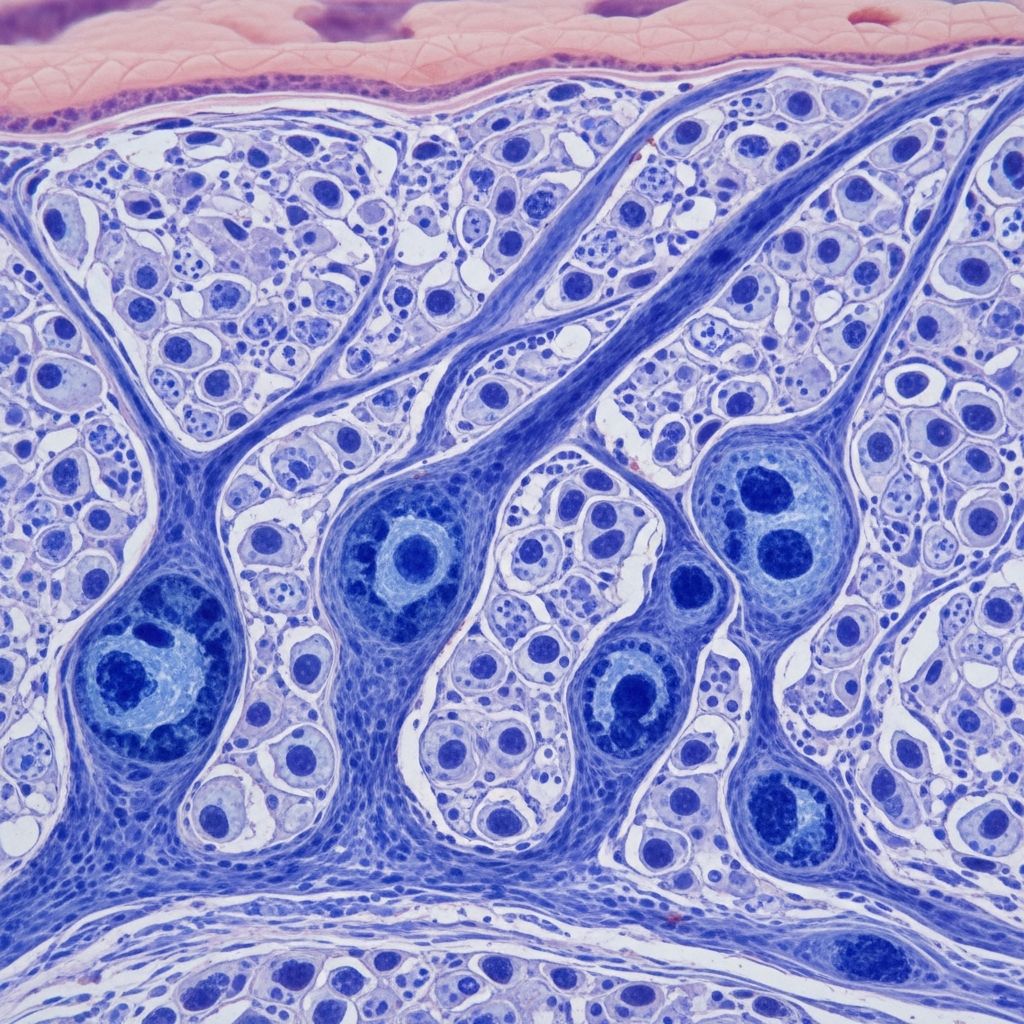
Histologically, blue naevi feature
non-nested, dendritic/spindle melanocytes
with abundant melanin in the mid-to-deep dermis, admixed with collagen bundles. No epidermal involvement or junctional activity occurs.Common blue naevus
Slender, bipolar
pigmented dendritic melanocytes
aligned parallel to the epidermis, sclerotic collagen trapping pigment. Melan-A/MART-1, HMB-45, and S100 positive; Ki67 low (<1%).Cellular blue naevus
Biphasic: superficial dendritic zone overlies deep nodules of
pale spindle/oval cells
with low melanin, mimicking melanoma. Extension to subcutis common; ancient change (fibrosis, haemorrhage) in long-standing lesions.Epithelioid blue naevus
Prominent
epithelioid melanocytes
with abundant cytoplasm; linked to Carney complex (PS1 gene).Malignant blue naevus
Aggressive features:
sheet-like growth, high mitoses (>2/mm²), necrosis, atypia, deep invasion
. Arises in 1-5% of cellular blue naevi.Dermoscopy
Classic
homogeneous steel-blue, hazy/ground-glass pattern
without pigment network. Peripheral streaks (slate-blue, out-of-focus) in some; multichromatic (blue-white-grey-brown-black) variants exist. Combined naevi show blue + brown zones.- Distinguishes from melanoma (asymmetric, irregular globules, atypical network).
Differential diagnosis
- Melanoma: Asymmetric, changing, bleeding/itching; ulceration, irregular borders.
- Dermatofibroma: Firm, reddish-brown, stellate on dermoscopy.
- Metastatic melanoma: Amelanotic, multiple.
- Clear cell sarcoma: Mimics cellular blue naevus, S100+, deep soft tissue.
- Bednar tumour: Pigmented cells in storiform pattern.
- Osteoma cutis: Calcified, non-pigmented.
Treatment
Most blue naevi require
no treatment
as they are benign and stable. Indications for excision:- Large (>1 cm), scalp, de novo in adults, cosmetic concerns, or changes.
- Shave/tangential biopsy risks recurrence;
excisional biopsy
preferred for cellular variants.
Monitor for ABCDE changes (Asymmetry, Border irregularity, Colour variation, Diameter >6mm, Evolving).
Frequently Asked Questions (FAQs)
Related Stories



What causes the blue colour in blue naevi?
The blue hue results from the Tyndall effect, where deep dermal melanin scatters shorter blue light wavelengths.
Are blue naevi cancerous?
Common blue naevi are benign. Cellular types rarely (<1%) transform to malignant blue naevus (melanoma).
When should a blue naevus be biopsied?
Biopsy if >1 cm, changing size/colour/shape, scalp location, adult onset, or symptomatic (itch/bleed).
How are blue naevi diagnosed?
Clinically by appearance + dermoscopy (homogeneous blue pattern). Histology confirms.
Can blue naevi be removed?
Yes, surgically for suspicion of malignancy or cosmetics. They persist lifelong if untreated.
Who gets blue naevi?
More common in females; any age but peak in adolescence/young adulthood. No racial predilection.
References
- Blue Nevus Treatment in Houston – Heights Dermatology — Heights Dermatology. 2023. https://www.heightsskin.com/blue-nevus
- Blue naevus (blue nevus) – DermNet — DermNet NZ. 2024-01-15. https://dermnetnz.org/topics/blue-naevus
- Blue nevus – Wikipedia — Wikipedia Contributors. 2025-10-20. https://en.wikipedia.org/wiki/Blue_nevus
- Melanocytic Naevi – Sussex Community Dermatology Service — Sussex CDS. 2024. https://sussexcds.co.uk/patient-information/melanocytic-naevi/
- Blue nevi – dermoscopedia — Dermoscopedia. 2024. https://dermoscopedia.org/Blue_nevi
- Why Are Some Moles Blue? | Blue Naevi Explained – YouTube — YouTube (Medical Channel). 2023-05-10. https://www.youtube.com/watch?v=f60ov86anWQ
Similar Articles








Read full bio of medha deb