Boerhaave Syndrome: Symptoms, Treatment & Definition
Understanding Boerhaave syndrome: causes, symptoms, diagnosis, and emergency treatment options.
What Is Boerhaave Syndrome?
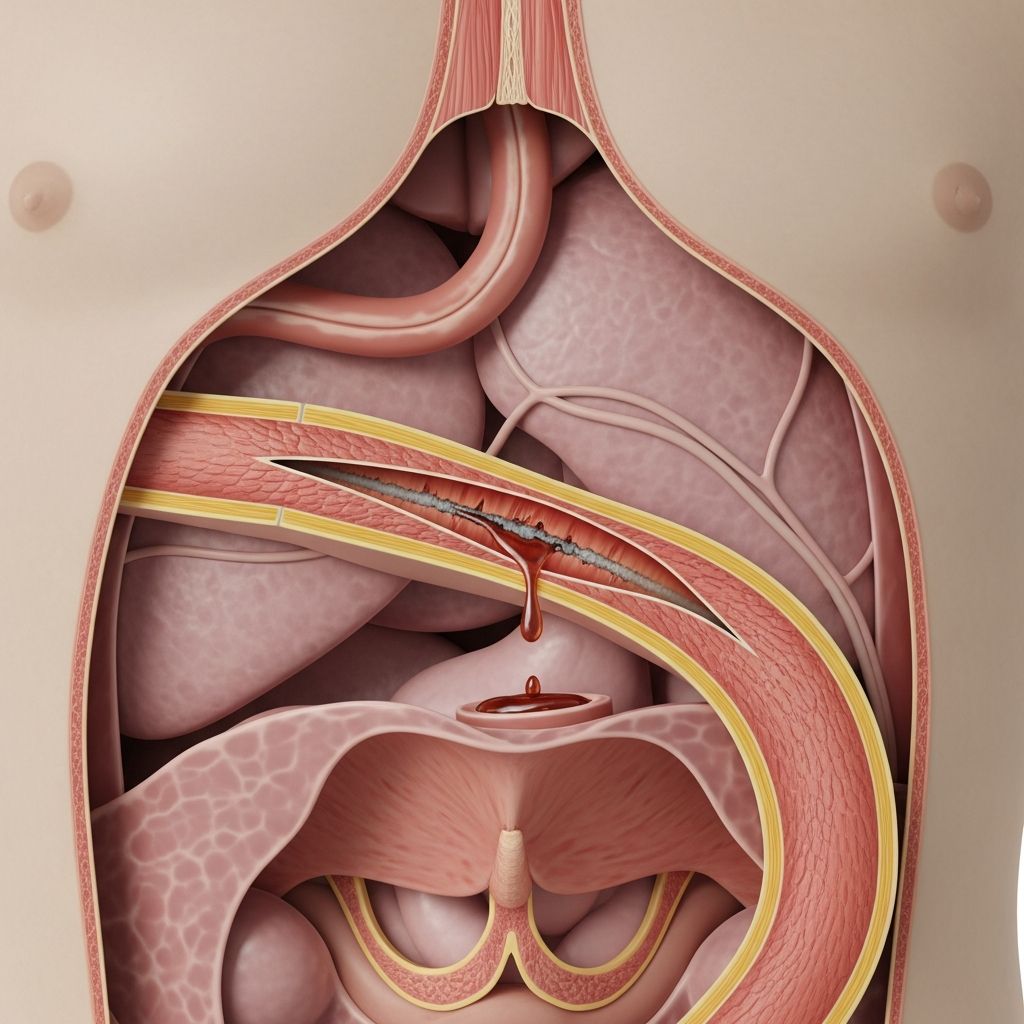
Boerhaave syndrome is a spontaneous rupture of the esophagus that occurs during intense straining or forceful vomiting. It represents a full-thickness tear through the esophageal wall, also called a transmural tear, which is distinctly different from partial tears. Healthcare professionals refer to this condition as an “effort rupture” or “spontaneous rupture” to differentiate it from ruptures caused by direct injury or trauma to the esophagus. This is a medical emergency that requires immediate attention and treatment.
Unlike a Mallory-Weiss tear, which only affects the inner lining of the esophagus and may cause vomiting of blood, Boerhaave syndrome ruptures completely through the entire esophageal wall. This transmural tear is significantly more dangerous and typically requires emergency surgical repair. When the esophagus tears, toxic digestive contents can leak into the surrounding tissues and body cavities, causing severe infection and life-threatening complications.
How Common Is Boerhaave Syndrome?
Boerhaave syndrome is an uncommon medical condition, affecting an estimated 0.0003% of the population. Despite its rarity, it represents approximately 15% of all traumatic ruptures of the esophagus. The condition does not discriminate but is significantly more prevalent in certain populations. Men are affected more frequently than women, and it is more common in people older than 50 years of age. Up to 80% of those affected are middle-aged males. Additionally, the condition is more prevalent in people who engage in heavy alcohol consumption.
What Causes Boerhaave Syndrome?
Boerhaave syndrome results from a combination of two distinct physiological factors working together. The primary factor involves a buildup of pressure inside the esophagus from extraordinary effort or straining. The secondary factor involves a buildup of negative pressure outside the esophagus when the upper esophageal sphincter, known as the cricopharyngeus muscle, fails to relax in response to internal pressure.
Normally, when pressure builds inside the esophagus, nerve signals should trigger the cricopharyngeus muscle to relax and release that internal pressure. However, in Boerhaave syndrome, this neuromuscular coordination fails for reasons that are not completely understood. The condition is characterized by a barogenic injury resulting from a sudden increase in intraluminal pressure against a closed cricopharyngeus. This neuromuscular dysfunction results in a non-relaxed cricopharyngeus, causing a resultant rise in pressure that overwhelms the wall of the esophagus at its weakest point.
Common Triggers and Risk Factors
The most common cause of strain in Boerhaave syndrome is forceful or repeated vomiting. Other potential causes include childbirth, seizures, weightlifting, and ingestion of something caustic or corrosive. The classic presentation of Boerhaave syndrome follows repeated episodes of vomiting after excessive food and/or alcohol consumption. Excessive alcohol use is certainly a significant risk factor. Alcohol use disorder sets the stage for this condition, as do binge eating and bulimia.
Symptoms of Boerhaave Syndrome
Boerhaave syndrome presents with severe and distinctive symptoms that develop suddenly. The pain is often described as severe or excruciating and is typically vaguely localized around the site of the rupture. In most cases, this pain occurs in the lower third of the esophagus, which passes through the bottom of the chest cavity and the top of the abdominal cavity, but it could be located higher in the esophagus. The pain may also radiate to the back or shoulder.
Related Stories



Beyond the primary chest pain, patients may experience a range of additional symptoms. Clinical presentation depends on the time elapsed since the injury and the extent of leakage. Patient complaints can vary greatly and may include sudden onset of chest, neck, and abdominal pain, odynophagia (painful swallowing), dysphagia (difficulty swallowing), hoarseness, dysphonia (voice changes), vomiting, hematemesis (vomiting blood), and respiratory distress.
Physical examination may reveal several concerning findings including subcutaneous crepitation (air in the tissues under the skin), mediastinal crunching sounds synchronized with each heartbeat in the left lateral decubitus position (Hamman sign), fever, hypotension, tachycardia, tachypnea, cyanosis, decreased breath sounds, abdominal pain, abdominal rigidity, neck pain, tracheal shift, proptosis, and altered mental status.
The Mackler Triad
Boerhaave syndrome can be difficult to diagnose, and timely diagnosis is important. It is easier to identify when it presents with the classic triad of symptoms known as the Mackler triad. These symptoms include severe or repeated vomiting, sudden onset chest pain, and subcutaneous emphysema, which is a condition in which air is trapped in the tissues under the skin. This last symptom is especially telling of an esophageal rupture.
However, not all cases present with these classic symptoms. The rupture may occur in an uncommon location, leading to pain in an uncommon area like the neck or clavicles. It may occur from less common causes than vomiting, or it may come with uncommon side effects.
How Is Boerhaave Syndrome Diagnosed?
The evaluation of suspected Boerhaave syndrome consists mainly of physical examination and radiographic assessment. A focused physical examination is essential to ascertain the degree of distress or physiologic derangement. Imaging is critical in diagnosing Boerhaave syndrome and determining the extent of injury.
Imaging Studies
Plain films of the chest and abdomen may show several telltale signs including subcutaneous or mediastinal emphysema, mediastinal widening, and pleural effusion. In up to 20% of cases, the Nacleario V-sign may be seen as radiolucent streaks that dissect the retrocardiac fascia to form the letter V, which is a specific but insensitive radiographic sign of esophageal perforation. A standard chest X-ray might give some hints, but more sensitive imaging tests are needed to definitively diagnose the condition.
Contrast studies can be obtained at any time of day and can provide valuable diagnostic information. These advanced imaging studies are essential for confirming the diagnosis and evaluating the extent of esophageal perforation.
Treatment Options for Boerhaave Syndrome
Early diagnosis and treatment is key to avoiding the serious complications of infection, including death. The three common treatment modalities for Boerhaave syndrome include nonsurgical, endoscopic, and surgical approaches, which can be either open or minimally invasive. The management decision is best made by an interprofessional team with experience in all treatment options. Treatment often consists of a combination of medical and surgical interventions.
Conservative Medical Management
Medical management includes avoidance of all oral intake for at least 7 days, parenteral nutrition (nutrition administered intravenously), broad-spectrum IV antibiotics for 7 to 14 days, and drainage of any fluid collections. The mainstay of conservative treatment includes avoidance of all oral intake, volume replacement, broad-spectrum antibiotic coverage, nutritional support through parenteral means, source control of any leaks through interventional radiology or video-assisted thoracoscopic surgery (VATS), and prompt surgical or endoscopic intervention as indicated.
Surgical and Endoscopic Intervention
Patients who show signs of clinical deterioration during conservative treatment require surgical intervention. Surgery is indicated if any of the following develops: contained perforation develops into a free perforation, the injury extends, the patient exhibits persistent fevers, clinical deterioration including the development of sepsis, progression of pneumothorax or pneumomediastinum, or development of empyema. Surgical specialists should be readily available if the patient deteriorates, and treatment decisions should be made promptly.
Prognosis and Outcomes
The prognosis of Boerhaave syndrome often depends critically on the time between injury and diagnosis. Delayed diagnosis and treatment are associated with worse outcomes and increased mortality. When diagnosis and appropriate treatment occur within 12 to 24 hours, patients have a good prognosis with a survival rate approaching 75%.
Those who are treated within 24 hours of the rupture have a good prognosis and a survival rate of approximately 75%. However, after 24 hours, the chance of death increases to more than 50%, and after 48 hours it rises to 90%. The overall mortality rate is around 35%. Boerhaave syndrome, if left untreated, has a mortality rate of over 90%. Those who are successfully treated in time can heal completely, but the recovery may take several months.
Delayed diagnosis poses substantial challenges, leading to adverse outcomes, with mortality rates reaching 60% despite intervention and nearly 100% without timely treatment.
Distinguishing Boerhaave Syndrome from Other Conditions
It is important to distinguish Boerhaave syndrome from other esophageal conditions that may present with similar symptoms. A Mallory-Weiss tear is a tear in the inner lining of the esophagus that also occurs after forceful vomiting or straining and is associated with drinking too much alcohol. Both conditions can cause vomiting of blood, but a Mallory-Weiss tear does not tear all the way through the esophagus. Boerhaave syndrome, on the other hand, ruptures the full thickness of the esophageal wall, which is a transmural tear and is significantly more serious. A transmural tear will likely need emergency repair, making the distinction between these conditions a matter of life or death.
Why Timing Matters
The critical importance of rapid diagnosis and treatment cannot be overstated. Those who receive treatment within 24 hours have substantially better survival rates compared to those whose diagnosis is delayed. The deterioration in prognosis is dramatic as hours pass without treatment, underscoring why this condition is considered a true medical emergency. Physicians must maintain a high level of suspicion for this condition in patients presenting with the classic symptoms, particularly those with a history of alcohol abuse or recent forceful vomiting episodes.
Frequently Asked Questions About Boerhaave Syndrome
Q: What is the difference between Boerhaave syndrome and a Mallory-Weiss tear?
A: Both occur after forceful vomiting or straining and are associated with alcohol use. The key difference is that a Mallory-Weiss tear only affects the inner lining of the esophagus, whereas Boerhaave syndrome is a full-thickness transmural tear through the entire esophageal wall. Boerhaave syndrome is far more serious and requires emergency intervention, while a Mallory-Weiss tear may be managed more conservatively.
Q: Can Boerhaave syndrome be treated without surgery?
A: Yes, conservative medical management is possible in some cases and includes avoidance of oral intake, parenteral nutrition, broad-spectrum antibiotics, and fluid drainage. However, many cases require surgical or endoscopic intervention, especially if the patient shows signs of deterioration or develops complications.
Q: How quickly must Boerhaave syndrome be diagnosed and treated?
A: Time is critical. Patients treated within 24 hours have approximately a 75% survival rate. After 24 hours, mortality increases to over 50%, and after 48 hours, it reaches 90%. This demonstrates why rapid diagnosis and treatment are essential for survival.
Q: What causes the neuromuscular failure in Boerhaave syndrome?
A: The exact mechanism is not completely understood, but it involves a failure of the cricopharyngeus muscle to relax appropriately in response to internal pressure buildup. This neuromuscular coordination failure prevents the normal release of pressure, leading to esophageal rupture.
Q: Who is most at risk for Boerhaave syndrome?
A: The condition is more common in middle-aged males (up to 80% of cases), people over 50, and individuals with heavy alcohol consumption. It can also occur after childbirth, seizures, or intense weightlifting in anyone susceptible to the condition.
Q: How long is recovery from Boerhaave syndrome?
A: Those who are successfully treated in time can heal completely, but recovery typically takes several months. The specific recovery timeline depends on the severity of the rupture and the type of treatment required.
References
- Boerhaave Syndrome – StatPearls — National Institutes of Health, National Center for Biotechnology Information. 2024. https://www.ncbi.nlm.nih.gov/books/NBK430808/
- Boerhaave’s Syndrome: Symptoms, Treatment & Definition — Cleveland Clinic. 2024. https://my.clevelandclinic.org/health/diseases/22898-boerhaave-syndrome
- Esophageal Perforation (Rupture): Symptoms & Treatment — Cleveland Clinic. 2024. https://my.clevelandclinic.org/health/diseases/24284-esophageal-rupture
Similar Articles








Read full bio of Sneha Tete