Botryomycosis: Essential Guide To Diagnosis And Treatment
Rare chronic bacterial skin infections mimicking fungal diseases: clinical features, diagnosis, and management strategies.
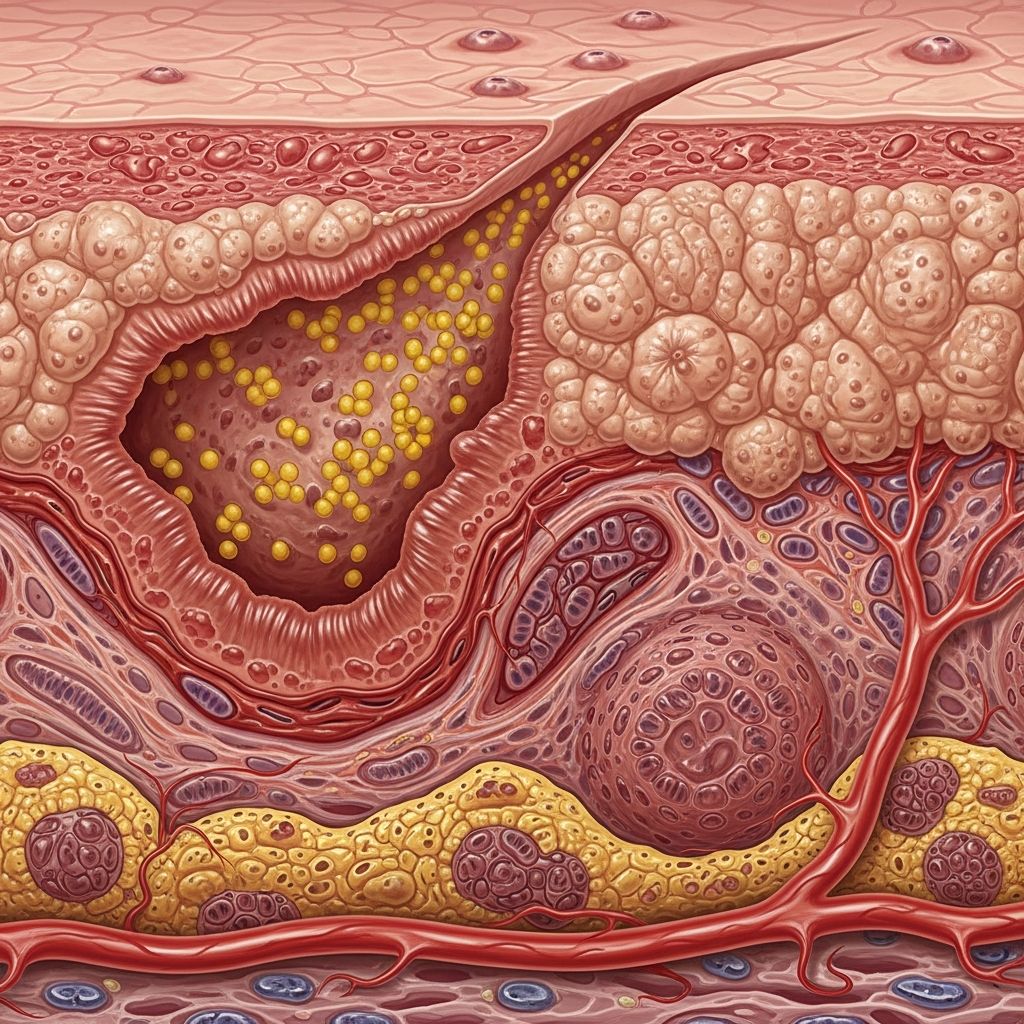
Botryomycosis, also known as bacterial pseudomycosis or pyoderma vegetans, represents a rare chronic granulomatous bacterial infection primarily affecting the skin but occasionally involving internal organs. This condition arises from an exaggerated inflammatory response to bacterial invasion, most commonly Staphylococcus aureus, mimicking fungal infections due to its grape-like (botryoid) clusters of bacteria.
What is Botryomycosis?
Botryomycosis is characterized by a persistent inflammatory reaction to bacterial infection, leading to the formation of distinctive granules resembling those in actinomycosis or mycetoma. The term ‘botryomycosis’ derives from the Greek ‘botrys’ meaning bunch of grapes, reflecting the macroscopic appearance of bacterial colonies in pus or tissue. It differs from true mycoses as it is purely bacterial, often triggered by trauma or underlying immune compromise.
Historically, botryomycosis was first described in the early 20th century in both humans and animals, with cutaneous forms being the most prevalent. The disease progresses slowly, forming subcutaneous nodules that evolve into abscesses, verrucous plaques, ulcers, fistulae, and draining sinuses containing purulent material with yellow grains. These grains consist of bacterial clusters embedded in an eosinophilic matrix, a hallmark known as the Splendore-Hoeppli phenomenon.
Who Gets Botryomycosis?
Botryomycosis predominantly affects individuals with predisposing factors that impair local or systemic immunity. Common risk factors include:
- Immunodeficiencies such as HIV infection, diabetes mellitus, alcoholism, cystic fibrosis, and prolonged corticosteroid therapy.
- Trauma, surgical wounds, or presence of foreign bodies that serve as entry points for bacteria.
- Chronic conditions like end-stage renal disease or malignancy, which further compromise host defenses.
While it can occur in immunocompetent hosts, especially following penetrating injuries, the majority of cases (over 70% in reported series) involve immunocompromised patients. No strong gender or age predilection exists, though it is more frequently documented in adults.
Causes of Botryomycosis
The etiology centers on bacterial pathogens, with Staphylococcus aureus implicated in approximately 80-90% of cases. Other causative agents include Pseudomonas aeruginosa, Proteus species, and Escherichia coli. Rarely, polymicrobial infections occur.
Infection typically initiates at sites of skin breach, leading to bacterial proliferation and granuloma formation. In susceptible hosts, impaired phagocytosis allows bacteria to form protective biofilms or granules, evading immune clearance and antibiotics. Recent studies highlight the role of bacterial virulence factors, such as exotoxins and adhesins in S. aureus, contributing to chronicity.
Clinical Features of Botryomycosis
Skin manifestations dominate, appearing weeks to months post-insult. Key features include:
- Subcutaneous nodules evolving into abscesses with purulent drainage.
- Verrucous plaques, ulcers, fistulae, and sinuses, often on extremities, trunk, or perineal areas.
- Characteristic yellow-white ‘sulfur granules’ (1-2 mm) in pus, similar to actinomycosis.
Lesions expand centrifugally, causing significant morbidity through tissue destruction and secondary infection. Systemic symptoms like fever or weight loss are uncommon unless visceral involvement occurs. Lungs are the most frequent extracutaneous site, often post-surgery or in cystic fibrosis patients.
Related Stories



Pyoderma Vegetans Subtype
Pyoderma vegetans (PDV), sometimes synonymous with cutaneous botryomycosis, presents as large verrucous plaques with elevated, pustular borders, primarily in intertriginous areas like axillae, groin, and face. Histologically, it features pseudoepitheliomatous hyperplasia, subcorneal pustules with neutrophils and eosinophils, and mixed dermal infiltrates. Peripheral eosinophilia may accompany it.
In one documented case, a 93-year-old man developed rapidly progressive PDV in axillae and inguinal folds, culture-positive for S. aureus, resolving with doxycycline and topical steroids.
Diagnosis of Botryomycosis
Diagnosis requires clinical suspicion, corroborated by laboratory findings, as it mimics deep fungal infections, tuberculosis, or malignancy.
- Microscopy and Culture: Pus swabs reveal gram-positive cocci in clusters or rods; cultures confirm pathogens.
- Histopathology: Biopsy shows granulomatous inflammation with abscesses containing Splendore-Hoeppli material—basophilic bacterial cores with radiating eosinophilic clubs. Special stains (Gram, Giemsa, silver) highlight this.
- Imaging: For deep involvement, ultrasound, CT, or MRI delineates extent.
Differential diagnoses include actinomycosis, nocardiosis, sporotrichosis, squamous cell carcinoma, and pyoderma gangrenosum. Negative fungal cultures and typical granules favor botryomycosis.
Treatment of Botryomycosis
Management combines surgical intervention and prolonged antibiotics tailored to culture sensitivities.
- Surgical: Debridement or excision of lesions and granules is crucial for source control, especially in localized disease.
- Antibiotics: For S. aureus, options include trimethoprim-sulfamethoxazole, clindamycin, doxycycline (100 mg BID), or fluoroquinolones for 4-12 weeks. Doxycycline offers anti-inflammatory benefits in PDV.
- Adjuncts: Topical agents (mupirocin) and low-potency steroids for PDV; monitor for resistance.
Response is monitored clinically; recurrence is possible without addressing predispositions. In the PDV case, doxycycline led to resolution in 13 weeks without systemic steroids. Visceral disease may require IV therapy like vancomycin or imipenem.
Prognosis and Complications
With appropriate therapy, cutaneous botryomycosis has a good prognosis, though scarring and keloids are common sequelae. Untreated, it can lead to osteomyelitis, sepsis, or squamous cell carcinoma transformation. Immunocompromised patients face higher recurrence and mortality risks from dissemination.
Prevention
- Prompt wound care post-trauma or surgery.
- Immune status optimization in at-risk patients.
- Early biopsy of persistent nodules.
Frequently Asked Questions
What causes botryomycosis?
Staphylococcus aureus is the primary cause, often following trauma in immunocompromised individuals.
How is botryomycosis diagnosed?
Through clinical exam, pus culture, and biopsy showing Splendore-Hoeppli granules.
Is pyoderma vegetans the same as botryomycosis?
They overlap significantly; PDV is a vegetating form often linked to bacterial granulomas.
What is the treatment for pyoderma vegetans?
Doxycycline with topical steroids has shown success; surgery for refractory cases.
Can botryomycosis affect internal organs?
Rarely, lungs are most common, especially with predisposing factors like cystic fibrosis.
References
- Botryomycosis, pyoderma vegetans – DermNet — DermNet NZ. 2023. https://dermnetnz.org/topics/botryomycosis-pyoderma-vegetans
- Successful treatment of pyoderma vegetans with doxycycline — PMC (PubMed Central). 2022-02-01. https://pmc.ncbi.nlm.nih.gov/articles/PMC8814734/
- Pyoderma Vegetans — Sage Journals. 2001. https://journals.sagepub.com/doi/10.1177/120347540100500306
- Botryomycosis — Our Dermatology Online. 2019. https://www.odermatol.com/issue-in-html/2019-4-12-botryomycosis/
- Pyoderma Vegetans — AFRH (PDF). 2001. https://www.afrh.fr/web-content/documents/Basedocumentairemedicale/2001/2001%20Pyoderma%20Vegetans%20HS%20IgE%20Papadopoulos.pdf
Similar Articles








Read full bio of Sneha Tete