Botulinum Toxin Mechanism: 4 Phases For Eye Treatments
Discover how botulinum toxin, known as Botox, precisely targets nerves to relax muscles and treat eye conditions effectively.
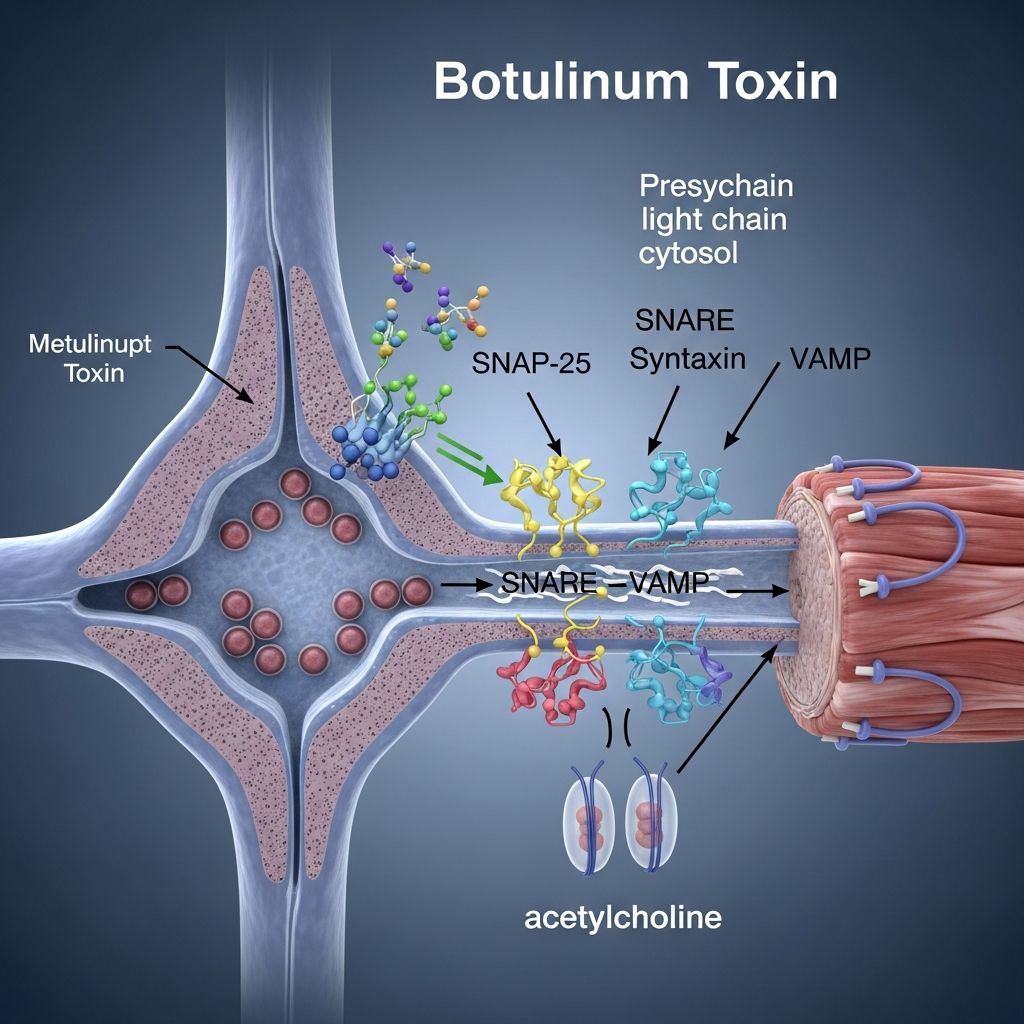
Botulinum toxin, commonly recognized as Botox, functions by interrupting nerve signals to muscles, leading to temporary relaxation that benefits various medical and cosmetic applications, particularly in eye health.
The Science of Nerve-Muscle Communication
Normal muscle contraction relies on a precise sequence where nerves release the neurotransmitter acetylcholine at the neuromuscular junction. This chemical messenger binds to receptors on muscle cells, triggering contraction. Botulinum toxin disrupts this process at its core, preventing acetylcholine release without damaging nerve structures permanently.
Understanding this starts with the neuromuscular junction, a synapse between motor neurons and muscle fibers. An action potential travels along the neuron, opening calcium channels and prompting vesicle fusion to release acetylcholine. The toxin targets this vesicle fusion mechanism, halting signal transmission.
Step-by-Step: How Botulinum Toxin Operates
The action of botulinum toxin unfolds in four distinct phases: binding, internalization, translocation, and inhibition. Each step ensures targeted, potent effects lasting several months.
Phase 1: Precise Binding to Nerve Terminals
The toxin’s heavy chain acts as a homing device, selectively attaching to high-affinity receptors on cholinergic nerve endings. These include gangliosides, synaptotagmin, and SV2 proteins, ensuring specificity for acetylcholine-releasing neurons. This binding is rapid, saturable, and irreversible, concentrating the toxin exactly where needed.
- Heavy chain role: Facilitates receptor recognition on presynaptic membranes.
- Selectivity: Targets motor and autonomic nerves releasing acetylcholine.
- Saturation: Limits effects to injected sites, minimizing spread.
Phase 2: Entry via Endocytosis
Once bound, the neuron engulfs the toxin-receptor complex through receptor-mediated endocytosis. The plasma membrane invaginates, forming an endocytic vesicle that carries the toxin inside. Acidification of this vesicle prepares the toxin for the next step.
This process leverages the cell’s natural synaptic recycling, making entry efficient and cell-specific. No energy from the cell is required beyond standard endocytosis pathways.
Phase 3: Translocation into Cytoplasm
Inside the vesicle, the toxin’s light chain separates via cleavage of a disulfide bond. The light chain, a zinc-dependent protease, crosses the vesicle membrane into the cytoplasm. This translocation is toxin-specific, driven by conformational changes in low pH.
Botulinum toxin type A primarily cleaves SNAP-25, a SNARE protein essential for vesicle docking. Other serotypes target different SNAREs like VAMP or syntaxin, but type A dominates clinical use.
Phase 4: Blocking Neurotransmitter Release
In the cytoplasm, the light chain enzymatically cleaves SNAP-25, impairing SNARE complex formation. Without intact SNAREs, acetylcholine vesicles cannot fuse with the presynaptic membrane, blocking release. Muscles cease contracting, leading to flaccid paralysis.
This inhibition persists until new SNARE proteins synthesize and nerve terminals sprout new endings, typically 3-6 months later. Muscle atrophy may occur temporarily, reversing with reinnervation.
Applications in Eye Health
In ophthalmology, botulinum toxin treats conditions involving overactive eye muscles. Blepharospasm causes involuntary eyelid closure, while hemifacial spasm affects facial muscles including eyes. Injections relax these muscles, restoring normal function.
Related Stories



| Condition | Symptoms | Treatment Effect |
|---|---|---|
| Blepharospasm | Involuntary blinking/closure | Reduces spasms for 3-4 months |
| Hemifacial Spasm | Unilateral facial twitching | Relaxes affected muscles |
| Strabismus | Misaligned eyes | Balances eye muscle pull |
| Cosmetic Wrinkles | Dynamic lines (e.g., crow’s feet) | Smooths skin temporarily |
For cosmetic use around eyes, low doses target orbicularis oculi, reducing glabellar lines and crow’s feet without affecting vision.
Duration and Recovery Process
Effects peak 4-7 days post-injection, lasting 3-6 months depending on dose, muscle size, and patient factors like age or ethnicity. Recovery involves axonal sprouting, new receptor formation, and SNARE regeneration. Extrajunctional acetylcholine receptors may develop, aiding reversal.
- Onset: Visible in 24-72 hours, full by week 1.
- Peak: Days 4-7 for maximal paralysis.
- Decline: Gradual as nerves adapt.
Beyond Muscles: Sensory and Other Effects
Recent research reveals actions on sensory nerves and skin. In chronic migraine or overactive bladder, it modulates TRPV1 receptors and afferent feedback via SNARE inhibition. For eye conditions, this may reduce pain from spasms.
In detrusor overactivity, Botox normalizes ion channel levels, acting as a modulator rather than complete blocker.
Safety Profile and Considerations
At therapeutic doses, botulinum toxin causes localized, reversible effects. Systemic spread is rare with proper dosing. Common side effects include injection-site bruising or temporary ptosis in eye treatments.
Contraindications include neuromuscular disorders like myasthenia gravis. Pregnancy and lactation require caution. Always administered by trained specialists.
Types of Botulinum Toxin
Serotype A (onabotulinumtoxinA) is most common, cleaving SNAP-25. Type B targets VAMP. All share core mechanisms but vary in potency and immunogenicity.
| Serotype | Target Protein | Primary Use |
|---|---|---|
| A (Botox) | SNAP-25 | Eye spasms, cosmetics |
| B (Myobloc) | VAMP | Alternative for A-resistant cases |
Clinical Evidence and Efficacy Factors
Efficacy depends on molecular potency, muscle mass, gender, age, and ethnicity. Higher doses for larger muscles; women often need less than men. Studies confirm reliable relief in 80-90% of blepharospasm patients.
Future Directions in Eye Treatments
Ongoing research explores longer-lasting formulations and sensory applications. Combinations with fillers enhance cosmetic outcomes around eyes. Precision delivery via ultrasound-guided injections improves accuracy.
Frequently Asked Questions
How quickly does Botox work for eye spasms?
Effects begin within 24-72 hours, peaking at 4-7 days.
Is Botox permanent for eye conditions?
No, effects last 3-6 months; repeat injections needed.
Can Botox affect vision?
Rarely; proper dosing by ophthalmologists minimizes risks.
Who should avoid Botox treatments?
Those with neuromuscular diseases or allergies to components.
Does Botox work on all wrinkle types?
Best for dynamic wrinkles from muscle movement; static lines need other treatments.
References
- Botulinum toxin – Wikipedia — Wikipedia. 2023-10-01. https://en.wikipedia.org/wiki/Botulinum_toxin
- How does botulinum work — Dr. Fountain. 2022-05-15. https://www.drfountain.com/how-does-botulinum-work-blepharospasm-hemifacial-hemi-facial-spasm.html
- Botulinum toxin type A: Uses, Interactions, Mechanism of Action — DrugBank Online. 2024-01-20. https://go.drugbank.com/drugs/DB00083
- The mechanisms of action and use of botulinum neurotoxin type A — Wiley Online Library. 2020-06-10. https://onlinelibrary.wiley.com/doi/10.1111/jocd.13702
- Botox (onabotulinumtoxinA) mechanism of action – PMC — National Center for Biotechnology Information. 2023-07-15. https://pmc.ncbi.nlm.nih.gov/articles/PMC10374191/
- Mechanism of action, clinical indication and results of botulinum toxin — PubMed. 1996-12-01. https://pubmed.ncbi.nlm.nih.gov/8975111/
Similar Articles








Read full bio of Sneha Tete