Bowenoid Papulosis: Causes, Diagnosis & 6 Treatment Options
Sexually transmitted pigmented papules due to high-risk HPV with premalignant potential in anogenital skin.
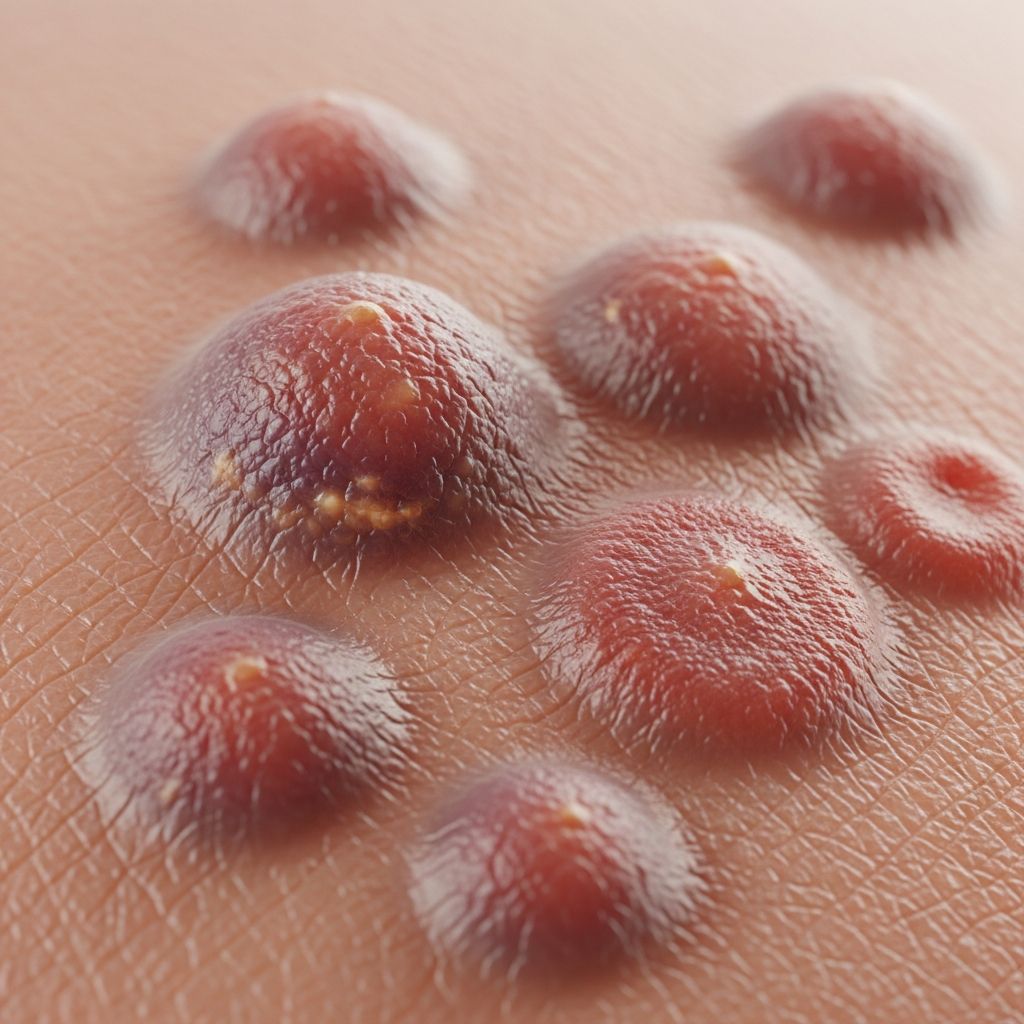
Bowenoid papulosis is a sexually transmitted premalignant dermatosis characterised by multiple small pigmented papules in the anogenital region due to infection with high-risk human papillomavirus (HPV) types, particularly HPV-16.
What is bowenoid papulosis?
Bowenoid papulosis is a dysplastic lesion of the anogenital skin associated with oncogenic human papillomavirus (HPV) infection. It manifests clinically as multiple, small, pigmented papules that histologically show full-thickness epidermal atypia akin to squamous cell carcinoma in situ (SCCIS), also known as Bowen disease. However, despite its alarming histology, bowenoid papulosis typically follows a benign clinical course with frequent spontaneous regression, especially in young patients.
Originally described by Lloyd in 1970 as a pigmented variant of Bowen disease in the groin, the term ‘bowenoid papulosis’ was coined by Kopf and Bart in 1977 to describe recurrent papules with epidermal hyperplasia and atypical keratinocytes resembling squamous intraepithelial neoplasia. In modern classifications, such as the WHO Classification of Tumours 5th edition (2020), ‘bowenoid papulosis’ is no longer used by pathologists; instead, it is categorised as a high-grade squamous intraepithelial lesion (HSIL) of the vulva, penis, or perianal skin.
The condition primarily affects sexually active young adults aged 20–40 years, with a male predominance (male-to-female ratio approximately 3:1). It is transmitted via close skin-to-skin contact, most commonly during sexual activity. Extragenital involvement is rare but reported in the oral cavity, thighs, or inguinal folds following primary anogenital disease.
Who gets bowenoid papulosis?
Bowenoid papulosis occurs in sexually active individuals, peaking in the third and fourth decades of life. Men are affected more frequently, with lesions commonly on the penile shaft, glans, or scrotum. In women, the vulva (labia minora/majora, clitoris) is the typical site, though perianal and inguinal involvement occurs.
Risk factors include:
- High-risk sexual behaviour with multiple partners
- Infection with oncogenic HPV types (16, 18 most common; others include 31–35, 39–42, 49, 51–54, 56)
- Immunosuppression (e.g., HIV, transplant recipients)
- Tobacco smoking
- Possibly hormonal factors or local trauma
Concurrent anogenital intraepithelial neoplasia (e.g., cervical, vaginal, anal) is common due to persistent HPV infection. Partners of affected individuals are at risk for HPV transmission and related dysplasias.
What causes bowenoid papulosis?
Bowenoid papulosis is caused by infection with high-risk (oncogenic) HPV genotypes that integrate into host DNA, driving epidermal dysplasia. HPV-16 is identified in over 80% of cases, followed by HPV-18. These viruses express E6 and E7 oncoproteins, which inactivate tumour suppressors p53 and Rb, promoting uncontrolled keratinocyte proliferation.
Transmission occurs through microtrauma during sexual contact. While viral infection is necessary, progression to bowenoid papulosis likely requires host factors like immune status and co-carcinogens (e.g., smoking). The virus induces full-thickness atypia but spares deeper structures, explaining the low invasion risk in immunocompetent hosts.
What are the clinical features of bowenoid papulosis?
Lesions typically present as multiple (often 10–100), discrete or confluent papules measuring 2–10 mm in diameter. They are usually asymptomatic but may itch, burn, or become inflamed/infected.
Key clinical characteristics:
- Colour: Reddish-brown, violaceous, or hyperpigmented; may be skin-coloured
- Surface: Verrucous, flat-topped, or velvety; occasionally scaly
- Distribution: Bilateral, symmetrical in anogenital skin (penis, vulva, perianal, groin, inner thighs)
- Male sites: Shaft, glans, coronal sulcus, foreskin, scrotum
- Female sites: Labia minora/majora, clitoris, fourchette, perineum
Related Stories



Lesions evolve over weeks to months, sometimes coalescing into plaques. Spontaneous regression occurs in 50–80% of cases within 2–5 years, particularly post-partum in women. Persistence or progression raises concern for malignant transformation, estimated at 2.6–30% for penile sites, higher in immunocompromised patients.
Diagnosis of bowenoid papulosis
Suspected clinically in young adults with multifocal pigmented anogenital papules. Differentials include condyloma acuminatum (sharper verrucae, koilocytes), lichen planus (pruritic polygonal papules), seborrhoeic keratosis, melanoma, or psoriasis.
Investigations:
- Skin biopsy: Essential for confirmation. Shows irregular acanthosis, full-thickness dyskeratosis, atypical keratinocytes (hyperchromatic nuclei, mitoses in all layers), parakeratosis, and intact basement membrane. Follicles often spared (vs. Bowen disease).
- HPV testing: PCR detects high-risk types; p16 immunohistochemistry strongly positive (diffuse block staining vs. focal in warts).
- Dermoscopy: Limited data; irregular vessels, mosaic pattern, or structureless pigmentation reported.
- Screening: Cervical cytology/HPV testing in women and partners; anoscopy/proctoscopy if perianal.
Treatment of bowenoid papulosis
Management balances malignant potential against frequent spontaneous resolution. Observation with regular follow-up (every 3–6 months) is appropriate for small, stable lesions in immunocompetent young patients.
Active treatments (for symptomatic, extensive, or persistent disease):
| Modality | Efficacy | Advantages | Disadvantages |
|---|---|---|---|
| Imiquimod 5% cream (3x/week, 16 weeks) | 70–90% clearance | Non-invasive, home-applied, immune-modulating | Local irritation, recurrence 20–40% |
| Cryotherapy (liquid N2) | 60–80% | Quick, inexpensive | Painful, hypopigmentation, recurrence |
| CO2/Er:YAG laser ablation | 80–95% | Precise, good cosmesis | Expensive, requires expertise, recurrence |
| Electrodesiccation/curettage | 70–85% | Simple office procedure | Scarring, pigment changes |
| 5-Fluorouracil cream | 50–70% | Topical | Severe inflammation |
| Photodynamic therapy (PDT) | 75–90% | Minimal scarring | Multiple sessions, photosensitivity |
Recurrence is common (20–50%) due to multifocal subclinical infection; retreatment as needed. Immunosuppressed patients warrant aggressive therapy. Partner notification and HPV vaccination (if eligible) recommended.
What is the outcome for bowenoid papulosis?
Most cases regress spontaneously within 2–8 years (higher in young women post-pregnancy). Malignant transformation to invasive squamous cell carcinoma is rare (<3%) in immunocompetent hosts but rises to 10–30% in persistent/large lesions or immunosuppression. Regular surveillance essential; excision for suspicious changes.
Psychosocial impact significant due to visible lesions and STI stigma; counselling improves compliance.
Frequently Asked Questions (FAQs)
Is bowenoid papulosis an STI?
Yes, it is transmitted sexually via skin-to-skin contact with HPV-infected mucosa.
Will bowenoid papulosis turn into cancer?
Risk is low (2–5%) with spontaneous resolution common, but monitoring required as it represents HSIL.
Do I need to treat my partner?
Partners should be screened for HPV-related disease; vaccination advised.
Can bowenoid papulosis be cured?
Many resolve without treatment; therapies clear visible lesions but subclinical HPV may persist.
Is HPV vaccination effective after diagnosis?
Vaccination prevents new infections but not existing; recommended for prevention.
References
- Bowenoid Papulosis | Treatment & Management — StatPearls Publishing. 2023-07-17. https://www.statpearls.com/point-of-care/18487
- Bowenoid Papulosis — DermNet NZ. 2023. https://dermnetnz.org/topics/bowenoid-papulosis
- Bowenoid Papulosis: Causes, Symptoms & Treatment — Cleveland Clinic. 2024-05-15. https://my.clevelandclinic.org/health/diseases/bowenoid-papulosis
Similar Articles








Read full bio of medha deb