Breast Self-Exam: Guide to Early Detection
Learn how to perform monthly breast self-exams and recognize changes early.
Breast Self-Exam: What You Need to Know
Breast self-exams are an important part of breast health awareness that allows you to become familiar with how your breasts normally look and feel. By performing regular self-exams, you can detect any changes early, when treatment is most effective. While breast self-exams alone cannot prevent breast cancer, they serve as a valuable tool in your overall breast health routine, complementing professional screenings like mammograms and clinical breast exams.
The goal of a breast self-exam is not to find cancer, but rather to notice what is normal for you personally. Every woman’s breasts are different, and changes that might be concerning in one person could be completely normal in another. This is why becoming familiar with your own breast tissue is crucial for recognizing when something is truly different or unusual.
Why Breast Self-Exams Matter
Research demonstrates that many breast cancers are first detected through self-exams rather than clinical examinations performed by healthcare providers. Self-awareness of your breasts can lead to earlier detection of potential problems, which significantly improves treatment outcomes and survival rates. When breast cancer is detected in its early stages, treatment options are often less invasive and more successful.
Self-exams empower you to take an active role in your healthcare. Unlike clinical exams that happen once or twice a year, self-exams give you the opportunity to monitor your breasts monthly, providing more frequent opportunities to notice changes. This regular monitoring creates a baseline understanding of what is normal for your body, making any abnormalities more noticeable.
However, it is important to understand that breast self-exams should never replace professional breast cancer screening tests such as mammograms or clinical breast exams. These professional screening tools use advanced technology and expert evaluation to detect cancers that might not be felt or visible during self-exams. Self-exams work best when combined with regular professional screenings as part of a comprehensive breast health plan.
When to Perform Your Breast Self-Exam
Timing is important when performing breast self-exams. Most healthcare providers recommend doing your exam at the same time each month to maintain consistency and make it easier to remember. The best time to perform your self-exam depends on your menstrual status.
For menstruating women: Perform your self-exam three to five days after your period ends. At this time in your menstrual cycle, your breasts are typically less swollen and tender, making it easier to feel any changes or lumps. Hormonal fluctuations throughout your cycle can make your breasts feel different at various times, so choosing a consistent time helps you avoid confusion caused by normal cyclical changes.
For postmenopausal women or those with irregular periods: Choose one specific day each month that is easy for you to remember, such as the first day of each month or the day you pay your bills. Consistency is more important than the specific date you choose.
Related Stories



You can incorporate your breast self-exam into your daily routine. Many women find it convenient to perform their exam while showering, as wet skin allows your hands to glide more easily across your breast tissue. Alternatively, you can perform the exam lying down in bed or standing in front of a mirror. Choose whatever position feels most comfortable and allows you thorough access to your entire breast tissue.
How to Perform a Breast Self-Exam
Performing a breast self-exam involves both visual inspection and physical palpation (feeling) of your breast tissue. Here are the step-by-step instructions to ensure you are examining your breasts properly:
Visual Inspection
Step 1: Stand in front of a mirror with your arms at your sides. Look at your breasts for their usual size, shape, and color. Note the appearance of your skin and nipples. Check for any visible lumps, dimpling, puckering, or skin texture changes.
Step 2: Raise your arms above your head while continuing to observe your breasts in the mirror. This position helps reveal any changes in contour or skin that might not be visible when your arms are at your sides. Look for the same characteristics as before—size, shape, skin appearance, and nipple condition.
Step 3: Place your hands on your hips and press inward while tightening your chest muscles. This position further accentuates any changes in breast shape or skin appearance. Again, look for any dimpling, puckering, or other abnormalities.
Step 4: Inspect your nipples closely. Look for any discharge, inversion (turning inward), or changes in appearance. Gently squeeze each nipple to check for discharge. Note that some discharge can be normal, especially if it occurs in both breasts or if you have recently had a mammogram.
Physical Examination (Palpation)
Step 5: Lie down on your back. This position allows your breast tissue to spread evenly across your chest, making it easier to feel all areas of your breast. Place a pillow under your head for comfort if desired.
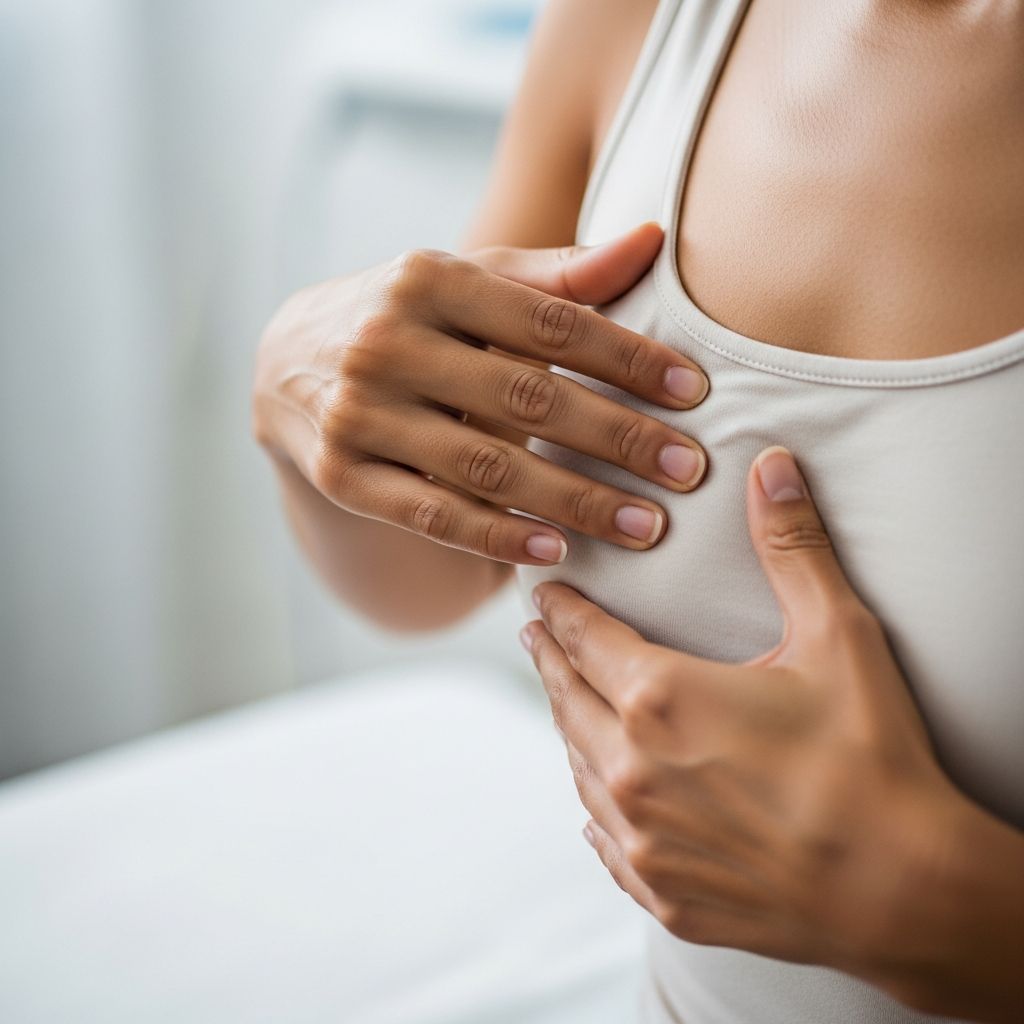
Step 6: Use the pads of your three middle fingers (index, middle, and ring finger) to feel your breast tissue. Do not use only your fingertips, as this may cause you to miss subtle changes. Press gently but firmly against your chest wall.
Step 7: Examine your entire breast using one of two methods. The first method is the circular motion technique: move your fingers in small circular motions, gradually moving across your entire breast in a spiral pattern from the outer edge toward the nipple. The second method is the up-and-down or strip pattern: move your fingers up and down your breast in vertical lines, starting from the outer edge and working toward the center.
Step 8: Check all breast tissue, including the tissue extending into your armpit (axilla). Many women forget to examine this area, yet breast tissue extends up into the armpit. Use the same circular or vertical motion to examine this region thoroughly.
Step 9: Repeat the process on your other breast using the same technique and pressure. Pay attention to any differences between your breasts, but remember that many women naturally have one breast that is slightly larger or smaller than the other.
Step 10: Perform the exam while standing or sitting. After completing the lying-down examination, you can also perform the palpation while standing or sitting in the shower. Some women find it helpful to examine their breasts in multiple positions to ensure thorough coverage.
What to Look For During Your Exam
During your breast self-exam, you are looking for any changes from your normal baseline. It is important to report the following changes to your healthcare provider:
- Lumps or masses: Any new lump, nodule, or thickened area that feels different from the surrounding tissue or from your other breast
- Dimpling or puckering: Areas of skin that appear indented or drawn inward
- Nipple changes: Nipples that become inverted (turn inward), discharge (especially if bloody or from one breast only), or show changes in appearance or texture
- Skin changes: Redness, flaking, or orange-peel texture (called peau d’orange)
- Swelling: Unusual swelling, edema, or enlargement in one breast or one area
- Pain: Persistent pain in a specific area of your breast
- Rash: Any unexplained rash on your breast or around the nipple
- Asymmetry: Significant differences in size, shape, or appearance between your breasts (though some asymmetry is normal)
Remember that many of these changes, if they occur, may not be related to cancer. Breast tissue naturally changes throughout your menstrual cycle, with hormonal birth control use, and with aging. Benign (non-cancerous) conditions like fibroadenomas, cysts, and fibrocystic changes are common and account for many breast lumps and changes. However, any change that is new for you should be evaluated by a healthcare provider to determine its cause.
Important Things to Remember
Certain factors can affect how your breasts look and feel, which is why understanding your normal baseline is so important. Menstruation causes hormonal changes that can lead to breast swelling, tenderness, and the development of temporary lumps or areas of thickening. These cyclical changes are completely normal and typically resolve after your period ends.
Caffeine consumption has been studied as a potential contributor to breast tenderness and changes, though research on this topic remains inconclusive. Hormonal birth control, hormone replacement therapy, and other medications can also cause changes in breast tissue. Stress, underwire bras, and certain activities can occasionally cause chest wall discomfort that feels like breast pain.
Because your breasts naturally change throughout your cycle and throughout your life, becoming familiar with what is normal for you at different times is crucial. This is why performing your self-exam at the same time each month is recommended—it helps you track changes in a consistent manner and reduces the likelihood of mistaking normal cyclical changes for something concerning.
When to See a Healthcare Provider
Schedule an appointment with your healthcare provider if you notice any persistent changes in your breasts or if you find something during your self-exam that concerns you. Persistent changes are those that do not go away after your menstrual cycle or that continue to worsen over time. Do not wait to see if the change goes away on its own—early evaluation of any concerning finding is important.
Your healthcare provider can perform a clinical breast exam and determine whether follow-up imaging such as mammography, ultrasound, or MRI is needed. Many breast changes turn out to be benign, but professional evaluation is always the appropriate step when you notice something new or unusual.
Breast Self-Exams and Professional Screening
Breast self-exams are just one component of comprehensive breast cancer screening and should be combined with professional screening tests. Clinical breast exams performed by healthcare providers involve physical examination by a trained professional who can detect changes you might miss. Mammography remains the gold standard screening test for breast cancer and can detect cancers too small to feel or see.
Your healthcare provider will recommend a screening schedule based on your individual risk factors, age, and breast health history. Typically, women at average risk are recommended to begin screening mammography at age 40 or 50, depending on current guidelines and your provider’s recommendations. Women at higher risk due to family history, genetic mutations, or personal history of breast cancer may need to begin screening earlier or more frequently.
The combination of breast self-awareness, clinical breast exams, and mammographic screening provides the most comprehensive approach to early breast cancer detection. Self-exams empower you to know your body, while professional screening provides advanced detection capabilities.
Frequently Asked Questions
Q: Is it normal for my breasts to feel lumpy?
A: Yes, many women have naturally lumpy breast tissue, especially in the upper outer quadrant of the breast. This is called fibrocystic breast tissue and is benign. However, you should know what is normal for your breasts so you can detect any new lumps or changes. If you develop a new lump that feels different from your usual tissue, report it to your healthcare provider.
Q: Should I be concerned if my breasts are different sizes?
A: Most women have one breast that is slightly larger or smaller than the other, and this is completely normal. However, if you notice a significant new change in the size difference between your breasts, contact your healthcare provider for evaluation.
Q: What should I do if I find a lump?
A: Do not panic. Contact your healthcare provider and schedule an appointment. Most breast lumps are benign, but a professional evaluation is important. Your provider can determine whether the lump requires further imaging or other tests.
Q: How accurate are breast self-exams at detecting cancer?
A: While self-exams cannot detect all cancers and are not as accurate as mammography, they do help many women detect breast cancer early because they notice changes in their own breasts. Self-exams should complement, not replace, professional screening.
Q: Can I perform a breast self-exam if I am pregnant or breastfeeding?
A: Yes, you can perform self-exams during pregnancy and breastfeeding. Your breasts will naturally feel and look different during these times due to hormonal and physical changes, but self-awareness remains important. If you notice anything concerning, discuss it with your healthcare provider.
Q: How long does a breast self-exam take?
A: A thorough breast self-exam typically takes only five to ten minutes. Once you become familiar with the technique, it becomes a quick and easy part of your monthly routine.
References
- Clinical Breast Exam (CBE): What To Expect — Cleveland Clinic. 2024. https://my.clevelandclinic.org/health/diagnostics/clinical-breast-exam
- How To Do A Breast Self-Examination — Cleveland Clinic Abu Dhabi. 2024. https://www.clevelandclinicabudhabi.ae/en/health-byte/health/how-to-do-a-breast-self-examination
- General Cancer Screening Guidelines — Cleveland Clinic. 2024. https://my.clevelandclinic.org/departments/cancer/patient-education/wellness-prevention/screening-guidelines
- Recognizing the Warning Signs of Breast Cancer — Cleveland Clinic. 2024. https://my.clevelandclinic.org/watch/breast-cancer-warning-sign
- Breast Cancer Screenings: Guidelines & Types of Tests — Cleveland Clinic. 2024. https://my.clevelandclinic.org/health/diagnostics/breast-cancer-screenings
Similar Articles








Read full bio of medha deb