Brinzolamide Eye Drops for Glaucoma (Azopt)
Comprehensive guide to Brinzolamide (Azopt) eye drops: uses, dosage, side effects, and management of glaucoma and ocular hypertension.
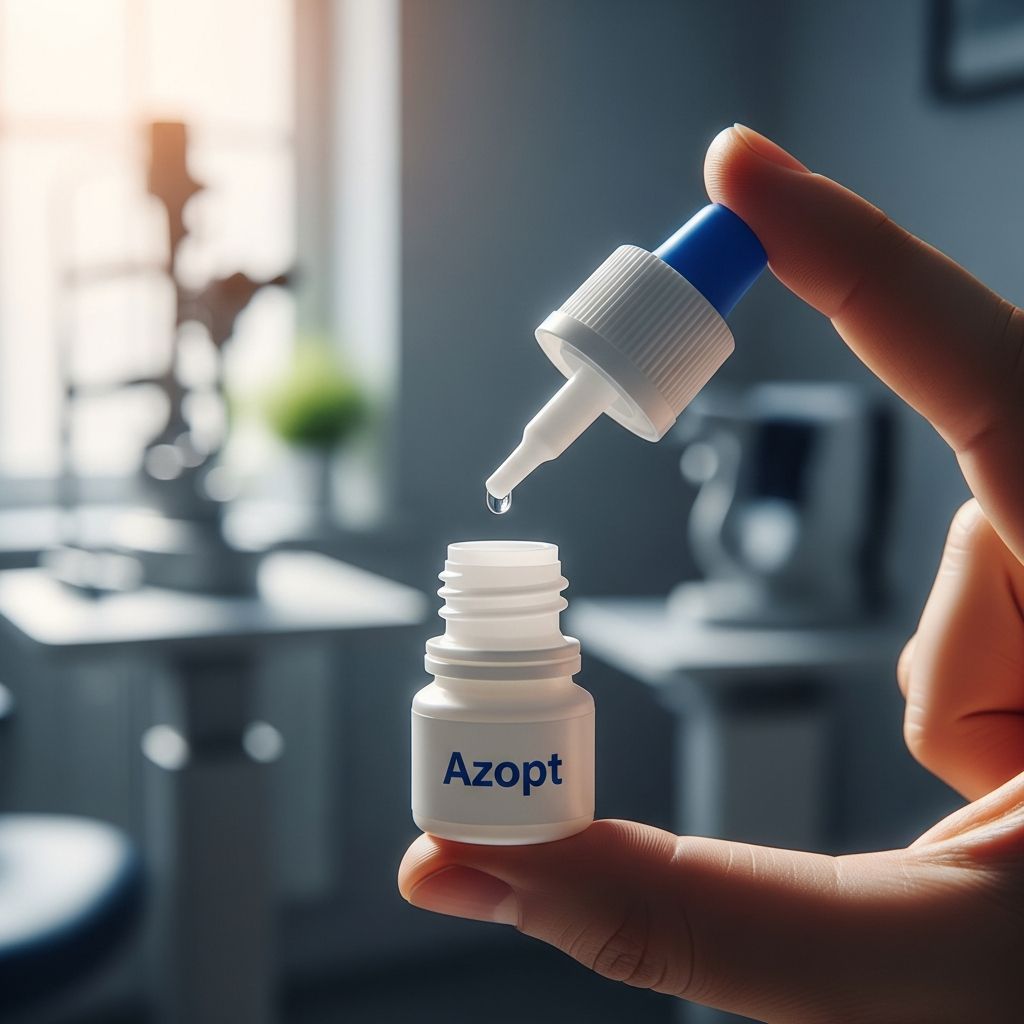
Brinzolamide eye drops, marketed as
Azopt
, are a prescription medication designed to reduce elevated intraocular pressure (IOP) in patients withopen-angle glaucoma
orocular hypertension
. This condition, if untreated, can lead to optic nerve damage and vision loss. Brinzolamide works as a carbonic anhydrase inhibitor, decreasing the production of aqueous humour—the fluid inside the eye—to lower pressure effectively.Available as a 1% ophthalmic suspension, Azopt is applied topically and is suitable for monotherapy or as an adjunct to other treatments like beta-blockers when beta-blockers alone are insufficient or contraindicated. Unlike oral carbonic anhydrase inhibitors, topical brinzolamide minimizes systemic side effects while providing comparable IOP reduction to alternatives like dorzolamide.
About brinzolamide eye drops
Brinzolamide is a highly specific inhibitor of carbonic anhydrase II (CA-II), an enzyme crucial for aqueous humour formation. By blocking this enzyme in the eye, it reduces fluid production, thereby lowering IOP—a key risk factor for glaucomatous damage. Administered as a suspension, it must be shaken well before use to ensure even distribution of the active ingredient.
The medication is absorbed systemically to a limited extent, with a long half-life in red blood cells (approximately 111 days), but at therapeutic doses, it does not significantly affect renal function or respiration in healthy individuals. Clinical studies demonstrate that brinzolamide 1% dosed three times daily reduces IOP by 4-5 mmHg, equivalent to dorzolamide 2%, but with less ocular discomfort like stinging or burning.
Azopt is now available generically, potentially improving accessibility, though costs may vary compared to other glaucoma therapies. It is indicated for adults and, in some cases, pediatric patients under specialist supervision.
Key facts about brinzolamide eye drops
- Brand name:
Azopt
(generic: brinzolamide ophthalmic suspension 1%). - Type: Carbonic anhydrase inhibitor eye drops.
- Used for: Elevated IOP in open-angle glaucoma or ocular hypertension.
- Dose: Typically 1 drop in affected eye(s) 2-3 times daily.
- Common side effects: Blurred vision, bitter taste, mild eye irritation.
- Alternatives: Beta-blockers (e.g., timolol), prostaglandins, or combinations like brinzolamide/brimonidine.
- Not for: Acute angle-closure glaucoma or severe renal impairment without medical advice.
When to use brinzolamide eye drops
Brinzolamide is primarily used for
primary open-angle glaucoma (POAG)
andocular hypertension
, the most common forms where drainage is impaired gradually. It serves as monotherapy for those intolerant to beta-blockers or as adjunctive therapy with topical beta-blockers like timolol, enhancing IOP control when single agents fail.Separate administration by at least 10 minutes if using multiple eye drops to allow proper absorption. It is not suitable for acute angle-closure glaucoma, which requires urgent intervention beyond hypotensive agents. Patients unresponsive to beta-blockers or with contraindications (e.g., respiratory issues) benefit particularly from brinzolamide.
How to use brinzolamide eye drops
Follow these steps for safe and effective use:
Related Stories



- Wash hands thoroughly before handling.
- Shake the bottle well.
- Tilt head back, pull down lower eyelid to form a pocket.
- Instill
1 drop
into the affected eye(s), aiming to avoid touching the dropper tip to the eye or surfaces. - Close eyes for 1-2 minutes, gently press the inner corner to minimize drainage.
- Wipe excess with a clean tissue.
- If using other drops, wait 10 minutes.
Administer 2-3 times daily as prescribed; some respond better to three times. Do not exceed the dose. Contact lenses should be removed before use and waited 15 minutes before reinserting due to the suspension nature.
Cautions – before starting brinzolamide
Consult a healthcare provider before starting, especially if you have:
- Severe kidney problems (CrCl <30 mL/min)—use not studied.
- Sulpha allergy—brinzolamide is a sulphonamide derivative.
- Corneal issues—long-term effects on endothelium not fully evaluated.
- Pregnancy or breastfeeding—limited data; use only if benefits outweigh risks.
Inform your doctor of all medications to avoid interactions. Driving may be impaired initially due to blurred vision—do not drive until effects are known.
How to use brinzolamide with other eye drops
Combination therapy is common in glaucoma management. Administer brinzolamide at least 10 minutes apart from other drops. Fixed combinations like Simbrinza (brinzolamide/brimonidine) offer convenience for multi-drug regimens.
| Medication Class | Example | Timing with Brinzolamide |
|---|---|---|
| Beta-blockers | Timolol (Timoptic) | 10+ minutes apart |
| Prostaglandins | Latanoprost | 10+ minutes apart |
| Alpha agonists | Brimonidine (Alphagan P) | Available as combo (Simbrinza) |
Common questions about brinzolamide eye drops
Who can and cannot use brinzolamide eye drops?
Most adults with open-angle glaucoma or ocular hypertension can use it. Avoid in acute angle-closure glaucoma, severe renal impairment, or sulpha allergy without advice. Suitable for children in some cases under specialist care.
How and when to take or use brinzolamide eye drops?
1 drop 2-3 times daily in affected eyes. Shake well, use as directed, consistently for best results.
Side effects of brinzolamide eye drops
Common: Blurred vision (temporary), bitter/dry/sour taste, eyelid inflammation, foreign body sensation. Less common: Headache, dermatitis, nausea. Systemic effects rare due to topical use. Report severe reactions like eye pain or vision changes immediately.
How to cope with brinzolamide eye drops side effects?
- Blurred vision: Wait 15-30 minutes before activities.
- Taste disturbance: Rinse mouth or suck a sweet.
- Irritation: Use artificial tears if approved.
Effects often improve; consult doctor if persistent.
Pregnancy and breastfeeding with brinzolamide eye drops
Limited data—use only if necessary. Systemic absorption occurs; discuss risks with provider.
Other medicines, food and drink, driving with brinzolamide
No major food interactions. Caution with other IOP-lowering drugs. May cause transient blur—avoid driving until accustomed.
Side effects of brinzolamide eye drops
Most are mild and ocular:
- Very common (>10%): Blurred vision, bitter taste.
- Common (1-10%): Blepharitis, keratitis, allergic reactions.
- Rare: Stevens-Johnson syndrome, renal issues in predisposed.
Safer profile than oral CAIs; less stinging than dorzolamide.
What happens if you take too much?
Overdose unlikely topically. If accidental ingestion or multiple doses, seek medical help. Symptoms may mimic oral CAI excess: electrolyte imbalance.
Further information about brinzolamide eye drops
Store at room temperature, protect from light. Discard 28 days after opening. Regular IOP monitoring essential. Lifestyle: Avoid high-risk activities if vision affected.
Frequently Asked Questions (FAQs)
Q: Is brinzolamide the same as dorzolamide?
A: No, but both are topical CAIs with similar efficacy. Brinzolamide causes less discomfort.
Q: Can I wear contact lenses with Azopt?
A: Remove before use; wait 15 minutes before reinserting.
Q: Does brinzolamide cure glaucoma?
A: No, it manages IOP to prevent progression.
Q: How quickly does it lower eye pressure?
A: Significant reduction within hours; full effect in weeks.
References
- Brinzolamide: a review of its use in the management of… — PubMed. 2003-10-22. https://pubmed.ncbi.nlm.nih.gov/14565787/
- Brinzolamide (Azopt): Uses, Side Effects, Dosage & Reviews — GoodRx. Recent access 2026. https://www.goodrx.com/brinzolamide/what-is
- AZOPT® (brinzolamide ophthalmic suspension) 1%, for topical… — Novartis. Recent PDF. https://www.novartis.com/us-en/sites/novartis_us/files/azopt.pdf
- Azopt | European Medicines Agency (EMA) — EMA. Recent. https://www.ema.europa.eu/en/medicines/human/EPAR/azopt
- Azopt® (brinzolamide ophthalmic suspension) 1% | FDA — FDA. 2006 (authoritative label). https://www.accessdata.fda.gov/drugsatfda_docs/label/2006/020816s009lbl.pdf
- Brinzolamide Eye Suspension – Cleveland Clinic — Cleveland Clinic. Recent. https://my.clevelandclinic.org/health/drugs/18867-brinzolamide-eye-drops-suspension
- Brinzolamide Ophthalmic: MedlinePlus Drug Information — MedlinePlus (NIH). Recent. https://medlineplus.gov/druginfo/meds/a601233.html
Similar Articles








Read full bio of Sneha Tete