Bullous Systemic Lupus Erythematosus: 3 Types And Treatments
Rare autoimmune blistering disorder in SLE patients, featuring tense vesicles on sun-exposed skin and targeting type VII collagen.
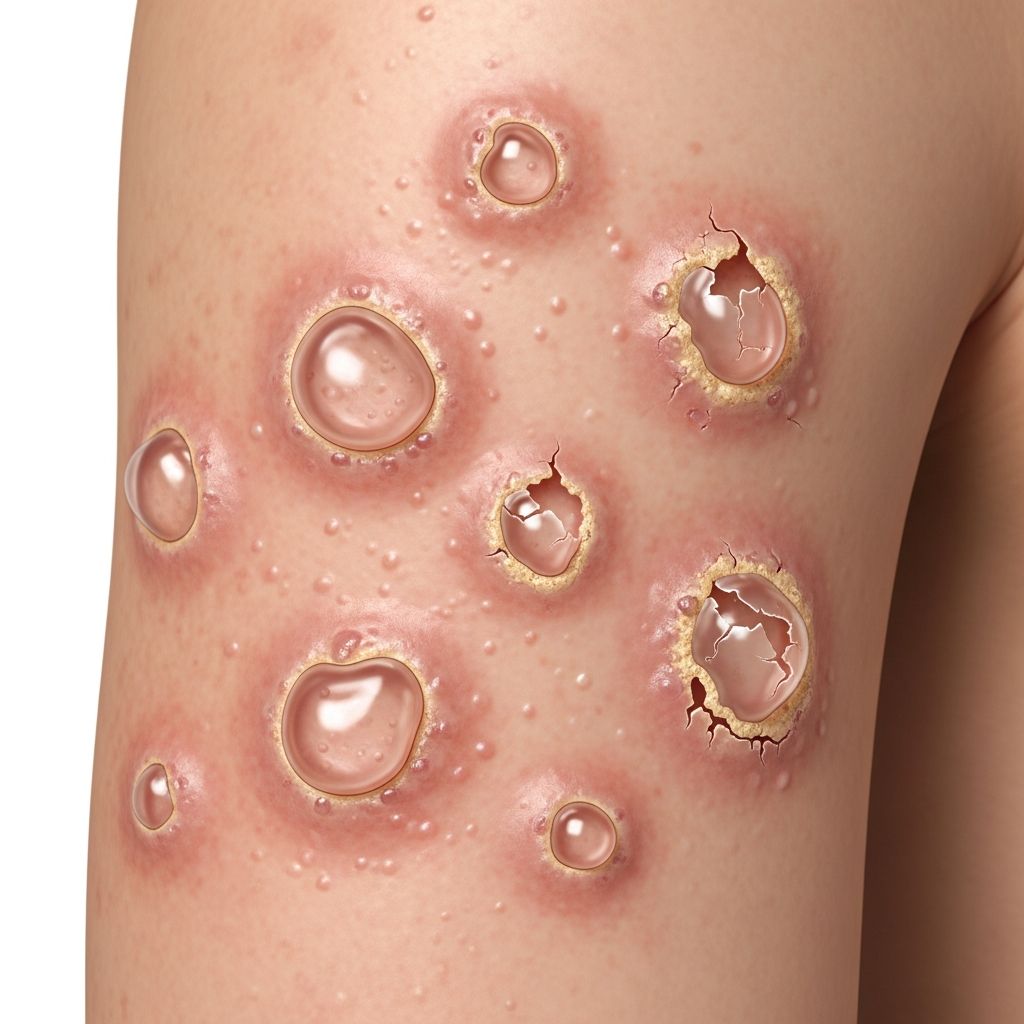
Bullous systemic lupus erythematosus (BSLE), also known as bullous eruption of SLE or vesiculobullous SLE, is a rare autoimmune subepidermal blistering disease occurring in patients with systemic lupus erythematosus (SLE). It manifests as tense vesicles, bullae, and erosions primarily on sun-exposed skin and is associated with autoantibodies targeting the dermoepidermal junction, particularly type VII collagen.
Introduction
Bullous SLE represents a distinct cutaneous manifestation of SLE, an autoimmune disorder where the immune system attacks healthy tissues, leading to widespread inflammation affecting skin, joints, kidneys, and other organs. In BSLE, this attack focuses on the skin’s basement membrane zone (BMZ), causing blister formation. BSLE may present as the initial sign of SLE in about one-third of cases, though it more commonly arises in patients with pre-existing SLE diagnosis, sometimes years later.
The condition is classified into three immunopathological types based on antibody targets, which cannot be differentiated clinically: Type I involves anti-type VII collagen antibodies (similar to epidermolysis bullosa acquisita or EBA); Type II targets BP180, BP230, or laminin; and Type III involves other BMZ components. Predisposing factors include ultraviolet B (UVB) exposure and drugs like hydralazine, penicillamine, or methimazole.
Demographics
BSLE is exceedingly rare, with most data derived from case reports and small series rather than large epidemiological studies. It predominantly affects individuals with established SLE, showing no strong gender bias beyond SLE’s female predominance (approximately 9:1 female-to-male). Age of onset varies, but it often occurs in young adults with SLE, which itself peaks between ages 15-44. Racial predispositions mirror SLE, with higher incidence in African Americans, Hispanics, and Asians compared to Caucasians.
In a review of 128 cases, significant comorbidities included lupus nephritis (50%, mostly class III/IV), neuropsychiatric SLE (7%), and hematologic abnormalities (45%). This underscores BSLE’s association with active, multisystem SLE flares.
Causes
The precise etiology of BSLE remains unclear, but it stems from autoantibodies attacking the dermoepidermal junction in SLE patients. Primarily, IgG antibodies target type VII collagen, a key anchoring fibril protein in the sublamina densa zone of the BMZ. This leads to subepidermal separation and blister formation.
Triggers include:
- UVB radiation: Blisters favor sun-exposed sites, exacerbating photo sensitivity common in SLE.
- Drugs: Hydralazine, D-penicillamine, and methimazole induce drug-induced lupus with bullous features.
- SLE flares: Often coincides with nephritis or other organ involvement, suggesting immune dysregulation.
Unlike typical SLE rashes, BSLE’s bullae result from specific anti-collagen VII pathogenicity, distinguishing it from non-bullous cutaneous lupus.
Clinical Features
BSLE presents abruptly with tense vesicles and bullae on normal or erythematous skin, predominantly in sun-exposed areas like the face, neck, upper trunk, proximal extremities, and lips. Mucosal involvement occurs in the mouth, with erosions and vesicles. Blisters are characteristically non-scarring, though healing may yield milia (small white cysts) or mild atrophy; post-inflammatory hyper- or hypopigmentation is common.
Rare patterns include erythema gyratum repens, a figurate erythema expanding centrifugally. Itching is variable, and urticaria is uncommon. Lesions heal rapidly (1-4 weeks) without intervention but recur with SLE activity.
Related Stories



| Site | Frequency |
|---|---|
| Face and neck | High |
| Trunk (supraclavicular, upper arms) | High |
| Proximal limbs | Moderate |
| Mucosa (oral) | Occasional |
| Covered areas | Rare |
Complications
Complications mirror underlying SLE but include BSLE-specific issues:
- Infections: Blister rupture predisposes to secondary bacterial infections.
- Esophagitis: Sloughing esophagitis from mucosal bullae.
- SLE flares: Frequent association with lupus nephritis (50%), neuropsychiatric disease (7%), and cytopenias.
- Scarring/milia: Mild, non-disfiguring.
- Treatment-related: Immunosuppressant side effects (e.g., infection risk, osteoporosis).
Lupus nephritis, if class III/IV, risks progression to end-stage renal disease without prompt management.
Diagnosis
Diagnosis requires:
- Established SLE per ACR/EULAR criteria.
- Subepidermal blisters, often photosensitive.
- Histology resembling dermatitis herpetiformis: neutrophilic infiltrates, papillary dermal edema, no basal vacuolization.
- Direct immunofluorescence (DIF): Linear/granular IgG, IgM, IgA, C3 at DEJ (u-serrated for type VII collagen).
- Serum autoantibodies: Anti-type VII collagen (type I), or others (ELISA/IIF).
Serration pattern analysis on DIF distinguishes u-serrated (anti-CVII, BSLE/EBA) from n-serrated (other anti-BMZ). Salt-split skin IIF shows floor staining in type I.
Differential Diagnoses
BSLE mimics other bullous diseases:
| Condition | Key Features | Immunopathology |
|---|---|---|
| Dermatitis Herpetiformis | Intensely pruritic, extensor surfaces | Granular IgA in dermal papillae |
| Epidermolysis Bullosa Acquisita | Mechano-bullous, scarring | Linear IgG at DEJ, u-serrated |
| Bullous Pemphigoid | Tense bullae, elderly | Linear IgG/C3 roof of split |
| Linear IgA Disease | Annular lesions | Linear IgA at lamina lucida |
| SLE with Blisters | Non-specific blisters in active SLE | Lupus band, no subepidermal neutrophils |
Treatment
Treatment targets SLE activity and blister control:
- First-line: Dapsone (0.5-2 mg/kg/day) induces rapid remission in 80-90% (monitor for hemolysis).
- Systemic: Corticosteroids, immunosuppressants (azathioprine, mycophenolate, rituximab for refractory cases).
- Symptomatic: Topical steroids, wound care, sun protection.
- SLE management: Hydroxychloroquine baseline; escalate for nephritis.
Refractory BSLE may respond to IVIG or anti-CD20 therapy.
Outcome
BSLE follows SLE’s relapsing course but blisters respond well to dapsone/SLE therapy. Nephritis portends poorer prognosis if uncontrolled. With modern management, most achieve control, though scarring/milia persist mildly. Long-term monitoring for SLE complications is essential.
Frequently Asked Questions (FAQs)
Q: Is bullous SLE contagious?
A: No, BSLE is an autoimmune condition, not infectious.
Q: Does BSLE always scar?
A: Rarely; most heal without scars, possibly with milia or pigment changes.
Q: Can sun exposure trigger BSLE?
A: Yes, UVB worsens lesions; strict photoprotection is advised.
Q: Is dapsone safe for all BSLE patients?
A: Screen for G6PD deficiency; effective but monitor blood counts.
Q: How is BSLE diagnosed?
A: Via clinical SLE + subepidermal blisters + DIF showing DEJ deposits.
References
- Bullous Systemic Lupus Erythematosus — MD Searchlight. 2023. https://mdsearchlight.com/skin-problems-and-treatments/bullous-systemic-lupus-erythematosus/
- Bullous systemic lupus erythematosus — DermNet NZ. 2023-10-01. https://dermnetnz.org/topics/bullous-systemic-lupus-erythematosus
- Bullous systemic lupus erythematosus: a review and update — PubMed (Clin Exp Dermatol). 2015-02. https://pubmed.ncbi.nlm.nih.gov/25358414/
- Lupus – Symptoms & causes — Mayo Clinic. 2023-11-23. https://www.mayoclinic.org/diseases-conditions/lupus/symptoms-causes/syc-20365789
- Lupus: What It Is, Symptoms, Causes & Treatment — Cleveland Clinic. 2023-09-08. https://my.clevelandclinic.org/health/diseases/4875-lupus
Similar Articles








Read full bio of Sneha Tete