Buschke-Ollendorff Syndrome: Key Facts On Symptoms & Diagnosis
Rare hereditary connective tissue disorder featuring skin nevi and sclerotic bone lesions like osteopoikilosis.
Buschke 6Ollendorff syndrome
Buschke 6Ollendorff syndrome (BOS) is a rare, autosomal dominant disorder characterized by the association of connective tissue nevi and skeletal abnormalities, primarily osteopoikilosis.
Also known as dermatofibrosis lenticularis disseminata, dermato-osteopoikilosis, and familial cutaneous collagenoma, it affects connective tissues with an estimated incidence of 1 in 20,000.
Introduction
Buschke 6Ollendorff syndrome refers to a rare, hereditary disorder affecting the connective tissues. First described in 1928 by Abraham Buschke and Helwig Ollendorff, it combines cutaneous manifestations such as multiple asymptomatic papules or plaques with radiographic bone changes.
The syndrome is typically benign, with skin lesions appearing in childhood and bone changes often incidental findings. While most cases are mild, some patients may experience complications like leg length discrepancy or joint issues requiring intervention.
Demographics
BOS exhibits no sex predilection and affects individuals worldwide, though underdiagnosis leads to limited epidemiological data. The mean age of presentation is around 6 years, with diagnosis often delayed until the mid-20s due to asymptomatic nature.
- Incidence: Approximately 1 in 20,000.
- Inheritance: Autosomal dominant with variable penetrance and expressivity.
- Age of onset: Skin lesions usually in childhood; bone changes may be detected at any age via imaging.
Family history is key, as up to 164 cases in large series show familial clustering.
Causes
BOS results from loss-of-function mutations in the LEMD3 gene (LEM domain containing 3) on chromosome 12q14, encoding an inner nuclear membrane protein that regulates TGF-β and BMP signaling pathways.
Mutations lead to dysregulation: LEMD3 normally antagonizes SMAD signaling; its deactivation causes excess bone formation (osteopoikilosis) and altered connective tissue production in skin.
- Genetic mechanism: Pathogenic variants like c.1323C>A (p.Y441X) disrupt LEMD3 function.
- Pathophysiology: Increased TGF-β signaling explains dermal fibrosis and elastic fiber abnormalities; focal nature suggests additional modifiers.
- Penetrance: Incomplete, explaining isolated skin or bone phenotypes in families.
Not all cases harbor LEMD3 mutations, suggesting genetic heterogeneity.
Clinical features
Skin lesions
Cutaneous manifestations are connective tissue nevi, presenting as asymptomatic, skin-colored to yellowish papules, nodules, or plaques, often coalescing. Common sites: trunk, buttocks, thighs, arms; symmetric distribution typical.
- Dermatofibrosis lenticularis disseminata: Small, uniform lichenoid papules.
- Juvenile elastomas: Larger, grouped yellowish nodules.
- Progression: Lesions increase in size/number with growth; nonpruritic, nontender.
Rarely, lesions on face or mucous membranes.
Skeletal abnormalities
Osteopoikilosis (most common): Multiple small, round-to-oval sclerotic bone foci on radiographs, especially pelvis, long bones, feet, hands. Asymptomatic, uniform spots 1-10 mm.
- Melorheostosis: Drip-like cortical hyperostosis along bone, causing pain, deformity, leg length discrepancy (LLD).
- Other: Osteopathia condensans disseminata; rare fractures or joint contractures.
Not all patients have both skin and bone involvement (dissociated forms).
Associated features
Occasional: Varus foot, LLD requiring surgery, mild growth delays. No visceral involvement typically.
Diagnosis
Diagnosis relies on clinical-radiological correlation, confirmed by histopathology and genetics.
Clinical suspicion
Multiple connective tissue nevi + osteopoikilosis on X-ray in a patient with family history.
Histopathology
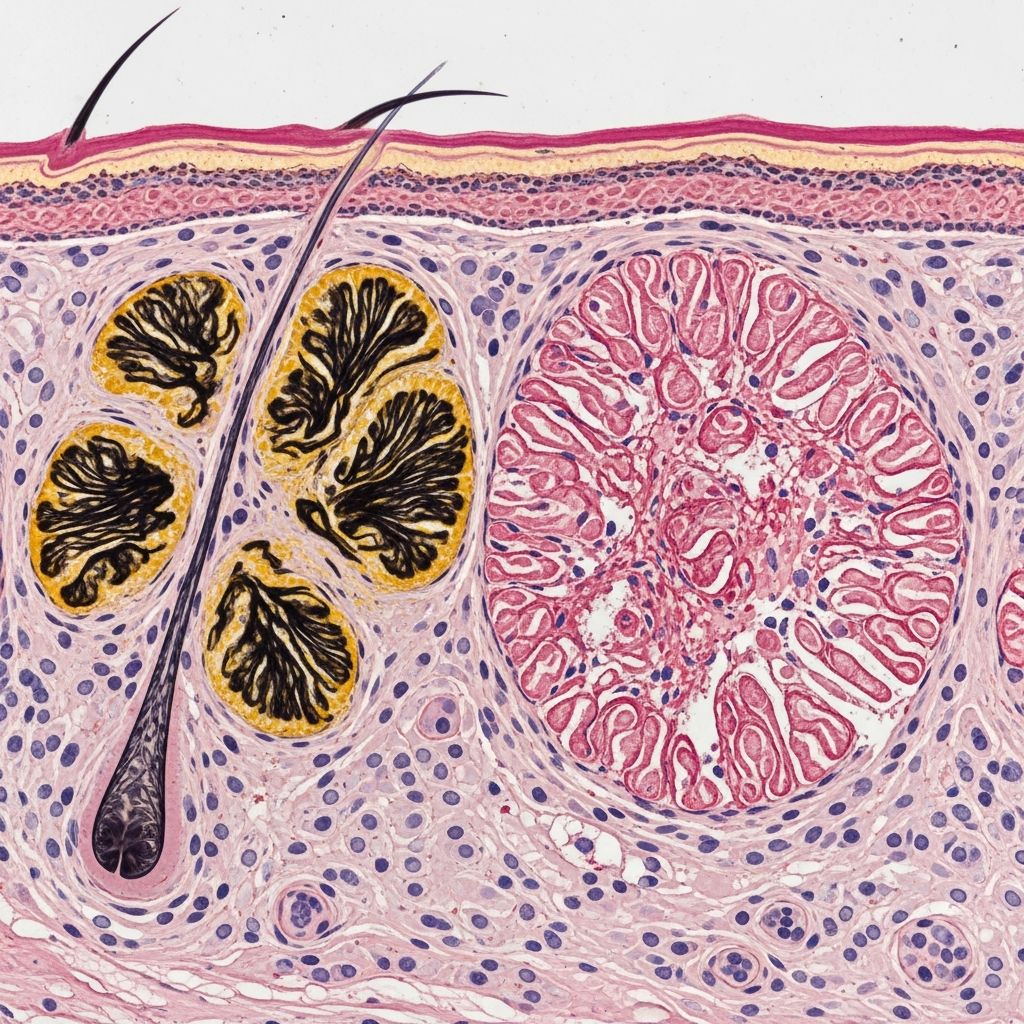
Skin biopsy shows dermal hamartoma:
- Thickened, haphazard collagen bundles; increased fibroblasts.
- Elastica-van Gieson: Thick, irregular elastic fibers clumped between collagen.
- Other: Interstitial mucin (Alcian blue), fibroplasia, edema.
Consistent with elastic or collagen nevus.
Imaging
| Modality | Findings |
|---|---|
| X-ray | Sclerotic spots (osteopoikilosis); hyperostosis (melorheostosis). |
| CT/MRI | Confirms bone lesions; assesses complications like LLD. |
Genetic testing
LEMD3 sequencing confirms diagnosis, especially in atypical cases.
Differential diagnosis
- Pseudoxanthoma elasticum (PXE): Similar skin but with retinal/vascular issues, no bone lesions.
- Isolated elastoma: Skin-only, sporadic.
- Elastosis perforans serpiginosa: Hyperkeratotic annular plaques.
- Others: Tuberous sclerosis, neurofibromatosis, lipomatosis.
Treatment
Generally supportive; no cure. Focus on cosmesis and complications.
- Skin: Observation; laser (CO2, Nd:YAG) or excision for prominent lesions.
- Bone: Orthotics/surgery for LLD, melorheostosis pain (bisphosphonates rarely).
- Genetic counseling: For families due to autosomal dominant inheritance.
Benign course; monitor growth in children.
Outcome
Excellent prognosis: Normal lifespan, no malignancy risk. Skin lesions persist but stable; bone changes non-progressive. Rare orthopedic interventions needed.
Early diagnosis prevents unnecessary biopsies; genetic confirmation aids family screening.
Frequently Asked Questions
What is Buschke-Ollendorff syndrome?
A rare genetic disorder with skin nevi and osteopoikilosis due to LEMD3 mutations.
Is BOS inherited?
Yes, autosomal dominant with variable expression.
Are skin lesions painful?
No, asymptomatic papules/plaques.
Do all patients have bone changes?
No, skin or bone may present alone.
How is BOS diagnosed?
Clinical, biopsy, X-ray, genetic testing.
Is treatment needed?
Usually not; symptomatic management only.
References
- Buschke-Ollendorff Syndrome: Absence of LEMD3 Mutation in an Affected Family. 6 JAMA Dermatology. 2006-04-01. https://jamanetwork.com/journals/jamadermatology/fullarticle/420913
- Buschke-Ollendorff syndrome presenting with asymptomatic plaques and osteopoikilosis. 6 PMC / NIH. 2022-05-25. https://pmc.ncbi.nlm.nih.gov/articles/PMC9186461/
- Buschke 6Ollendorff syndrome. 6 British Journal of Dermatology. 2016-04-01. https://academic.oup.com/bjd/article/174/4/709/6617916
Similar Articles




Read full bio of medha deb