Calcaneal Petechiae: Black Heel Diagnosis And Management Guide
Understanding black heel: causes, diagnosis, and management of this common sports-related skin condition.
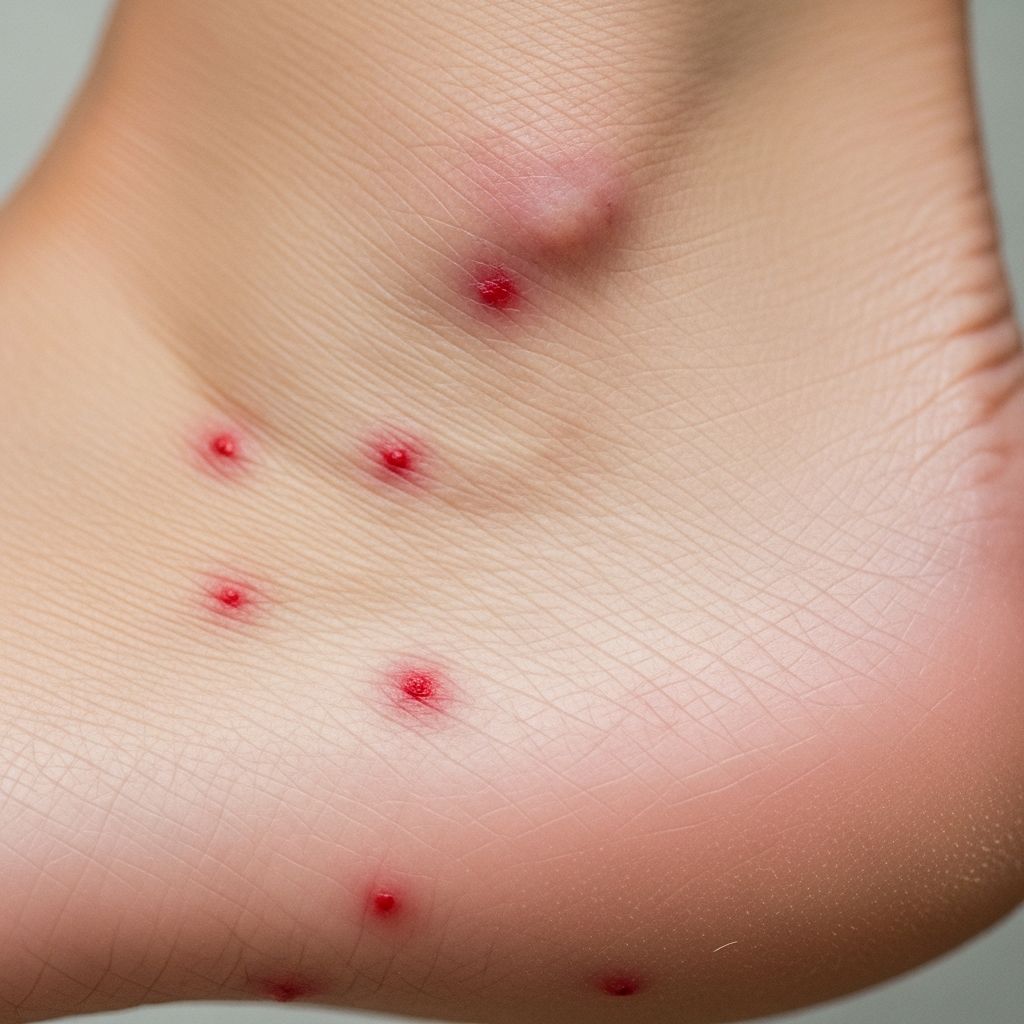
Calcaneal petechiae, also known as black heel or talon noir, is a benign dermatological condition characterized by multiple small, dark hemorrhagic spots on the posterior or posterolateral heel. It results from repetitive trauma, commonly seen in athletes participating in high-impact sports.
What is Calcaneal Petechiae?
Calcaneal petechiae refers to punctate hemorrhages confined to the stratum corneum of the heel, presenting as irregular black, bluish-black, or dark brown macules or plaques. These lesions are typically located just above the edge of the plantar skin on the posterior or posterolateral aspect of the heel. They are flat, non-raised, and usually asymptomatic, though mild tenderness may occur in some cases.
The condition is often termed ‘black heel’ due to its appearance, resembling ink spots, or ‘talon noir’ (French for black claw), highlighting its claw-like distribution on the heel edge. It is a form of post-traumatic hemorrhage where extravasated red blood cells are extruded through eccrine sweat ducts into the horny layer of the epidermis.
This entity is frequently underrecognized because it is painless and self-resolving, but it can mimic more serious pigmented lesions, prompting unnecessary biopsies if not properly diagnosed.
Who gets Calcaneal Petechiae?
Calcaneal petechiae predominantly affects adolescents and young adults engaged in sports involving repetitive heel impact or sudden directional changes. Common in basketball players (‘basketball heel’), tennis players (‘tennis heel’), runners (‘runner’s heel’), soccer players, volleyball players, and dancers. Alpinists and other athletes with high foot stress are also at risk.
- Athletes in court sports like basketball and tennis.
- Runners and track athletes.
- Team sports participants (soccer, volleyball).
- Individuals with occupations or hobbies involving hard surface pounding.
While more common in males due to participation rates, it can occur in anyone with sufficient trauma exposure. Patients often do not recall the exact onset, noticing lesions incidentally.
Clinical Features
Lesions appear as multiple discrete or coalescing brown-black or blue-black petechiae forming a central hyperpigmented macule or patch, often surrounded by satellite spots. Size varies from millimeters to several centimeters. They are confined to the epidermal layer and do not extend deeper.
Key characteristics:
- Location: Posterior or posterolateral heel, just proximal to the callus edge; rarely medial heel or sole.
- Color: Black, dark brown, or bluish; non-blanching.
- Morphology: Macular, flat; may have hyperkeratotic scale.
- Symptoms: Usually asymptomatic; occasional mild pain or pruritus.
- Duration: Persists 2-6 weeks unless traumatized further.
Associated findings may include overlying callus, but this is incidental, not causal. Histologically, lakes of hemorrhage within the stratum corneum are seen, with intact epidermis and no dermal involvement.
Pathophysiology
The mechanism involves shearing or pinching stress from abrupt foot contact with hard surfaces, rupturing papillary dermal capillaries. Extravasated erythrocytes travel transepidermally via eccrine ducts—the path of least resistance—forming pigment lakes in the stratum corneum.
Related Stories



Repetitive pounding or lateral shear forces during stops, pivots, or jumps exacerbate this. No vascular malformation or systemic disorder is involved; purely mechanical.
Diagnosis
Diagnosis is clinical, based on history of sports trauma and characteristic location/morphology. Dermoscopy may show roundish red globules or glomerular structures in the stratum corneum.
Confirmatory test: Superficial paring with a scalpel or curette. Petechiae clear completely, revealing normal skin beneath, unlike melanocytic lesions which retain pigment. No biopsy needed routinely, as it shows nonspecific hemorrhage.
Differential Diagnosis
Crucial to distinguish from malignant mimics:
| Condition | Key Differentiators |
|---|---|
| Melanoma | Irregular borders, asymmetry, color variation; does not clear with paring; dermal pigment. |
| Verruca (wart) | Hyperkeratotic, thrombosed capillaries; mosaic pattern; HPV positive. |
| Angioma | Vascular, blanchable; persists after paring. |
| Fixed drug eruption | Recurs in same site; history of medication. |
| Post-inflammatory hyperpigmentation | Brown, not black; follows inflammation. |
Other petechiae causes (e.g., thrombocytopenia, vasculitis) are generalized, not localized.
Treatment
No treatment required; self-resolves in 2-6 weeks with activity cessation. Sports can continue with padding.
Options for cosmesis or patient reassurance:
- Observation: Primary approach.
- Paring/debridement: Removes hyperkeratosis and pigment instantly.
- Cushioning: Heel cups, gel pads, felt pads, orthotics with arch support.
- Preventive: Thick socks, padded shoes, lubrication, training breaks.
Surgical excision unnecessary.
Prevention
- Wear well-cushioned, supportive footwear.
- Use heel pads/cups in athletic shoes.
- Double-layer thick socks.
- Gradual training increase; rest periods.
- Surface choice: Avoid overly hard courts when possible.
Prognosis
Excellent; complete resolution without scarring in 4-6 weeks. Recurs with resumed trauma. No systemic risks or complications.
Frequently Asked Questions
Is calcaneal petechiae dangerous?
No, it is benign and self-limiting, not cancerous.
Can I continue sports with black heel?
Yes, with padding; it won’t worsen significantly.
How long does it take to go away?
Typically 2-6 weeks after reducing trauma.
Does paring hurt?
Minimal discomfort; topical anesthetic if needed.
Is it contagious?
No, trauma-induced, not infectious.
References
- Calcaneal petechiae – PodiaPaedia — PodiaPaedia. Accessed 2026. https://podiapaedia.org/wiki/dermatology/trauma-to-the-skin/calcaneal-petechiae/
- 2014.3-15.Heel – Our Dermatology Online — Our Dermatology Online. 2014-07-15. https://www.odermatol.com/issue-in-html/2014-3-15-heel/
- Talon noire (Black heel, calcaneal petechiae…) – Dermatology Advisor — Dermatology Advisor. Accessed 2026. https://www.dermatologyadvisor.com/home/decision-support-in-medicine/dermatology/talon-noire-black-heel-calcaneal-petechiae-runners-heel-basketball-heel-tennis-heel-hyperkeratosis-hemorrhagica-pseudochromhidrosis-plantaris-chromidrose-plantaire-eccrine-intracorne/
- Petechiae: Causes, Symptoms, Diagnosis, & Treatment — WebMD. Accessed 2026. https://www.webmd.com/skin-problems-and-treatments/what-are-petechiae
- Calcaneal Petechiae – DoveMed — DoveMed. Accessed 2026. https://www.dovemed.com/diseases-conditions/calcaneal-petechiae
- Petechiae: What Are They, Causes, Treatment & Prevention — Cleveland Clinic. Accessed 2026. https://my.clevelandclinic.org/health/symptoms/21636-petechiae
Similar Articles








Read full bio of medha deb