Calcium: Benefits, Sources, Deficiency, and Risks
Unlock the essential role of calcium in bone health, muscle function, and overall wellness—discover top sources, daily needs, and potential risks.
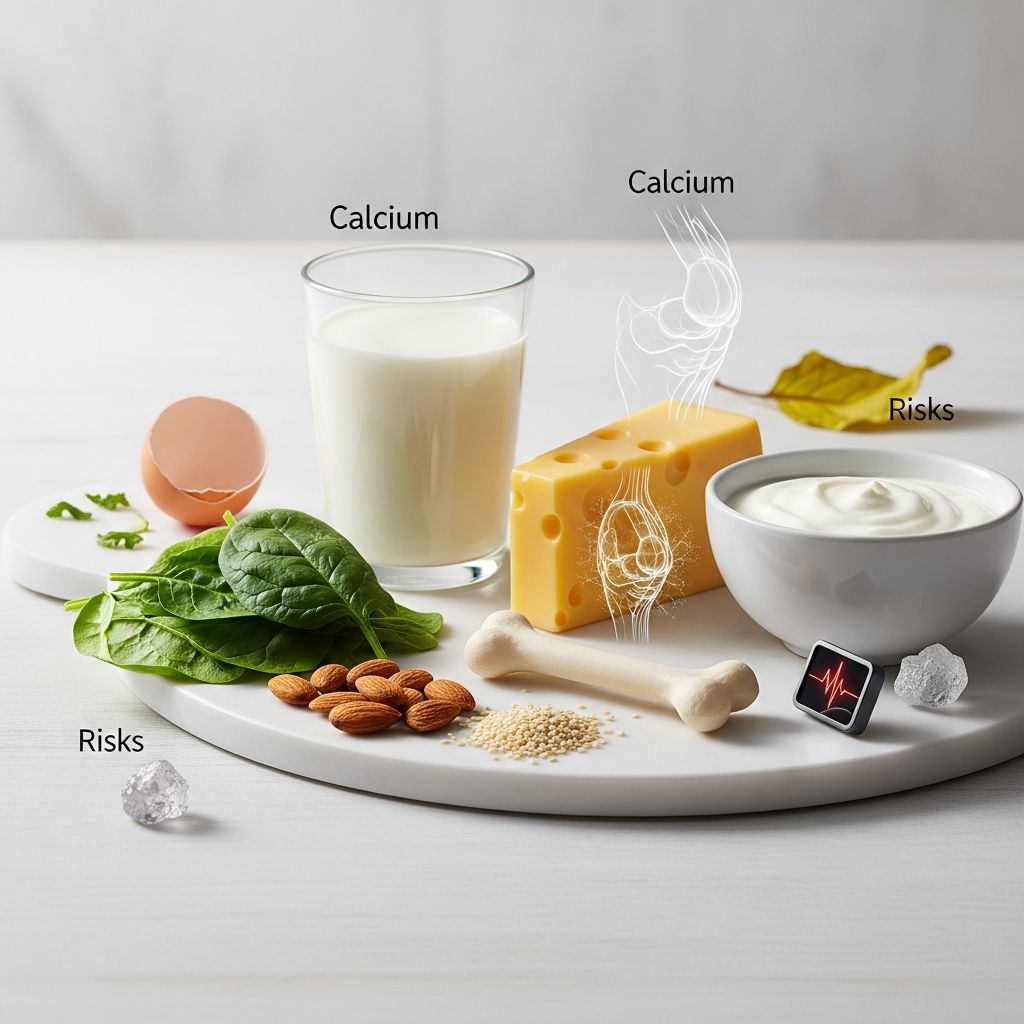
Calcium is one of the most essential minerals for human health, with over 99% stored in bones and teeth to provide structural support while the remainder circulates in blood to regulate vital functions like muscle contraction, nerve signaling, and blood clotting.
What Is Calcium?
Calcium serves as a foundational mineral in the body, integral to skeletal integrity and numerous physiological processes. Approximately 99% of the body’s calcium resides in bones and teeth, acting as a reservoir that maintains blood levels through hormones like parathyroid hormone (PTH) and calcitonin. When serum calcium drops, PTH triggers bone calcium release, kidney reabsorption, and intestinal absorption via vitamin D activation; elevated levels prompt calcitonin to counteract these effects.
Beyond bones, calcium facilitates blood clotting, nerve impulse transmission, muscle squeezing and relaxation, hormone release, and heartbeat regulation. Plasma calcium homeostasis is critical for life-sustaining activities, underscoring its integrative role.
Calcium Benefits
Calcium’s primary benefit is building and maintaining strong bones and teeth, preventing osteoporosis—a condition where bones weaken, increasing fracture risk. Lifetime adequate intake supports peak bone mass in youth and slows age-related loss.
Additional roles include muscle and nerve function, vascular tone, and hormonal regulation. Some evidence suggests cardiovascular protection; a Chinese cohort study linked 600 mg/day dietary calcium to lower all-cause and CVD mortality. It may reduce colon cancer risk by 30-46% at intakes over 1,000 mg/day. Combined with vitamin D, it modestly reduces fracture risk (RR=0.88) and bone loss (0.54% hip, 1.19% spine).
Calcium Needs by Age
Recommended Dietary Allowances (RDAs) vary by life stage, accounting for absorption rates that peak at 60% in infants and drop to 15-20% in adults, further declining with age. Adults absorb only 500-600 mg at once, so split doses are ideal.
| Age Group | Males (mg/day) | Females (mg/day) | Notes |
|---|---|---|---|
| 0-6 months | 200 | 200 | Adequate Intake (AI) |
| 7-12 months | 260 | 260 | AI |
| 1-3 years | 700 | 700 | |
| 4-8 years | 1,000 | 1,000 | |
| 9-13 years | 1,300 | 1,300 | |
| 14-18 years | 1,300 | 1,300 | Pregnant/lactating: 1,300 |
| 19-50 years | 1,000 | 1,000 | Pregnant/lactating: 1,000 |
| 51-70 years | 1,000 | 1,200 | |
| 71+ years | 1,200 | 1,200 |
Upper Limits (UL): 2,500 mg/day for adults; 2,000-3,000 mg for ages 1-18; 2,000 mg for over 50 to minimize risks. About 38% of Americans fall short of needs.
Top 12 Calcium-Rich Foods
Food sources are preferable over supplements for better absorption and fewer risks. Prioritize dairy, fortified items, and greens.
- Yogurt, plain low-fat (8 oz): ~400-450 mg (30-35% DV). Probiotics enhance absorption.
- Cheese, cheddar (1.5 oz): ~300-350 mg. Bioavailable but calorie-dense.
- Milk, low-fat (1 cup): ~300 mg. Fortified options boost vitamin D synergy.
- Fortified cereals (1 cup): ~200-1,000 mg. Check labels for added calcium.
- Tofu, calcium-set (½ cup): ~250-400 mg. Versatile vegan option.
- Sardines, canned with bones (3 oz): ~325 mg. Omega-3 bonus.
- Almonds (1 oz): ~75 mg. Heart-healthy fats included.
- Kale, cooked (1 cup): ~180 mg. Oxalates may reduce absorption slightly.
- Figs, dried (5 pieces): ~135 mg. Natural sweetness.
- Orange juice, fortified (1 cup): ~300 mg. Convenient for non-dairy.
- Broccoli, cooked (1 cup): ~60 mg. Add volume for cumulative intake.
- White beans, canned (1 cup): ~190 mg. Fiber-rich plant source.
Aim for 3 dairy servings daily or equivalents; combine sources for optimal intake.
Calcium Deficiency (Hypocalcemia)
Hypocalcemia (serum calcium <8.5 mg/dL) arises from vitamin D/magnesium shortages, hypoparathyroidism, medications (e.g., bisphosphonates), or critical illness. Chronic low intake leads to osteoporosis, fractures, and muscle cramps. Body compensates by leaching bone calcium, weakening skeleton over time. Infants/children risk rickets; adults face tetany, seizures in severe cases. Women post-menopause and elderly are vulnerable due to absorption decline.
Calcium Supplements: Types, Dosage, and Absorption
Supplements bridge dietary gaps but aren’t superior to food. Types:
- Calcium carbonate: 40% elemental calcium; take with meals for acid-dependent absorption. Cheapest, causes constipation/gas.
- Calcium citrate: 21% elemental; acid-independent, ideal for low stomach acid (e.g., elderly, PPI users). More pills needed.
- Others: Lactate (13%), gluconate (9%)—lower potency.
Dosage: 500-600 mg elemental calcium per dose, 2-3x/day with food. Pair with vitamin D (600-800 IU/day) for synergy. Greatest bone benefits in <35-year-olds at >1,500 mg/day total. A meta-analysis showed supplements (162-2,000 mg/day) improved lipids: LDL down 4.6 mg/dL, HDL up 1.9 mg/dL.
Related Stories



Calcium Side Effects and Risks
Excess risks hypercalcemia, kidney stones, constipation, iron/zinc interference. High supplemental doses (>1,000 mg/day) may vascularly deposit calcium, raising CVD concerns—though guidelines affirm safety up to UL in healthy adults. WHI follow-up noted 6% higher CVD mortality in women on calcium+vitamin D vs. placebo, but expert panels find no CVD link.
Kidney stones: >500 mg/day dietary/supplemental may lower oxalate but excess urine calcium risks formation. GI issues common with carbonate. Prostate cancer risk rises with >2,000 mg/day.
Who Should Take Calcium Supplements?
- Post-menopausal women: Higher RDA; at risk for osteoporosis.
- Lactose-intolerant/vegans: Limited dairy/fortified access.
- Elderly: Poor absorption; bone loss accelerates.
- Low dietary intake: < RDA despite efforts.
- Medical conditions: Osteoporosis, hyperparathyroidism, long-term steroid use.
Consult doctors; test 25(OH)D levels first.
Calcium Absorption Factors
Enhancers: Vitamin D, lactose, stomach acid. Inhibitors: Oxalates (spinach), phytates (grains), high fiber/protein. Age reduces efficiency; split doses maximize uptake.
Frequently Asked Questions (FAQs)
What is the best calcium supplement?
Calcium citrate for better absorption without food; carbonate if budget/tolerance allows. Choose USP-verified.
Can you take too much calcium?
Yes, exceeding UL (2,000-2,500 mg/day) risks stones, hypercalcemia, CVD.
Does calcium cause kidney stones?
Moderate intake lowers risk by binding oxalate; excess supplemental raises urine calcium.
Is calcium from food better than supplements?
Yes—fewer side effects, better absorption with nutrients.
Should I take calcium with vitamin D?
Yes, enhances absorption and bone benefits.
Who is at risk for calcium deficiency?
Elderly, post-menopausal women, vegans, low-dairy diets.
References
- The good, the bad, and the ugly of calcium supplementation — PMC/NCBI. 2018-10-10. https://pmc.ncbi.nlm.nih.gov/articles/PMC6276611/
- Calcium in diet — MedlinePlus. Accessed 2026. https://medlineplus.gov/ency/article/002412.htm
- Calcium – The Nutrition Source — Harvard T.H. Chan School of Public Health. Accessed 2026. https://nutritionsource.hsph.harvard.edu/calcium/
- Calcium – Health Professional Fact Sheet — NIH Office of Dietary Supplements. Accessed 2026. https://ods.od.nih.gov/factsheets/Calcium-HealthProfessional/
- Calcium and Vitamin D Supplement Safety Fact Sheet — Bone Health & Osteoporosis Foundation. Accessed 2026. https://www.bonehealthandosteoporosis.org/calcium-vitamin-d-supplement-facts/
- Calcium and calcium supplements: Achieving the right balance — Mayo Clinic. Accessed 2026. https://www.mayoclinic.org/healthy-lifestyle/nutrition-and-healthy-eating/in-depth/calcium-supplements/art-20047097
Similar Articles








Read full bio of medha deb