Calculating Your Cholesterol: A Complete Guide
Understand cholesterol calculations and what your numbers mean for your heart health.
Understanding Cholesterol Calculation
Cholesterol is a waxy substance found in your bloodstream and cells that plays an essential role in producing hormones, vitamin D, and digestive acids. However, understanding your cholesterol levels requires more than just knowing a single number. When you receive cholesterol test results, you’re actually getting multiple measurements that together paint a picture of your cardiovascular health. The most important of these measurements is low-density lipoprotein (LDL) cholesterol, often called “bad cholesterol” because it can accumulate in your arteries and contribute to heart disease.
Your total cholesterol measurement includes all types of cholesterol in your blood, but calculating your LDL cholesterol level—the primary concern for heart health—involves a mathematical formula. For decades, doctors have relied on calculation methods to estimate LDL cholesterol rather than measuring it directly, as direct measurement is more expensive and time-consuming. Understanding how these calculations work and which methods are most accurate can help you better interpret your test results and work with your healthcare provider to maintain optimal heart health.
The Traditional Friedewald Equation
Since 1972, the Friedewald equation has been the standard method for calculating LDL cholesterol levels. This formula subtracts HDL cholesterol and one-fifth of triglycerides from your total cholesterol to estimate LDL cholesterol. The equation assumes a fixed ratio between triglycerides and very low-density lipoprotein cholesterol (VLDL-C), making calculations straightforward and practical for laboratories worldwide.
However, the Friedewald equation has significant limitations. It was developed using data from only 448 patients and performs poorly when triglyceride levels are elevated or when LDL cholesterol is very low. The fixed ratio assumption doesn’t account for the fact that this ratio varies considerably among different people. This means that in certain patient populations—particularly those with high triglycerides or very low LDL levels—the Friedewald calculation can significantly underestimate or overestimate true cholesterol values, potentially leading to missed diagnoses or unnecessary treatment.
The Martin-Hopkins Equation: A Modern Advance
Recognizing the limitations of the Friedewald equation, Johns Hopkins physicians developed an improved calculation method called the Martin-Hopkins equation. This newer formula uses an adjustable factor for the triglyceride-to-VLDL-C ratio based on individual triglyceride levels and non-HDL-C measurements. Rather than assuming everyone has the same relationship between triglycerides and VLDL cholesterol, the Martin-Hopkins equation creates a personalized calculation using a chart with 180 different adjustment factors.
The adjustable factor in the Martin-Hopkins equation can range from 3.1 to 9.5 in patients with triglyceride levels below 400 mg/dL, providing much more precision than the Friedewald method’s fixed ratio of 5.0. This equation was derived from analysis of triglyceride-to-VLDL-C ratios in more than 1.3 million people, giving it a much stronger scientific foundation than its predecessor.
Clinical studies have demonstrated the superior accuracy of the Martin-Hopkins equation. In a large validation study analyzing data from over 5 million patients, the Martin-Hopkins equation most accurately classified LDL-C to the correct category in 89.6% of cases, compared to 83.2% for the Friedewald equation. The American Heart Association and American College of Cardiology now provide a Class IIa recommendation for using the Martin-Hopkins equation, particularly in patients with LDL-C levels less than 70 mg/dL.
The Extended Martin-Hopkins Equation for High Triglycerides
When triglyceride levels reach 400 mg/dL or higher, standard LDL calculation methods become even less reliable. To address this challenge, researchers developed an extended version of the Martin-Hopkins equation specifically designed for patients with very high triglycerides. This extended formula uses a stratified approach with a 240-cell stratification based on 40 triglyceride categories and 6 non-HDL-C categories.
Related Stories



The extended Martin-Hopkins equation dramatically improves accuracy in this challenging patient population. In a study of patients with triglyceride levels between 400 and 799 mg/dL, the extended Martin-Hopkins equation achieved 62.1% accuracy compared to only 19.3% for the Friedewald equation and 40.4% for the Sampson equation. Even with this improvement, however, healthcare providers should exercise caution when interpreting LDL calculations in patients with very high triglycerides, as some degree of measurement uncertainty remains.
The Sampson Equation
Another estimation method developed more recently is the Sampson equation, which uses least-squares regression analysis to estimate LDL cholesterol. This method incorporates more complex mathematical terms, including interaction and quadratic terms that account for non-linearity in the relationship between triglycerides and VLDL cholesterol. The Sampson equation provides an intermediate level of accuracy between the traditional Friedewald method and the Martin-Hopkins approach.
In validation studies, the Sampson equation correctly classified LDL-C to the appropriate category in 86.3% of cases, making it more accurate than Friedewald but less accurate than Martin-Hopkins. The Sampson method can be particularly useful in certain clinical contexts, though the Martin-Hopkins equation has become the preferred choice for most laboratories and healthcare systems worldwide.
Understanding Your Cholesterol Numbers
Your cholesterol test provides several key measurements that work together to assess your cardiovascular health:
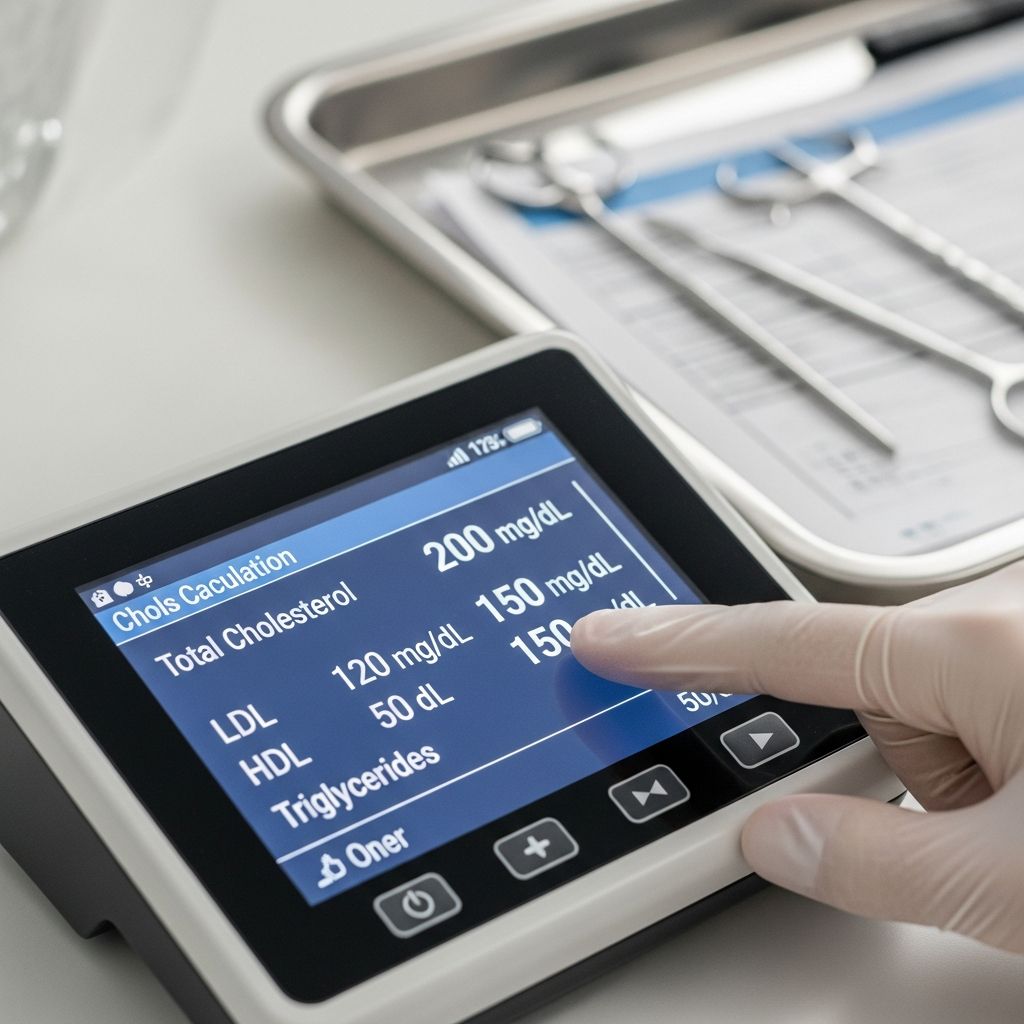
Total Cholesterol: This represents all cholesterol in your bloodstream. The target is typically less than 200 mg/dL, though this is just one piece of the overall picture.
LDL Cholesterol (“Bad” Cholesterol): This is the primary target of cholesterol management. LDL deposits cholesterol in arterial walls, contributing to plaque buildup and heart disease. Optimal LDL levels depend on your individual risk factors, but general guidelines suggest:
- Less than 100 mg/dL is considered optimal
- 100-129 mg/dL is near optimal
- 130-159 mg/dL is borderline high
- 160-189 mg/dL is high
- 190 mg/dL and above is very high
HDL Cholesterol (“Good” Cholesterol): This type of cholesterol actually protects your heart by removing other forms of cholesterol from your arteries. Higher levels are better, with 60 mg/dL or higher being protective against heart disease.
Triglycerides: These are another type of fat in your blood. Normal levels are less than 150 mg/dL. High triglyceride levels (especially above 400 mg/dL) increase cardiovascular risk and make LDL calculation more challenging.
Why Calculation Method Matters
The choice of calculation method can have real clinical consequences. Research shows that approximately one in five patients with Friedewald LDL-C measurements below 70 mg/dL would actually be reclassified to above 70 mg/dL using the Martin-Hopkins equation. In patients with both Friedewald LDL-C below 70 mg/dL and triglyceride levels between 150-399 mg/dL, nearly half would be reclassified to higher LDL levels by the Martin-Hopkins method.
These discrepancies can be clinically significant. If a patient’s true LDL level is actually above treatment targets but appears lower using an inaccurate calculation method, they may not receive necessary medication or lifestyle interventions to reduce their cardiovascular risk. Conversely, overestimation could lead to unnecessary treatment escalation.
Direct LDL Measurement
While calculation methods are convenient and cost-effective, direct measurement of LDL cholesterol is also possible. Many laboratories now offer direct LDL-C assays using chemical analysis rather than mathematical estimation. Direct measurement is increasingly recommended when triglyceride levels are extremely high (typically 400 mg/dL or greater) or when LDL levels are very low, as these are the situations where calculation methods are least accurate.
The trade-off with direct measurement is cost and complexity. Calculated LDL values are sufficient for most patients, particularly when the Martin-Hopkins equation is used. However, your healthcare provider may recommend direct measurement if your individual circumstances warrant it.
Fasting and Cholesterol Testing
Traditionally, cholesterol tests required fasting for 9-12 hours before the blood draw to ensure accurate measurements. The rationale was that food intake could temporarily raise triglyceride levels and potentially affect the accuracy of LDL calculations. However, research has shown that the Martin-Hopkins equation performs well even without fasting, potentially eliminating this inconvenience for patients.
Many laboratories and healthcare systems now accept non-fasting cholesterol tests as valid, particularly when using the Martin-Hopkins calculation method. This represents a practical advancement that makes it easier for people to get their cholesterol checked and monitored, removing a barrier to preventive healthcare.
Clinical Applications and Recommendations
Major medical organizations have adopted recommendations for LDL cholesterol management based on improved calculation methods. The American Heart Association and American College of Cardiology support using the Martin-Hopkins equation for patients with LDL-C less than 70 mg/dL, which includes many high-risk patients who require intensive cholesterol management.
The National Lipid Association, the European Atherosclerosis Society, and the European Federation of Clinical Chemistry and Laboratory Medicine have also endorsed the Martin-Hopkins equation. This widespread professional endorsement reflects the growing recognition of its superior accuracy across diverse patient populations and clinical settings.
Accuracy Across Different Patient Groups
The Martin-Hopkins equation has been validated to provide superior accuracy across multiple patient subgroups. Studies analyzing millions of patients found that the Martin-Hopkins method maintained its accuracy advantage when stratifying by age, sex, fasting status, and triglyceride levels. Additionally, the equation performed best in patients with specific conditions including atherosclerotic cardiovascular disease, hypertension, diabetes, chronic kidney disease, inflammation, and thyroid dysfunction.
This broad validation across diverse populations gives healthcare providers confidence in using the Martin-Hopkins calculation for virtually all patients, making it a truly universal improvement over the older Friedewald method.
What This Means for Your Health
Understanding how your cholesterol is calculated empowers you to have more informed conversations with your healthcare provider about your cardiovascular risk and treatment options. If you’ve had cholesterol testing, ask which calculation method was used to determine your LDL level. If your provider is still using the Friedewald equation, you might ask about switching to the Martin-Hopkins method, particularly if you have triglycerides in the 150-399 mg/dL range or LDL levels below 70 mg/dL.
More accurate LDL measurements mean better treatment decisions. If your true LDL level is higher than previously calculated, you and your provider may decide to intensify lifestyle modifications or adjust medications. Conversely, if better calculation methods show your LDL is actually lower than previously thought, it might allow for reduced medication in some cases.
Frequently Asked Questions
Q: Do I need to fast before a cholesterol test?
A: With modern calculation methods like Martin-Hopkins, fasting is generally not required. However, check with your healthcare provider or laboratory for their specific recommendations, as some may still prefer fasting for consistency.
Q: Which cholesterol calculation method does my laboratory use?
A: Most major laboratories and hospitals have adopted or are transitioning to the Martin-Hopkins equation due to its superior accuracy. You can contact your laboratory directly or ask your healthcare provider which method is being used for your results.
Q: Why is my LDL different at different clinics?
A: Different laboratories may use different calculation methods or analysis techniques. If significant differences appear, ensure you’re comparing tests from the same laboratory or discuss the discrepancy with your healthcare provider.
Q: What should my LDL cholesterol target be?
A: Target LDL levels depend on your individual cardiovascular risk factors. Generally, less than 100 mg/dL is optimal, but high-risk patients may need to achieve even lower levels (less than 70 mg/dL or lower). Your healthcare provider can determine your personal target based on your health history.
Q: How often should I have my cholesterol checked?
A: Adults should have cholesterol checked at least once every 4-6 years. If you have cardiovascular disease, diabetes, or other risk factors, more frequent monitoring may be recommended. Ask your healthcare provider about the appropriate testing schedule for you.
Q: Are there other factors besides cholesterol that affect heart disease risk?
A: Yes, many factors contribute to cardiovascular risk including blood pressure, smoking status, diabetes, physical activity, diet, and family history. Cholesterol is one important piece of the overall picture. Work with your healthcare provider to address all modifiable risk factors.
References
- Estimating Low-Density Lipoprotein Cholesterol in Patients With High Triglycerides — JAMA Network Open. 2021-08-13. https://jamanetwork.com/journals/jamanetworkopen/fullarticle/2785570
- Accuracy of 23 Equations for Estimating LDL Cholesterol in a Large Diverse Cohort — NIH/PubMed Central. 2023. https://pmc.ncbi.nlm.nih.gov/articles/PMC10289049/
- Validation of Friedewald, Martin-Hopkins and Sampson low-density lipoprotein cholesterol estimation equations — PLOS ONE. 2022-02-16. https://journals.plos.org/plosone/article?id=10.1371%2Fjournal.pone.0263860
- New cholesterol test may allow patients to pass on fasting, study shows — Johns Hopkins University. 2018-01-02. https://hub.jhu.edu/2018/01/02/cholesterol-test-without-fasting-more-accurate/
- Commonly used cholesterol calculation underestimates the heart disease risk — Science Daily. 2013-03-26. https://www.sciencedaily.com/releases/2013/03/130326141941.htm
- Comparison of LDL-C calculation by Friedewald and Martin/Hopkins equations — European Heart Journal. 2020. https://academic.oup.com/eurheartj/article/41/Supplement_2/ehaa946.2932/6004798
Similar Articles








Read full bio of medha deb