Candidiasis Pathology: Essential Guide To Accurate Diagnosis
Detailed histopathological analysis of candidiasis, from epidermal changes to diagnostic stains and key differentials.
Author: Dr. Ian H. McColl, Dermatopathologist, Pathlab Bay of Plenty, Tauranga, New Zealand
Introduction
Candidiasis, caused primarily by Candida albicans, represents a spectrum of infections from superficial mucocutaneous lesions to life-threatening disseminated disease. This yeast-like fungus exhibits both budding yeast and filamentous forms (pseudohyphae and hyphae), enabling tissue invasion. Superficial forms dominate clinical practice, while dissemination occurs almost exclusively in immunocompromised hosts with acquired or inherited deficiencies.
Histopathologically, candidiasis manifests with distinctive epidermal and inflammatory changes, crucial for diagnosis, especially when clinical correlation is ambiguous. Understanding these features aids in distinguishing it from mimics like bacterial or other fungal infections.
Histopathology
Sections from candidiasis biopsies reveal predominantly
spongiotic changes
in the epidermis, characterized by irregularacanthosis
(thickening of the spinous layer), mildspongiosis
(intercellular edema), and a superficial perivascular inflammatory infiltrate.- Epidermal alterations: Parakeratosis overlies the stratum corneum, often with embedded neutrophils forming
spongiform pustules
or microabscesses in the upper epidermis and cornified layer. - Inflammatory response: Neutrophils aggregate in small collections, mimicking impetigo or psoriasis. Deeper dermis shows lymphocytes and occasional eosinophils.
These changes reflect the host’s response to fungal invasion, with neutrophils targeting yeast forms in the keratin layer.
Characteristic Features
The hallmark of cutaneous candidiasis is
neutrophils within the stratum corneum
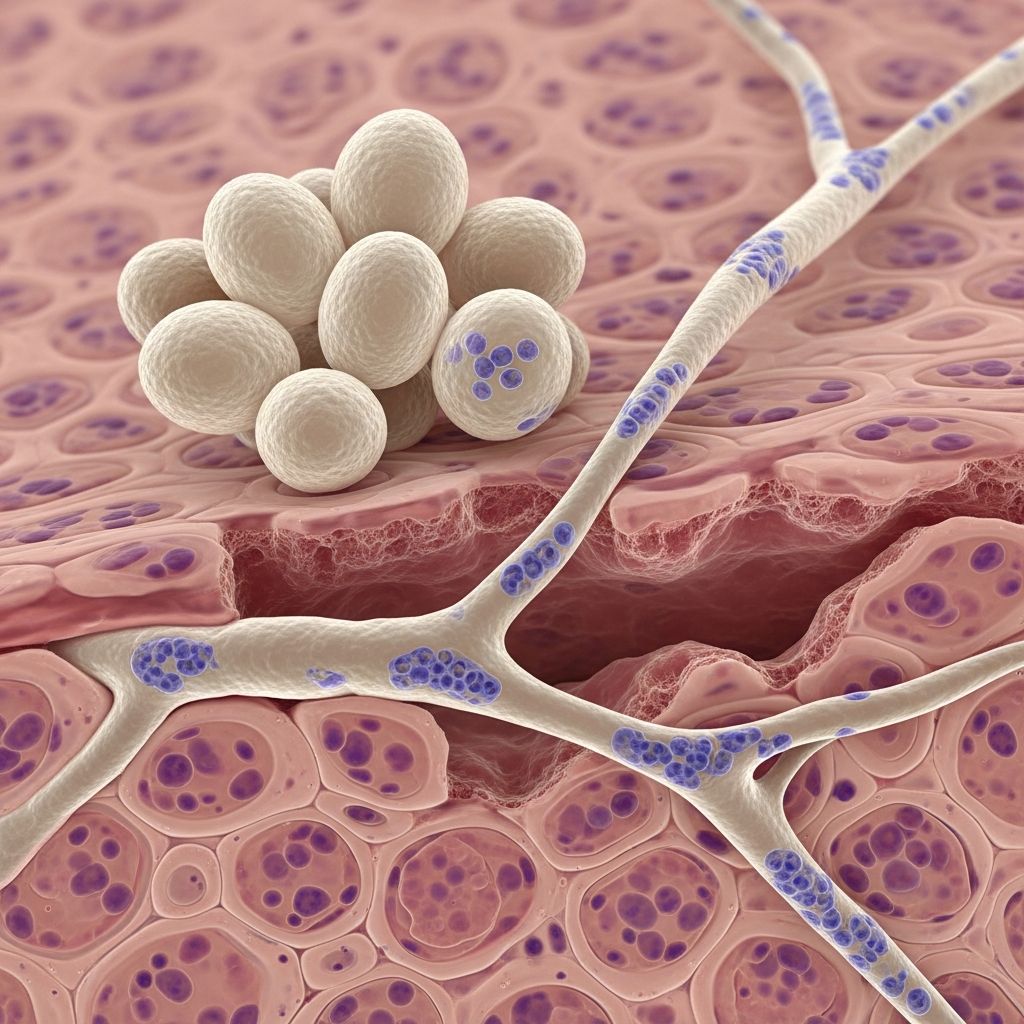
and superficial epidermis, forming spongiform pustules. Candida penetrates the keratinized epithelium, unlike dermatophytes confined to the cornified layer.

Fungal elements—yeast cells (2–6 µm, oval with buds) and elongated pseudohyphae (filamentous chains)—cluster in the parakeratotic stratum corneum.
Special Stains
Identification of Candida requires fungal-specific stains, as routine H&E may miss subtle forms:
| Stain | Appearance | Utility |
|---|---|---|
| Grocott methenamine silver (GMS) | Black staining of cell walls against green background | Highlights hyphae and yeasts sharply |
| Periodic acid-Schiff (PAS) | Magenta-red fungal elements | Excellent for yeast and pseudohyphae |
| Gram | Gram-positive yeasts and filaments | Distinguishes from bacteria |
PAS and GMS confirm diagnosis, with GMS superior for deeper hyphae.


Differential Diagnosis
Candidiasis shares features with several conditions, necessitating careful correlation:
- Impetigo: Spongiform pustules present, but Gram stain reveals bacterial colonies (not fungal on GMS/PAS). More acute purulence.
- Dermatophytosis (tinea): Similar pustules in tinea cruris/corporis, but special stains show septate hyphae without yeasts. Fungi limited to stratum corneum.
- Psoriasis: Neutrophilic collections (Munro microabscesses), but regular acanthosis, absent spongiosis, no fungi.
- Staphylococcal scalded skin syndrome: Cleavage at granular layer; no fungi.
Key discriminators: Candida’s invasive hyphae into viable epidermis and mixed yeast-hyphal forms.
Related Stories



Clinical Variants and Pathology
Intertrigo
Moist skin folds (groin, axillae) show hyperkeratotic changes with pseudohyphae overlying orthokeratotic stratum corneum. Irregular acanthosis and spongiosis mirror classic findings.
Chronic Mucocutaneous Candidiasis (CMC)
Persistent oral, skin, nail lesions in genetic immunodeficiencies (e.g., STAT1, AIRE mutations). Biopsies show hyperplastic epidermis with dense fungal burden.
- Chronic familial candidiasis: Early onset, T-cell defects.
- Candidiasis endocrinopathy syndrome: With hypoparathyroidism, Addison disease.
Nail and Paronychia
Chronic paronychia leads to onycholysis; histology shows subungual yeasts/hyphae with spongiosis.
Pathogenesis Insights
C. albicans dominates (70–80% cases), with non-albicans species (C. glabrata, C. tropicalis) in refractory infections. Virulence factors include proteinases degrading extracellular matrix and hyphal transition for invasion. Predispositions: moisture, diabetes, antibiotics, immunosuppression.
Invasive forms (candidaemia) rare in skin but show systemic yeast dissemination.
Diagnostic Approach
- Clinical suspicion in moist, erythematous lesions with satellites.
- KOH prep: Hyphae/yeasts (pseudohyphae pathognomonic).
- Biopsy for histopathology and culture.
- Culture: Speciate for azole-resistant strains (e.g., C. glabrata).
Frequently Asked Questions
What is the hallmark histological feature of candidiasis?
Neutrophils forming spongiform pustules in the stratum corneum, with invading pseudohyphae on special stains.
How does candidiasis differ histologically from dermatophytosis?
Candida shows yeasts + pseudohyphae invading epithelium; dermatophytes are septate hyphae in cornified layer only.
Which stains best detect Candida?
GMS (black) and PAS (magenta) highlight fungal elements; Gram for yeasts.
Is positive culture diagnostic?
No; Candida colonizes normal mucosa/skin. Correlate with histopathology.
What underlies chronic mucocutaneous candidiasis?
Genetic defects impairing IL-17 immunity (e.g., STAT3, DOCK8 mutations).
Conclusion
Candidiasis pathology hinges on recognizing spongiotic epidermis, neutrophilic spongiform pustules, and invasive fungal elements confirmed by GMS/PAS. Differentiation from mimics relies on stain-specific morphology. Early biopsy ensures accurate diagnosis, guiding antifungal therapy.
References
- Candidiasis Pathology — DermNet NZ. 2023. https://dermnetnz.org/topics/candidiasis-pathology
- Candidiasis Fact Sheet — College of Dental Hygienists of Ontario. 2022. https://cdho.org/factsheets/candidiasis/
- Candida Infection — DermNet NZ (CME). 2024. https://dermnetnz.org/cme/fungal-infections/candida-infection
- Tender White Lesions on the Groin — The Hospitalist (MDedge). 2023-05-15. https://blogs.the-hospitalist.org/content/tender-white-lesions-groin-0
- Oral Pathology Lecture 4: Oral Candidiasis — OralPathology.info. 2015. http://oralpathology.info/wp-content/uploads/2015/03/OralPathology-EN-Lecture-4.pdf
Similar Articles








Read full bio of medha deb