Cannabis Extract for Muscle Spasticity (Sativex)
Comprehensive guide to Sativex, the cannabis-based oromucosal spray for managing moderate to severe MS-related muscle spasticity.
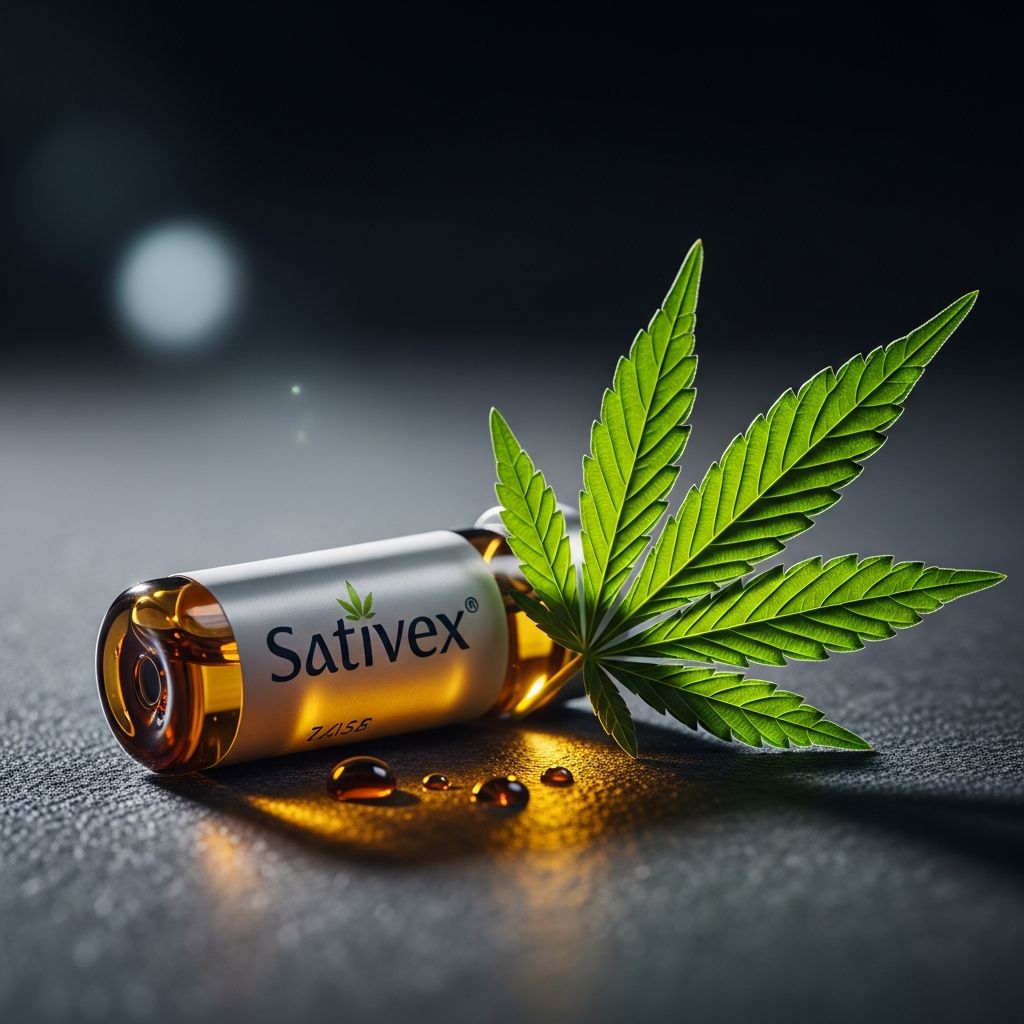
Sativex, also known as nabiximols, is an oromucosal spray containing extracts from the cannabis plant, specifically delta-9-tetrahydrocannabinol (THC) and cannabidiol (CBD) in approximately a 1:1 ratio. It is licensed for treating moderate to severe muscle spasticity in adults with multiple sclerosis (MS) who have not responded adequately to other antispasticity treatments.
About Cannabis Extract for Muscle Spasticity (Sativex)
Sativex represents the first cannabis-based medicine licensed in the UK and approved in over 25 countries for MS-related spasticity. Developed by GW Pharmaceuticals (now Jazz Pharmaceuticals), it is administered as a spray under the tongue or on the inside of the cheek, allowing for precise, as-needed dosing. Unlike traditional antispasticity drugs like baclofen or tizanidine, which are taken on a fixed schedule and may cause muscle weakness, Sativex targets the endocannabinoid system via CB1 and CB2 receptors in the brain, spinal cord, and peripheral nervous system, reducing spasticity without significantly impairing strength or mobility.
The medication’s botanical formulation is derived from cloned Cannabis sativa L. plants, ensuring standardized THC and CBD content. THC acts as a partial agonist at cannabinoid receptors, modulating excitatory (glutamate) and inhibitory (GABA) neurotransmission, which helps alleviate muscle stiffness and spasms. Clinical trials, including enriched designs, have shown statistically significant improvements in spasticity scores, with treatment differences of 0.52 to 1.9 points on the Numeric Rating Scale (NRS) compared to placebo.
In everyday practice, studies like MOVE 2 confirm its utility as an add-on therapy, where a greater proportion of patients achieved at least a 30% reduction in spasticity severity—a clinically meaningful threshold. Sativex is particularly valuable for patients experiencing intolerable side effects from standard therapies or incomplete symptom relief.
Before You Use Cannabis Extract for Muscle Spasticity (Sativex)
Consult your doctor before starting Sativex, especially if you have cardiovascular issues, psychiatric conditions, epilepsy, or a history of substance abuse, as THC may exacerbate these. It is contraindicated in patients with known cannabis allergies or severe renal/hepatic impairment. Inform your doctor of all medications, as interactions with strong CYP3A4 inhibitors (e.g., ketoconazole) can increase THC/CBD exposure, while inducers (e.g., rifampicin) may reduce efficacy.
Pregnancy and breastfeeding are not recommended due to limited data; effective contraception is advised during treatment. Driving or operating machinery is prohibited until you know how Sativex affects you, as it may impair psychomotor skills. Alcohol should be avoided, as it potentiates psychoactive effects.
How to Use Cannabis Extract for Muscle Spasticity (Sativex)
Sativex is self-administered via oromucosal spray. Start with a low dose: one spray on the tongue or inner cheek, wait 15 minutes, then add a second if needed. Subsequent doses can be taken every 15 minutes up to a maximum of 12 sprays in 3 hours during initiation.
After the first week, titrate based on response, not exceeding 8 sprays per day initially, up to a maintenance maximum of 12 sprays daily (delivering 52.4 mg THC/48 mg CBD). If no improvement after 14 days, discontinue. Each 10 ml vial (about 420 sprays) should last 2-3 weeks at maintenance dosing.
- Priming: For new vials, prime by spraying away from the face 3-4 times until a full spray appears.
- Administration: Tilt head back slightly; spray under tongue or cheek. Close mouth, avoid swallowing for 60 seconds, then swallow.
- Storage: Room temperature, away from children; discard after 28 days or 420 sprays.
Related Stories



Monitor for efficacy using the 0-10 NRS for spasticity; reassess with your doctor regularly.
Dosage
| Phase | Dosing Instructions | Max Sprays/Day |
|---|---|---|
| Initiation (Days 1-7) | 1 spray, wait 15 min, max 12 in 3 hours | 12 (tapered) |
| Maintenance (Week 2+) | Titrate per response | 12 |
| Discontinuation | No response after 14 days | N/A |
Dosing is patient-controlled and as-needed, offering flexibility over scheduled oral medications.
Further Information
Sativex improves spasticity without notable muscle weakness or reduced walking speed, as shown in three European RCTs involving over 500 MS patients. Improvements correlated weakly with strength (Motricity Index) or mobility (10-Meter Walk Test). Systematic reviews affirm its role as adjunctive therapy for refractory spasticity.
Beyond MS, exploratory trials examine stroke-related spasticity, with promising safety profiles. Patient-reported outcomes include better sleep, reduced pain, and improved quality of life.
Common Questions About Cannabis Extract for Muscle Spasticity (Sativex)
How quickly does Sativex work?
Effects may begin within 15-30 minutes, with full titration over 2-4 weeks.
Does Sativex cause a ‘high’?
Some patients experience mild psychoactive effects from THC, especially initially, but these often diminish with tolerance.
Is Sativex available in the US?
Not FDA-approved as of 2021 data; available in Europe, Canada, and UK.
Can Sativex be used with other MS drugs?
Yes, as add-on to baclofen/tizanidine when symptoms persist.
What if I forget a dose?
Use as-needed; no fixed schedule. Resume normal titration.
Side-Effects
Most side effects are mild and transient, resolving within days. Common ones (>10%): dizziness (25%), fatigue (10-20%), nausea, dry mouth.
- Frequent (1-10%): Headache, somnolence, balance issues, paresthesia.
- Rare/Serious (<1%): Psychosis, hallucinations, seizures, cardiovascular events (monitor in at-risk patients).
- Discontinuation: Taper if needed; no withdrawal syndrome typical.
In trials, adverse events led to 10-15% dropout, lower than some oral antispastics. Long-term use shows good tolerability.
Interactions
| Drug Class | Interaction | Advice |
|---|---|---|
| CYP3A4 Inhibitors (e.g., itraconazole) | Increased THC/CBD levels | Monitor; reduce dose |
| CYP3A4 Inducers (e.g., carbamazepine) | Decreased efficacy | May need higher dose |
| Antidepressants (e.g., amitriptyline) | Additive sedation | Caution |
| Alcohol | Enhanced impairment | Avoid |
No major food interactions; consistent with sublingual route.
Overdose
Overdosage causes extreme dizziness, hallucinations, nausea. Supportive care: monitor vitals, activated charcoal if recent ingestion. No specific antidote; symptoms self-limit.
Cautions
- Psychiatric history: Risk of exacerbation.
- Cardiovascular: THC may increase heart rate/BP.
- Elderly: Start low, monitor falls.
- Disability driving: Reassess after starting.
Important Information About All Medicines
Never share Sativex; take as prescribed. Report new symptoms promptly. Store securely.
References
- Cannabis Extract Improves Spasticity Without Increasing Weakness in Patients with MS — Cleveland Clinic Consult QD. 2020-11. https://consultqd.clevelandclinic.org/cannabis-extract-improves-spasticity-without-increasing-weakness-in-patients-with-ms
- Sativex — Curaleaf Clinic. Accessed 2026. https://curaleafclinic.com/medical-cannabis-glossaries/sativex/
- Cannabis in the Management of Multiple Sclerosis-Related Pain and Spasticity — ASRA. 2024-11-06. https://asra.com/news-publications/asra-newsletter/newsletter-item/asra-news/2024/11/06/cannabis-in-the-management-of-multiple-sclerosis-related-pain-and-spasticity
- Added benefit of Cannabis sativa for spasticity due to multiple sclerosis is not proven — IQWiG. 2012. https://www.iqwig.de/en/presse/press-releases/press-releases-detailpage_10815.html
- Sativex (nabiximols) — MS Trust. Accessed 2026. https://mstrust.org.uk/a-z/sativex-nabiximols
- Nabiximols (THC/CBD) oromucosal spray in patients with multiple sclerosis-associated neuropathic pain and spasticity — PubMed (Drugs R D). 2014. https://pubmed.ncbi.nlm.nih.gov/24671907/
- Cannabinoid Effect and Safety in Spasticity Following Stroke — PMC (Front Neurol). 2022. https://pmc.ncbi.nlm.nih.gov/articles/PMC9261779/
Similar Articles








Read full bio of Sneha Tete