Carcinoid Pathology: Cutaneous Neuroendocrine Tumor Overview
Detailed pathology of cutaneous carcinoid tumours, metastases, and associated skin manifestations from neuroendocrine origins.
Cutaneous carcinoid tumours are rare manifestations that typically represent metastatic deposits from primary neuroendocrine tumours (NETs) originating in the lung or gastrointestinal (GI) tract. These tumours arise from neuroendocrine cells, which are specialized cells capable of secreting bioactive amines and peptides. While primary cutaneous carcinoids are exceedingly uncommon, metastatic lesions can present on the skin, often accompanying systemic disease. Understanding their pathology is crucial for accurate diagnosis, as they may mimic other dermatological conditions. This article delves into the histopathological features, immunohistochemical profile, electron microscopy findings, and associated cutaneous syndromes seen in carcinoid pathology.
Clinical Context and Epidemiology
Carcinoid tumours belong to the broader family of neuroendocrine neoplasms, which can occur in various organs including the lungs, GI tract, pancreas, and rarely the skin. Cutaneous involvement usually signifies advanced disease with metastasis. According to comprehensive reviews, lung carcinoids, for instance, are slow-growing but can metastasize years after initial treatment. The incidence of neuroendocrine tumours is approximately 1–2 per 100,000 people annually, with cutaneous metastases being a late-stage feature. These tumours are more common in adults, with a slight female predominance in some subtypes like pulmonary carcinoids. Genetic predispositions such as multiple endocrine neoplasia type 1 (MEN1) increase risk.
In dermatology, patients may present with skin lesions alongside systemic symptoms. Early recognition is vital, as surgical resection offers curative potential in localized cases, though metastatic disease requires multimodal management.
Cutaneous Carcinoid Tumours
Cutaneous carcinoid tumours represent metastases from primaries in the lung or gastrointestinal system. These secondary lesions often appear as firm, reddish-brown nodules or plaques, typically on the trunk, extremities, or face. They are usually multiple and associated with advanced primary tumours that have spread via haematogenous or lymphatic routes. Liver metastases are common intermediaries, as hepatic involvement allows systemic release of tumour products leading to paraneoplastic syndromes.
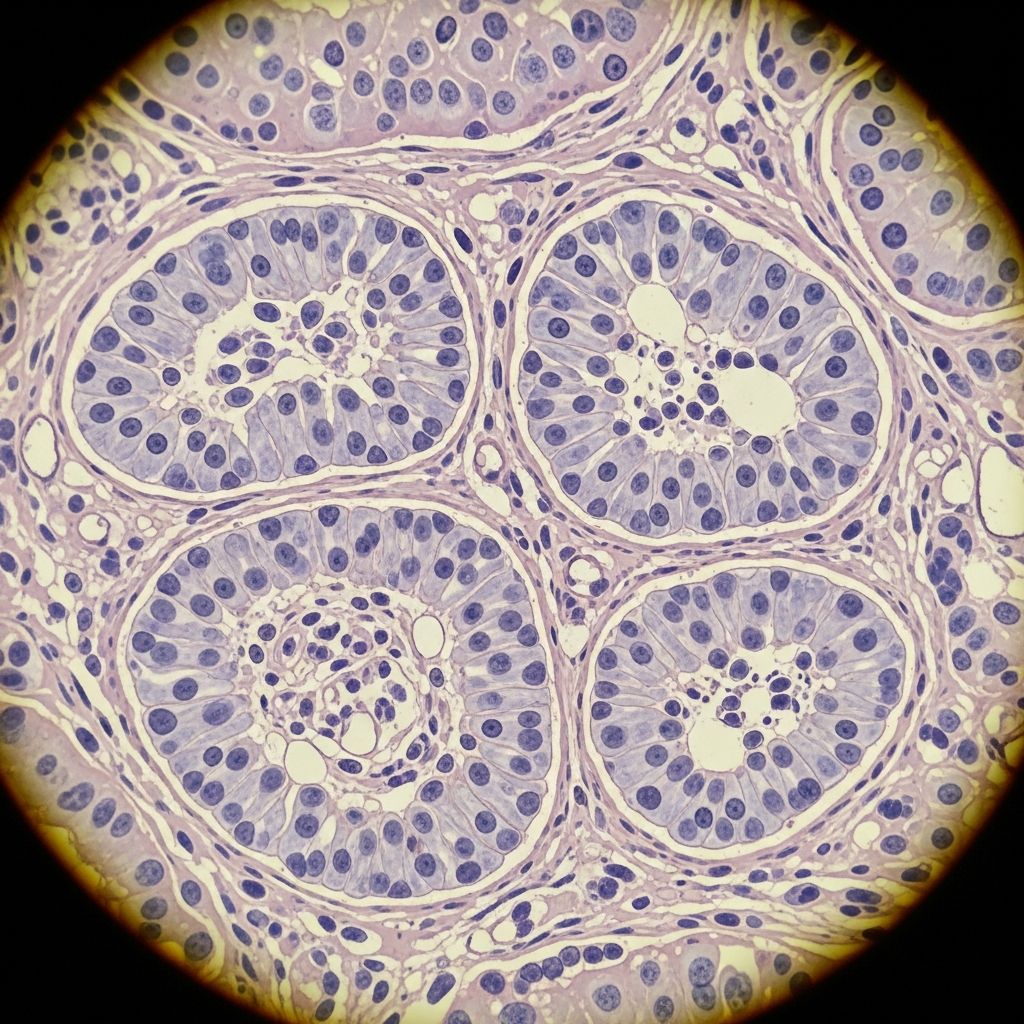
Histologically, these metastatic deposits infiltrate the dermis and subcutis. The tumours are composed of uniform, round to polygonal cells arranged in solid islands, nests, or trabeculae. Thin collagenous septa extend between the tumour nests, creating a characteristic organoid pattern. The cells exhibit moderate eosinophilic cytoplasm, round nuclei with finely dispersed ‘salt-and-pepper’ chromatin, and inconspicuous nucleoli—hallmarks of neuroendocrine differentiation.
- Cell morphology: Small to medium-sized polyhedral cells with granular cytoplasm.
- Growth patterns: Nesting, trabecular, or insular arrangements.
- Stroma: Delicate fibrous septa separating tumour nests.
- Mitotic activity: Low in typical carcinoids (<2 mitoses per 10 high-power fields); higher in atypical variants.
- Necrosis: Absent in typical; punctate in atypical.
Differential diagnoses include Merkel cell carcinoma, metastatic small cell carcinoma, adnexal tumours, and melanocytic lesions. Clinical correlation and ancillary studies are essential.
Cutaneous Features of Carcinoid Syndrome
Carcinoid syndrome is a paraneoplastic phenomenon resulting from the secretion of vasoactive substances like serotonin, bradykinin, and prostaglandins by advanced NETs. It affects up to 19% of patients with neuroendocrine tumours, particularly those with bowel primaries metastatic to the liver. Cutaneous manifestations are prominent and include:
- Flushing: The hallmark feature, occurring in 75% of cases. It presents as episodic, transient dilation of blood vessels leading to diffuse erythema, most pronounced on the face, neck, and upper chest. Foregut tumours (e.g., lung) cause bright red flushing lasting 30 minutes; midgut tumours yield pinkish-purple flushes lasting hours. Triggers include stress, alcohol, spicy foods, or anaesthetics.
- Rosacea-like changes: Persistent telangiectasia and papules resembling acne rosacea.
- Scleroderma: Facial skin thickening, fibrosis, and tightening, especially in midgut carcinoids, due to serotonin-induced connective tissue proliferation.
- Pellagra: Niacin deficiency secondary to serotonin overproduction diverting tryptophan metabolism. Manifests as the classic triad of photosensitive dermatitis (erythematous, scaly plaques on sun-exposed areas), diarrhoea, and dementia.
Related Stories



Other skin findings may include telangiectasias, acrocyanosis, and cutaneous metastases as nodular lesions. Diagnosis involves measuring urinary 5-hydroxyindoleacetic acid (5-HIAA), a serotonin metabolite, alongside imaging (CT, MRI, octreotide scans).
Microscopic Features
Microscopically, tumours are composed of solid islands and nests of uniform cells. Thin collagenous septa extend between the tumour nests, imparting a lobulated architecture. Tumour cells display neuroendocrine morphology: round to oval nuclei with ‘salt-and-pepper’ chromatin, absent or inconspicuous nucleoli, and finely granular cytoplasm. In lung carcinoids, typical variants show minimal pleomorphism, while atypical ones exhibit increased mitoses and focal necrosis.
Electron microscopy reveals dense-core neurosecretory granules in the cytoplasm, confirming neuroendocrine differentiation. These granules measure 100–250 nm and are eccentrically placed. Proliferation markers like Ki-67 are low (<3% in typical; 3–20% in atypical), aiding grading.
| Feature | Typical Carcinoid | Atypical Carcinoid |
|---|---|---|
| Mitoses/10 HPF | <2 | 2–10 |
| Necrosis | Absent | Punctate |
| Ki-67 Index | <3% | 3–20% |
| Prognosis | Excellent (90–95% 5-yr survival) | Moderate (60–70% 5-yr survival) |
| Metastatic Potential | Low | Higher |
Images provided by Dr Duncan Lamont, Waikato Hospital, typically show these nested patterns with fibrous stroma.
Immunohistochemistry
Tumour cells are positive for neuron-specific enolase (NSE), chromogranin A, and synaptophysin—core neuroendocrine markers. Additional positivity includes CD56, INSM1, and pan-cytokeratins. Hormone expression is common: serotonin (84%), pancreatic polypeptide, gastrin, ACTH, and others, often multifocal within the same tumour. S-100 highlights sustentacular cells in peripheral lesions; CD44 and Rb protein expression correlate with better prognosis in typical carcinoids. p53 and BCL-2 are typically negative but more expressed in atypical variants.
- Positive: Chromogranin A, Synaptophysin, NSE, CD56, INSM1.
- Variable: Serotonin, PP, Gastrin, ACTH.
- Prognostic: CD44 (favourable), Ki-67 (proliferation).
Differential Diagnoses
Key mimics include:
- Primary adnexal poroid neoplasm: Eccrine poroma or hidradenoma; lacks neuroendocrine markers.
- Hailey-Hailey disease: Acantholytic dermatosis; no nesting or granules.
- Merkel cell carcinoma: High Ki-67, CK20+ dot-like pattern.
- Metastatic small cell carcinoma: High mitoses, crushing artefact.
Immunoprofile and electron microscopy distinguish carcinoids.
Frequently Asked Questions (FAQs)
Q: What are cutaneous carcinoid tumours?
A: They are metastatic lesions from lung or GI neuroendocrine primaries, presenting as dermal nodules with nested uniform cells.
Q: How is carcinoid syndrome diagnosed?
A: Elevated urinary 5-HIAA, imaging, and clinical flushing/diarrhoea; octreotide scans confirm NETs.
Q: What are the main skin features of carcinoid syndrome?
A: Flushing (75%), rosacea, scleroderma, pellagra from niacin deficiency.
Q: How are lung carcinoids graded pathologically?
A: Typical (<2 mitoses/10 HPF, no necrosis); atypical (2–10 mitoses, punctate necrosis).
Q: What is the prognosis for metastatic carcinoid?
A: Guarded if unresectable; surgery curative for localized, somatostatin analogues for advanced.
Management Implications
Pathological confirmation guides therapy: resection for resectable disease, somatostatin analogues (e.g., lanreotide) for symptomatic control, PRRT or chemotherapy (temozolomide) for progressive metastases. In cutaneous cases, biopsy is pivotal for staging and syndrome management.
References
- Lung Carcinoids: A Comprehensive Review for Clinicians — PMC/NCBI. 2023-11-01. https://pmc.ncbi.nlm.nih.gov/articles/PMC10670505/
- Carcinoid syndrome: Causes and Management — DermNet NZ. 2024-01-15. https://dermnetnz.org/topics/carcinoid-syndrome
- Carcinoid pathology — DermNet NZ. 2024-02-20. https://dermnetnz.org/topics/carcinoid-pathology
- Pancreatic Neuroendocrine Tumours (PNETs) — Patient.info. 2023-05-10. https://patient.info/doctor/endocrine-disorders/pancreatic-endocrine-tumours
Similar Articles








Read full bio of medha deb