Cardiac Output: Understanding Heart Function and Blood Flow
Learn how cardiac output measures heart efficiency and blood circulation throughout your body.
What Is Cardiac Output?
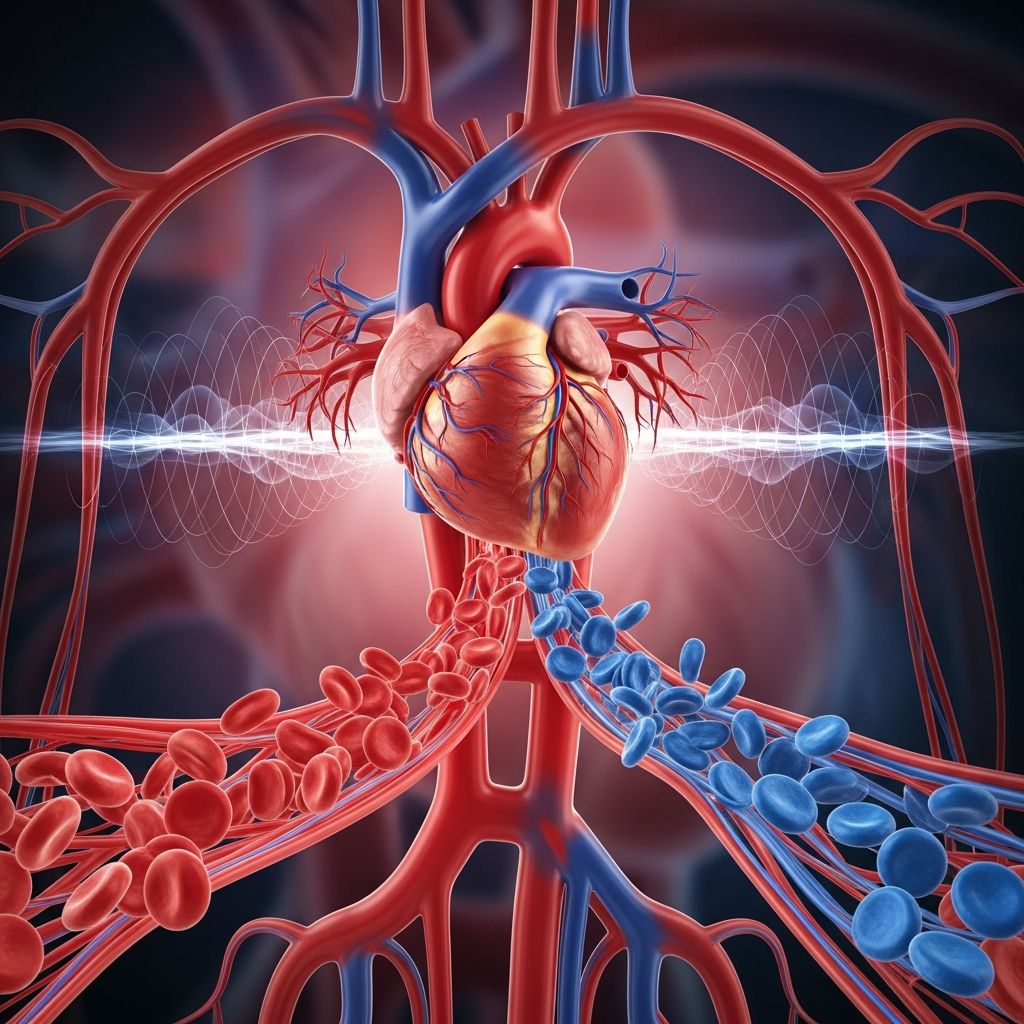
Cardiac output (CO) represents the amount of blood pumped by the heart each minute and serves as the fundamental mechanism through which blood circulates throughout your body. This critical measurement ensures adequate blood flow to the brain, heart, lungs, kidneys, and all other vital organs. The body continuously adjusts cardiac output in response to changing metabolic demands, particularly during periods of physical exertion, stress, or rest.
Your cardiac output is not static; it dynamically adapts to meet your body’s oxygen requirements. During exercise, your cardiac output can increase dramatically to supply muscles with oxygen-rich blood. Conversely, during rest, your cardiac output decreases to match your lower metabolic needs. This sophisticated regulation involves the autonomic nervous system, endocrine system, and various paracrine signaling pathways working in concert.
How Is Cardiac Output Measured?
Cardiac output is quantified in liters per minute (L/min), making it easy to track and compare measurements across different individuals and conditions. The normal range for resting cardiac output in healthy adults is approximately 5 to 6 liters per minute. However, this value can vary significantly based on individual factors such as body size, fitness level, and metabolic state.
Elite athletes can achieve cardiac outputs exceeding 35 liters per minute during intense exercise, demonstrating the remarkable adaptability of the cardiovascular system. This substantial increase allows their hearts to deliver oxygenated blood to working muscles at rates far exceeding those of sedentary individuals. Understanding these ranges helps healthcare providers assess whether your heart is functioning optimally.
The Formula: Heart Rate and Stroke Volume
Cardiac output is calculated using a straightforward mathematical relationship:
Cardiac Output (CO) = Heart Rate (HR) × Stroke Volume (SV)
This equation reveals that your cardiac output depends on two independent variables that your heart can modulate. Understanding each component is essential to comprehending how your cardiovascular system meets physiological demands.
Heart Rate
Heart rate refers to the number of times your heart beats per minute, typically ranging from 60 to 100 beats per minute at rest in healthy adults. The sinoatrial node, your heart’s natural pacemaker, automatically depolarizes at an intrinsic rate, establishing this baseline rhythm. Your heart rate increases during exercise, emotional stress, or when your body requires more oxygen, and decreases during rest or relaxation.
The autonomic nervous system precisely controls heart rate adjustments. The sympathetic nervous system increases heart rate during fight-or-flight responses, while the parasympathetic nervous system decreases it during rest-and-digest states. This dual control system ensures your heart rate matches your moment-to-moment physiological needs.
Stroke Volume
Stroke volume represents the volume of blood ejected by the heart with each contraction or beat. Unlike the total amount of blood filling the heart at the end of diastole (end-diastolic volume or EDV), not all this blood is expelled during systole. The volume remaining in the heart after contraction is called the end-systolic volume (ESV). Therefore, stroke volume is calculated as:
Related Stories



Stroke Volume = End-Diastolic Volume − End-Systolic Volume
A normal ejection fraction—the proportion of blood ejected relative to total volume—ranges from 55 to 65%. This metric provides clinicians with valuable information about overall heart function and efficiency.
Factors Affecting Cardiac Output
Multiple physiological factors influence both heart rate and stroke volume, thereby affecting overall cardiac output. These determinants work through complex neural, hormonal, and mechanical pathways.
Preload
Preload refers to the degree of stretch of the ventricular muscle fibers at the end of diastole, directly related to end-diastolic volume. According to the Frank-Starling law of the heart, increasing preload enhances stroke volume up to an optimal point. Greater venous return fills the ventricles more completely, allowing the heart muscle fibers to contract more forcefully during systole. However, excessive preload can impair contractility, establishing an upper limit to this beneficial relationship.
Afterload
Afterload represents the resistance the heart must overcome to eject blood, determined by arterial pressure and vascular resistance. When afterload increases—such as during high blood pressure or vasoconstriction—the heart must work harder to pump blood forward. Excessive afterload reduces stroke volume and can impair cardiac output. Conversely, decreased afterload, achieved through vasodilation, facilitates easier blood ejection and improved cardiac output.
Contractility
Contractility describes the intrinsic ability of heart muscle to generate force independently of preload and afterload changes. Positive inotropic agents—substances that enhance contractility—increase the force of ventricular contractions, thereby improving stroke volume and cardiac output. The sympathetic nervous system enhances contractility through catecholamine release, while certain medications and conditions can impair this crucial function.
Vascular Compliance
Arterial compliance, or the elasticity of blood vessels, influences the volume of blood able to leave the heart. Stiff, non-compliant arteries create increased resistance, effectively increasing afterload and reducing stroke volume. Healthy, elastic arteries accommodate blood flow more readily, facilitating improved cardiac output.
Organ Systems Involved in Cardiac Output Regulation
Cardiac output depends on the heart and the entire circulatory system, including veins and arteries. This integrated system works synergistically to maintain adequate perfusion pressure and blood flow distribution.
The Heart
The heart directly modulates cardiac output by altering heart rate and contractility. Changes to myocardial muscle function, electrical conduction, and valvular integrity directly affect how much blood is pumped with each beat.
Arterial System
Arterial compliance, vasoconstriction, and arterial pressure directly affect the volume of blood able to leave the heart, thereby influencing stroke volume and cardiac output. The arterial system must maintain appropriate pressure and resistance to facilitate efficient blood ejection.
Venous System
The venous system returns blood to the heart, establishing preload. Venous constriction increases venous return and preload, enhancing stroke volume. Conversely, venous dilation reduces preload and may decrease cardiac output.
The Physiological Function of Cardiac Output
The amount of blood pumped by the heart is closely matched to global metabolic needs through Fick’s principle, which demonstrates that oxygen delivery must equal oxygen consumption in the tissue capillary beds. Changes in cardiac output from baseline are directly proportionate to changes in total body oxygen requirements.
During times of physiologic stress—such as exercise, illness, or emotional distress—cardiac output increases to ensure adequate tissue perfusion and oxygen delivery. This compensatory response prevents tissue hypoxia and maintains cellular function. The body continuously monitors oxygen saturation and blood pressure, adjusting cardiac output accordingly through complex regulatory mechanisms.
Clinical Assessment of Cardiac Output
Healthcare providers assess cardiac output through various diagnostic methods to evaluate heart function and identify cardiovascular abnormalities. One important assessment parameter is ejection fraction, calculated as stroke volume divided by end-diastolic volume.
Normal Ejection Fraction
A normal ejection fraction ranges from 55 to 65%, indicating healthy ventricular function. When ejection fraction is greater than or equal to 50%, the heart is ejecting adequate proportions of its blood volume with each beat.
Diastolic Dysfunction
When ejection fraction remains greater than or equal to 50% but cardiac output is reduced, the condition is termed diastolic heart failure or heart failure with preserved ejection fraction (HFpEF). In this scenario, dysfunction typically results from the ventricle becoming stiff and unable to relax normally during diastole. Echocardiography is warranted to assess these conditions when cardiac dysfunction becomes evident.
Systolic Dysfunction
When ejection fraction declines to 40% or less, the condition becomes systolic heart failure or heart failure with reduced ejection fraction (HFrEF). This represents a more severe form of cardiac dysfunction where the heart cannot generate sufficient force to eject adequate blood volumes, resulting in reduced cardiac output and inadequate tissue perfusion.
Special Circumstances: High-Output Heart Failure
While most heart failure involves normal or reduced cardiac output, high-output heart failure represents a unique condition. In this scenario, the heart initially functions normally but cannot keep pace with the body’s escalating demand for blood flow. People with high-output heart failure have a cardiac output of 8 liters or more per minute—significantly exceeding the normal 5 to 6 liters per minute range.
High cardiac output distinguishes high-output heart failure from other heart failure types. Various medical conditions cause excessive vasodilation, setting off a cascade of events leading to higher cardiac output demands. While elevated cardiac output is beneficial during exercise, it becomes pathological when sustained by abnormal mechanisms. Identifying the underlying cause is critical for implementing appropriate treatment strategies tailored to that specific etiology.
Factors That Influence Cardiac Output Changes
Several physiological and pathological conditions modulate cardiac output. Exercise represents the most common physiological stimulus, during which cardiac output can increase dramatically to supply working muscles. Your sympathetic nervous system accelerates heart rate, enhances contractility, and increases preload during exercise, all working together to boost cardiac output.
Medications can also alter cardiac output. Cardiac glycosides, for example, work by increasing intracellular calcium concentration, which strengthens heart muscle contractions and increases stroke volume, thereby raising cardiac output. This mechanism makes these agents useful in treating certain heart conditions.
Fever, anemia, hyperthyroidism, and pregnancy all increase metabolic demands and necessitate elevated cardiac output. Conversely, hypothyroidism, hypoxemia, and heart disease may reduce cardiac output below normal levels, compromising tissue perfusion and oxygen delivery.
Clinical Significance and Monitoring
Monitoring cardiac output provides crucial information about cardiovascular function and metabolic status. In clinical settings, abnormal cardiac output suggests underlying pathology requiring investigation and treatment. Patients with heart disease, shock, sepsis, or other critical conditions require careful assessment of cardiac output to guide therapy and predict outcomes.
Understanding your cardiac output and the factors influencing it empowers both patients and healthcare providers to optimize cardiovascular health. Regular exercise, stress management, appropriate diet, and medication adherence all support healthy cardiac output and cardiovascular function.
Frequently Asked Questions
What is a normal cardiac output?
Normal cardiac output ranges from 5 to 6 liters per minute in healthy adults at rest. However, during exercise or times of physiologic stress, cardiac output can increase substantially to meet increased oxygen demands.
How can cardiac output be increased?
Cardiac output increases through elevation of heart rate, stroke volume, or both. Exercise, sympathetic nervous system activation, medications, and certain hormones can all increase cardiac output. The body naturally adjusts cardiac output to match metabolic demands.
What does low cardiac output indicate?
Low cardiac output suggests the heart is not pumping sufficient blood to meet the body’s oxygen demands. This may indicate heart failure, cardiogenic shock, severe dehydration, or other serious conditions requiring medical evaluation and treatment.
How is cardiac output measured clinically?
Cardiac output can be measured using various methods including echocardiography, cardiac catheterization, pulmonary artery catheterization, or non-invasive techniques such as impedance cardiography. Your healthcare provider will determine which measurement method is most appropriate for your clinical situation.
Can I improve my cardiac output?
Yes, regular aerobic exercise is one of the most effective ways to improve cardiac output. Exercise training increases stroke volume and allows the heart to pump more efficiently. Additionally, maintaining a healthy weight, managing stress, controlling blood pressure, and avoiding smoking support optimal cardiac output.
What relationship exists between heart rate and cardiac output?
Heart rate directly affects cardiac output according to the equation CO = HR × SV. Increasing heart rate increases cardiac output, assuming stroke volume remains constant. However, extremely elevated heart rates may actually reduce stroke volume, creating a less efficient cardiac output.
References
- Physiology, Cardiac Output — National Center for Biotechnology Information (NCBI), National Library of Medicine. 2024. https://www.ncbi.nlm.nih.gov/books/NBK470455/
- Cardiac Output Definition — Cleveland Clinic Heart, Vascular & Thoracic Institute. 2024. https://my.clevelandclinic.org/departments/heart/patient-education/dictionary
- High-Output Heart Failure from Arteriovenous Dialysis Access — Cleveland Clinic Journal of Medicine. 2023. https://www.ccjm.org/content/92/6/362
- What Is High-Output Heart Failure? — Cleveland Clinic. 2024. https://my.clevelandclinic.org/health/diseases/24660-high-output-heart-failure
- Cardiac Glycosides: Types and What They Treat — Cleveland Clinic. 2024. https://my.clevelandclinic.org/health/treatments/24512-cardiac-glycosides
- Heart Rate Reserve — Cleveland Clinic. 2024. https://my.clevelandclinic.org/health/articles/24649-heart-rate-reserve
Similar Articles








Read full bio of Sneha Tete