Central Centrifugal Cicatricial Alopecia
Understanding causes, symptoms, diagnosis, and management of CCCA, a scarring alopecia primarily affecting women of African descent.
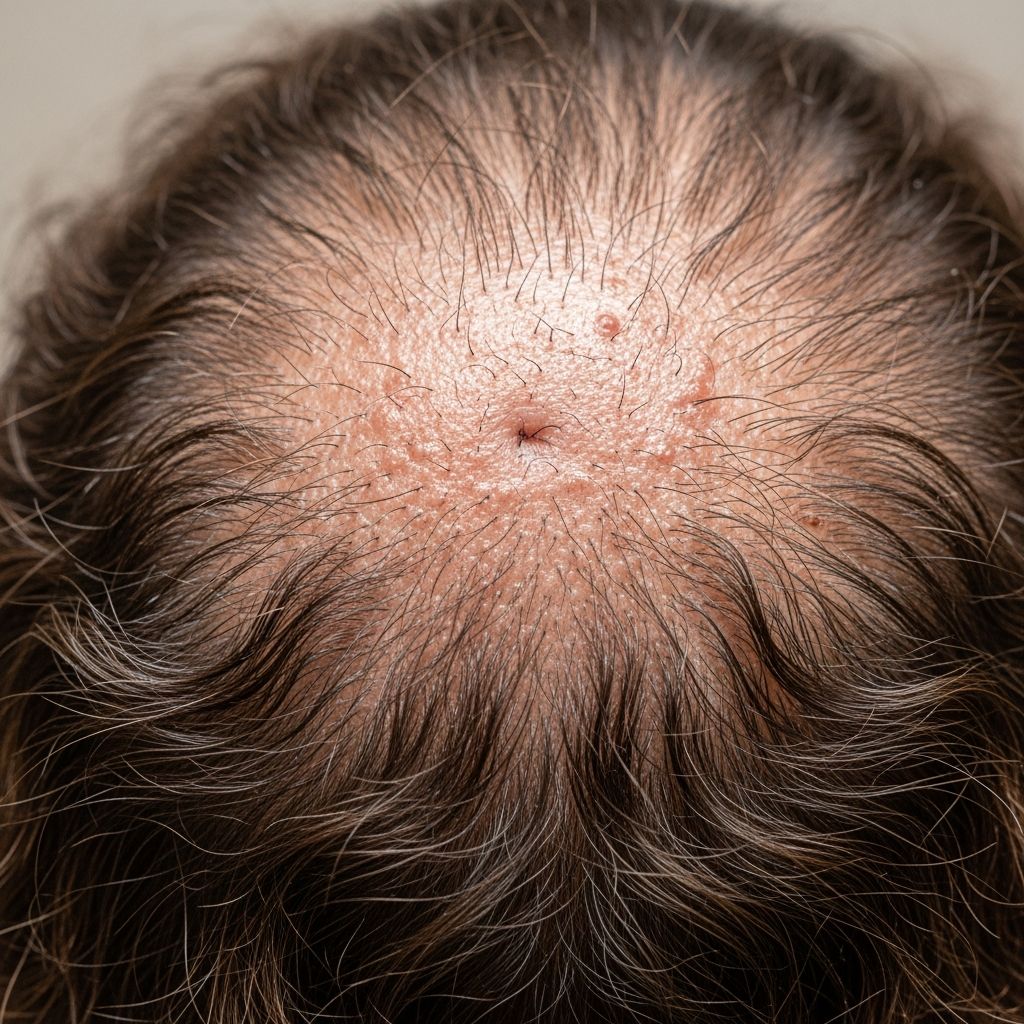
Central centrifugal cicatricial alopecia (CCCA), also known as hot comb alopecia or follicular degeneration syndrome, is a form of scarring alopecia that primarily affects women of African descent. It is characterized by progressive hair loss beginning at the crown of the scalp and expanding outward in a centrifugal pattern, leading to permanent hair loss due to fibrosis and destruction of hair follicles.
What is Central Centrifugal Cicatricial Alopecia?
CCCA is a primary scarring alopecia where inflammation around the hair follicle causes irreversible damage, replacing follicles with scar tissue. Unlike non-scarring alopecias, once follicles are destroyed, hair cannot regrow in those areas. The condition typically starts subtly with hair thinning at the vertex (crown) and progresses slowly, often over years.
It predominantly affects postmenopausal Black women but can occur in men and women of other ethnicities. Familial clustering suggests a genetic predisposition, with increased risk in those with a history of keloid scarring or uterine fibroids.
Who Gets Central Centrifugal Cicatricial Alopecia?
CCCA most commonly affects women of African descent, with prevalence estimates up to 7.5% in African American women in some studies. Age of onset is usually between 30 and 60 years, though it can start earlier. Men are less frequently affected but share similar clinical features.
- Primarily women of African or Afro-Caribbean heritage
- Postmenopausal women at higher risk
- Familial tendency observed
- Associated with keloids and uterine fibroids in affected individuals
What Causes Central Centrifugal Cicatricial Alopecia?
The exact cause remains multifactorial and incompletely understood. Several theories explain the pathogenesis:
- Traumatic/chemical injury: Historically linked to hot comb use with petroleum-based pomades, causing thermal injury and follicular degeneration. Modern cases often lack this history, suggesting other factors.
- Premature desquamation of inner root sheath: Leads to separation of inner and outer root sheaths, allowing irritants like chemicals or bacteria to trigger inflammation.
- Fibroproliferative disorder: Genetic tendency toward excessive scarring (fibrosis) around follicles.
- Autoimmune factors: Lymphocytic inflammation attacking follicles.
- Genetic predisposition: Runs in families; mutations in hair shaft proteins like cytokeratin 75 implicated.
While hair styling practices (tight braids, chemical relaxers) may exacerbate CCCA, they are not the primary cause in most cases. Minimizing trauma is still recommended.
What are the Clinical Features of Central Centrifugal Cicatricial Alopecia?
Hair loss begins at the vertex or mid-scalp, expanding centrifugally in a symmetrical pattern. Early signs include hair breakage and thinning; advanced stages show smooth, shiny scalp with absent follicular openings.
| Stage | Features |
|---|---|
| Early | Subtle thinning, breakage at crown; possible itch, burning, tenderness |
| Intermediate | Patchy alopecia with scaling, erythema, pustules; perifollicular inflammation |
| Late | Widespread scarring, shiny scalp, no follicles; permanent loss |
Related Stories



Symptoms vary: many are asymptomatic, but up to 50% report pruritus, burning, pain, or scaling. Dermoscopy reveals loss of follicular ostia and white peripilar halos.
Diagnosis of Central Centrifugal Cicatricial Alopecia
Diagnosis relies on clinical examination, history, dermoscopy, and scalp biopsy. Exclude differentials like androgenetic alopecia, traction alopecia, frontal fibrosing alopecia, or discoid lupus.
- Clinical: Centrifugal pattern from crown; soft scalp, mild hyperpigmentation
- Dermoscopy: Absent follicular openings, white halos
- Biopsy: Essential; from active edge. Shows premature desquamation, perifollicular lymphocytes, fibrosis, reduced follicles. Distinguish from lichen planopilaris by location and lesser interface changes.
Photographic scales assess severity. Early diagnosis prevents extensive scarring.
Treatment of Central Centrifugal Cicatricial Alopecia
No cure exists; goals are halting progression, reducing inflammation, symptom relief, and possible regrowth in non-scarred areas. Early intervention yields best results.
Non-medical measures:
- Avoid chemical relaxers or limit to every 6-8 weeks by professionals
- Minimize heat styling, traction hairstyles
- Gentle cleansing with antiseborrheic shampoos (e.g., every 1-2 weeks)
Medical therapy: Multimodal, anti-inflammatory focus.
| Treatment | Dosage/Regimen | Duration |
|---|---|---|
| Topical corticosteroids (high potency, e.g., clobetasol) | Daily or alternate days | 3-6 months |
| Intralesional triamcinolone (TAC) | 5-10 mg/mL, every 4-6 weeks | 3-6 months |
| Oral doxycycline/tetracycline | 100 mg BID | 3-6 months |
| Topical calcineurin inhibitors (e.g., tacrolimus) | Twice daily | Ongoing |
| Immunosuppressants (e.g., hydroxychloroquine) | For severe cases | Per response |
Response is slow (months); combine therapies for severe cases. Monitor for side effects like skin atrophy or hypopigmentation.
What is the Outcome for Central Centrifugal Cicatricial Alopecia?
Untreated, CCCA progresses to extensive central baldness. With early treatment, progression halts in 50-70% of cases; regrowth possible in active areas. Late-stage scarring is irreversible. Long-term maintenance therapy often needed.
Patient education on gentle hair care improves compliance and outcomes.
Frequently Asked Questions
Q: Is there a cure for CCCA?
A: No cure exists, but early treatment can halt progression and relieve symptoms.
Q: Can hair regrow in CCCA?
A: Regrowth possible in non-scarred, inflammatory areas with prompt anti-inflammatory therapy; scarred areas are permanent.
Q: Does hair straightening cause CCCA?
A: It may contribute but is not the sole cause; genetic factors predominate.
Q: How is CCCA diagnosed?
A: By clinical pattern, dermoscopy, and scalp biopsy showing characteristic inflammation and fibrosis.
Q: What shampoos help with CCCA?
A: Antiseborrheic shampoos (e.g., ketoconazole) reduce scaling and inflammation; use 1-2 times weekly.
References
- A Practical Approach to Centrifugal Cicatricial Alopecia — Journal of Clinical and Aesthetic Dermatology. 2023. https://jcadonline.com/practical-approach-centrifugal-cicatricial-alopecia/
- Central centrifugal cicatricial alopecia — Skin Health Info (BAD Patient Hub). 2024. https://www.skinhealthinfo.org.uk/condition/central-centrifugal-cicatricial-alopecia/
- Central centrifugal cicatricial alopecia — DermNet NZ. 2024. https://dermnetnz.org/topics/central-centrifugal-cicatricial-alopecia
- Central Centrifugal Cicatricial Alopecia — StatPearls, NCBI Bookshelf. 2023-10-05. https://www.ncbi.nlm.nih.gov/books/NBK559187/
- Central Centrifugal Cicatricial Alopecia — JAMA Dermatology. 2020. https://jamanetwork.com/journals/jamadermatology/fullarticle/2768748
- Central Centrifugal Cicatricial Alopecia — Scarring Alopecia.org. 2024. https://scarringalopecia.org/central-centrifugal-cicatricial-alopecia
Similar Articles








Read full bio of medha deb