Central Nervous System: What It Is and How It Works
Understanding your CNS: The brain and spinal cord control everything your body does.
Understanding the Central Nervous System
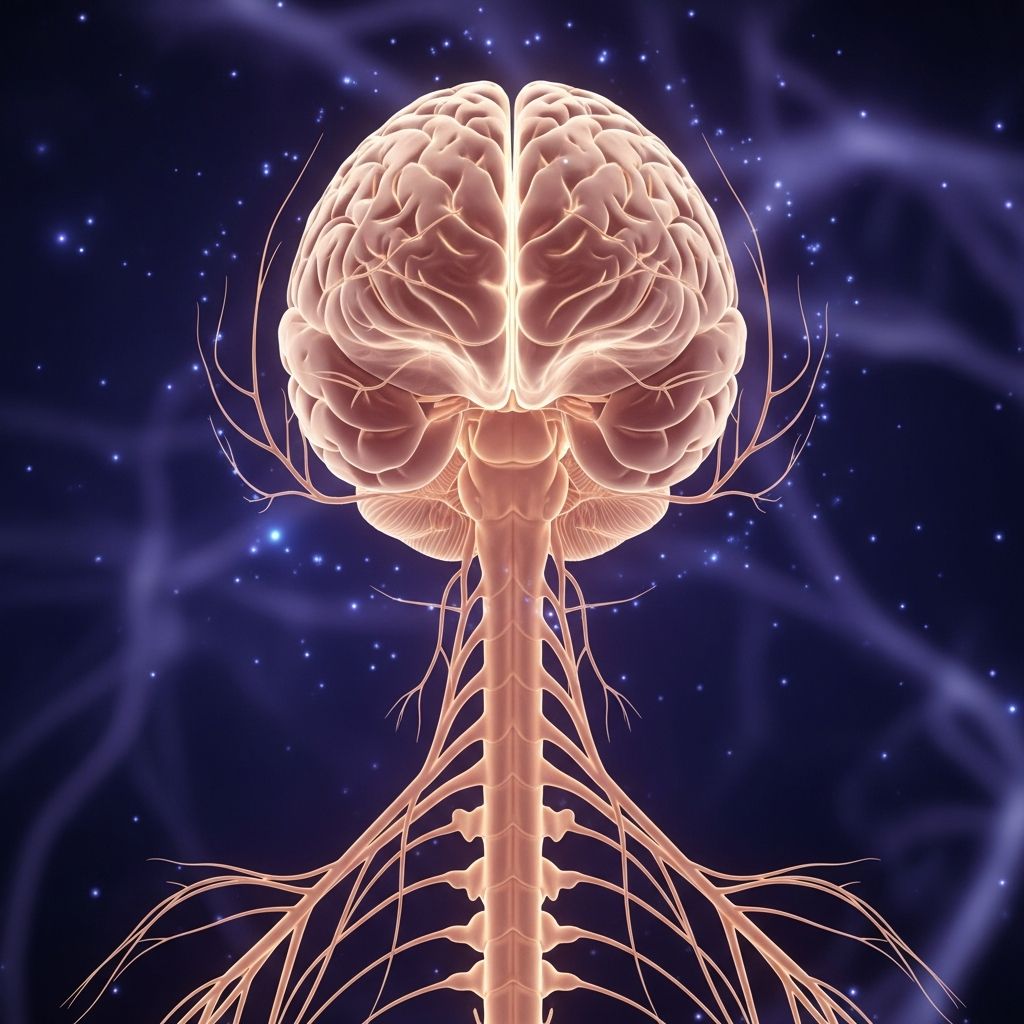
Your central nervous system (CNS) is the command center of your body, serving as a sophisticated processing hub that manages everything you do—from your conscious thoughts and emotions to your automatic bodily functions. Comprising your brain and spinal cord, your CNS is “central” because these two vital structures take in sensory information from throughout your body, process it, and send out signals that direct your actions and regulate your biological processes.
The central nervous system is essentially a highly organized network that allows you to interact with the world around you. It receives constant streams of information through sensory receptors, interprets this data, and generates appropriate responses. Without a functioning CNS, your body would be unable to coordinate basic movements, respond to environmental stimuli, or maintain the delicate balance required for survival.
What Is the Central Nervous System?
The central nervous system is part of your larger nervous system and consists specifically of two major components: your brain and your spinal cord. These structures work together to collect information from sensory nerves throughout your body, process that information, and coordinate responses.
Your brain is the primary control center, containing approximately 86 billion neurons (nerve cells) that communicate through electrical and chemical signals. The spinal cord serves as the main highway for information traveling between your brain and the rest of your body. Think of your brain as the executive decision-maker and your spinal cord as the communication network that relays those decisions to the muscles and organs that need to execute them.
Together, these structures form an integrated system that operates continuously, monitoring your internal environment and external surroundings, then adjusting your body’s functions accordingly. This seamless operation happens largely without your conscious awareness, yet it’s responsible for everything from maintaining your heart rate and breathing to enabling you to walk, talk, think, and learn.
The Three Main Functions of Your Central Nervous System
Your central nervous system performs three interconnected primary functions that keep your body operating smoothly and allow you to interact with your environment:
1. Sensory Input Reception
Your CNS continuously receives sensory information from throughout your body through specialized sensory neurons. These include visual information from your eyes, auditory signals from your ears, tactile sensations from your skin, and proprioceptive feedback that tells you where your body is in space. Additionally, your CNS monitors internal conditions like temperature, pH levels, and oxygen saturation through interoceptive sensors.
2. Information Processing and Integration
Once sensory information reaches your brain and spinal cord, your CNS processes and interprets this data. Your brain analyzes the incoming signals, compares them with stored memories and experiences, and determines the most appropriate response. This processing happens at incredible speeds, often in milliseconds, and involves complex neural networks and chemical signaling.
3. Motor Output Execution
After your brain processes incoming sensory data, it sends electrical signals through your spinal cord to activate your muscles and glands, producing motor output. For example, when you decide to walk across the room, your brain generates a motor command that travels through your spinal cord to the muscles in your legs, enabling them to contract and produce the coordinated movement needed for walking. This same process applies to more complex actions like writing, speaking, or playing an instrument, as well as to involuntary functions like digestion and breathing.
Related Stories



How Your Brain Controls Body Functions
Your brain is remarkably sophisticated in its ability to manage both voluntary and involuntary body processes. It regulates your thoughts, feelings, and conscious movements—such as bending your fingers, learning new information, and communicating with others. Simultaneously, your brain manages countless automatic functions that keep you alive without requiring conscious attention.
Your brain controls essential life-sustaining processes by sending signals to various organs and systems. It tells your lungs to breathe, your heart to beat at the appropriate rate, and your digestive system to break down and absorb food. These automatic functions are so fundamental that you rarely think about them, yet your CNS manages them continuously with remarkable precision.
Beyond these basic functions, your brain also manages memory formation, emotional regulation, decision-making, and complex learning. It enables the remarkable ability to adapt to new situations, learn from experience, and imagine future scenarios. This sophisticated control system is what makes you capable of reasoning, creating, and maintaining relationships.
The Signal Transmission Process
Understanding how your central nervous system works requires knowledge of how signals travel through this system. Your brain creates a neural message in response to sensory input or an internal state. This message takes the form of electrical and chemical signals that travel through neurons and across synapses (the spaces between neurons).
The signal travels from your brain down through your spinal cord, which acts as the main communication pathway. From there, the message is transmitted to your peripheral nervous system—the network of nerves that extends throughout your body to your muscles, organs, and skin. These signals travel constantly in both directions, with sensory information flowing toward your brain and motor commands flowing away from it, maintaining a continuous feedback loop that keeps your body synchronized and responsive.
This bidirectional communication system is extraordinarily efficient. When you touch a hot surface, sensory neurons detect the temperature and send signals to your spinal cord and brain. Your brain processes this information and determines that danger is present, then immediately sends motor signals back to your arm muscles to pull away from the heat source—all happening in just a fraction of a second.
The Brain’s Critical Role
Your brain is the centerpiece of your central nervous system, responsible for managing everything your body does. It’s not merely a processor of information but also the seat of your consciousness, personality, and sense of self. Your brain contains specialized regions, each dedicated to specific functions: the frontal lobe manages decision-making and motor control, the temporal lobe processes memory and emotion, the parietal lobe handles sensory information, and the occipital lobe processes visual information.
The brain’s complexity is matched by its plasticity—its remarkable ability to rewire itself and adapt to changing circumstances. This neuroplasticity allows you to recover from injury, learn throughout your lifetime, and form new memories. Your brain is constantly pruning unused neural connections while strengthening those that are frequently used, a process that underlies learning and memory consolidation.
Sensory Processing and Response
Your central nervous system doesn’t simply respond passively to sensory stimuli. Instead, it actively filters, prioritizes, and interprets sensory information based on context, experience, and current needs. This selective attention allows you to focus on relevant information while filtering out irrelevant background noise and sensations.
For instance, in a crowded room, you can focus on one conversation while effectively filtering out dozens of other voices—a phenomenon known as the “cocktail party effect.” Your CNS accomplishes this through sophisticated filtering mechanisms that begin in the sensory receptors themselves and continue through multiple levels of processing in your spinal cord and brain. This selective processing prevents your brain from being overwhelmed by the constant barrage of sensory information available from your environment.
Integration of Multiple Systems
Your central nervous system doesn’t work in isolation. It integrates information from and sends commands to multiple body systems, including your endocrine system (which produces hormones), your cardiovascular system (which circulates blood), and your immune system (which protects you from disease). This integration ensures that all your body’s systems work together harmoniously.
For example, when you experience stress, your CNS activates your sympathetic nervous system, which triggers the release of stress hormones like adrenaline and cortisol. These hormones increase your heart rate, sharpen your mental focus, and prepare your muscles for action—the classic “fight or flight” response. When the stressor passes, your CNS activates your parasympathetic nervous system, which promotes relaxation and recovery.
Common Central Nervous System Disorders
When the central nervous system becomes damaged or diseased, it can result in various neurological conditions. Some common CNS disorders include:
- Stroke: Occurs when blood flow to the brain is blocked, depriving brain cells of oxygen and potentially causing permanent damage.
- Spinal cord injury: Damage to the spinal cord can result in partial or complete loss of function below the injury site.
- Multiple sclerosis: An autoimmune disease in which the immune system attacks the protective coating of nerve fibers, disrupting communication.
- Parkinson’s disease: A progressive neurodegenerative disorder that affects movement control.
- Alzheimer’s disease: A progressive disease characterized by memory loss and cognitive decline.
- Epilepsy: A neurological condition characterized by recurrent seizures due to abnormal electrical activity in the brain.
- Traumatic brain injury: Damage to the brain resulting from external head trauma.
Why Your Central Nervous System Matters
Your central nervous system is absolutely essential for survival and quality of life. It enables every conscious experience you have, from reading these words to feeling emotions and making decisions. Beyond consciousness, your CNS maintains the physiological processes that keep you alive, regulating everything from respiration and circulation to digestion and immune response.
Understanding your CNS helps you appreciate the remarkable complexity of your body and the importance of protecting your neurological health. Maintaining good CNS health involves regular exercise, proper nutrition, adequate sleep, stress management, and cognitive engagement. These lifestyle factors support neuroplasticity and help prevent age-related cognitive decline.
Frequently Asked Questions
Q: What is the difference between the central nervous system and the peripheral nervous system?
A: Your central nervous system consists of your brain and spinal cord, which process information and make decisions. Your peripheral nervous system includes all the nerves branching out from your CNS to the rest of your body, transmitting signals between your CNS and your limbs, organs, and skin.
Q: Can the central nervous system repair itself?
A: While the brain and spinal cord have limited regenerative capacity compared to other body tissues, they do possess some ability to repair and reorganize themselves through neuroplasticity. However, severe damage often results in permanent impairment, which is why prevention and early treatment of CNS injuries are so important.
Q: How fast do neural signals travel?
A: Neural signals travel at different speeds depending on the type of nerve fiber, but they typically travel between 1 and 120 meters per second. Myelinated nerves (those covered with an insulating sheath) conduct signals much faster than unmyelinated nerves.
Q: What role does cerebrospinal fluid play in the CNS?
A: Cerebrospinal fluid cushions and protects your brain and spinal cord, provides nutrients to neural tissue, and removes waste products from the CNS. It also maintains intracranial pressure at optimal levels for proper CNS function.
Q: How does the blood-brain barrier protect the CNS?
A: The blood-brain barrier is a selective membrane that allows beneficial substances like glucose and oxygen to enter the brain while blocking harmful substances and pathogens. This protective mechanism helps maintain optimal conditions for CNS function and prevents most infections from reaching the brain.
References
- Cleveland Clinic Neurological Institute Overview — Cleveland Clinic. Accessed December 1, 2025. https://my.clevelandclinic.org/health/body/central-nervous-system-cns
- Central Nervous System (CNS): What It Is & Function — Cleveland Clinic. Accessed December 1, 2025. https://my.clevelandclinic.org/health/body/central-nervous-system-cns
- Nervous System: What It Is, Parts, Function & Disorders — Cleveland Clinic. Accessed December 1, 2025. https://my.clevelandclinic.org/health/body/21202-nervous-system
- Central Sensitization, Chronic Pain, and Other Symptoms — Cleveland Clinic Journal of Medicine, 2023. https://www.ccjm.org/content/90/4/245
- Cranial Nerves: Function, Anatomy & Location — Cleveland Clinic. Accessed December 1, 2025. https://my.clevelandclinic.org/health/body/21998-cranial-nerves
Similar Articles








Read full bio of Sneha Tete