Central Venous Catheter: Types, Placement & Care
Complete guide to CVCs: understanding placement, types, and long-term care for patients.
What Is a Central Venous Catheter?
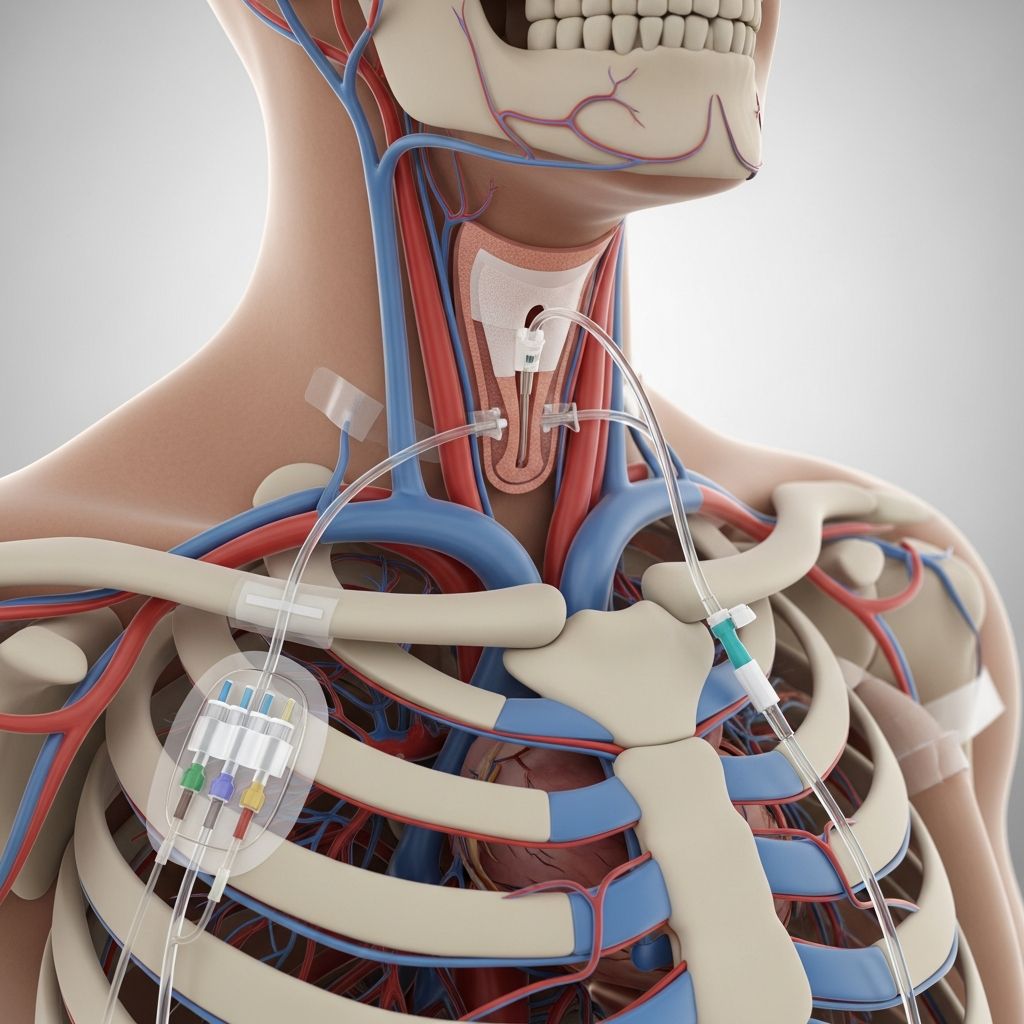
A central venous catheter (CVC) is a long, flexible tube that a healthcare provider inserts into a large vein in your body, typically in your neck, chest, arm, or groin. This catheter travels through your vein to reach your vena cava, which is a major vein that empties directly into your heart. The primary purpose of a central venous catheter is to provide a direct pathway for administering medications, fluids, blood products, and other treatments during emergency situations or for long-term medical care. Beyond treatment delivery, a CVC also facilitates blood draws, making it an essential tool for comprehensive patient care and monitoring.
Central venous catheters have become indispensable in modern medical practice. Millions of people receive a CVC every year, making it one of the most common medical procedures performed in healthcare settings today. The procedure is typically performed by a proceduralist—a physician who specializes in specific medical procedures and has extensive training in catheter placement techniques.
Understanding CVC Anatomy and Structure
To better understand how a CVC works, it’s important to know its basic anatomy. A central venous catheter has two main components: the tip and the access point. The catheter’s tip is positioned in your vena cava, the large vein that leads directly to your heart. This strategic placement allows for rapid distribution of medications and fluids throughout your bloodstream.
The other end of the catheter terminates either above or below your skin, typically on the right side of your chest. If this end is positioned on the outer surface of your skin, it’s called a hub. Since it extends outside your body, you can easily see and feel the hub, which serves as the access point for treatment administration. Alternatively, if the catheter end is positioned underneath your skin, it’s called a portal or reservoir. With this configuration, you’ll notice a small bump—approximately the size of a quarter—beneath your skin, though it’s far less noticeable than an external hub. The hub or reservoir serves as the critical access point where healthcare providers deliver your treatment.
Types of Central Venous Catheters
Several different types of central venous catheters are available, each designed for specific medical needs and patient circumstances. Understanding the differences between these types can help you work with your healthcare provider to determine which option is best for your situation.
Non-Tunneled Central Venous Catheters
Non-tunneled CVCs are catheters where the tube runs directly from the vein access point to the external hub without traveling through tunnels beneath the skin. These catheters are typically used for short-term treatment needs and are often placed in emergency situations because they can be inserted quickly. The catheter exits your body at the same point where it enters the vein, making maintenance and monitoring straightforward.
Tunneled Central Venous Catheters
Tunneled CVCs feature a unique design where the catheter travels through a tunnel created beneath your skin before exiting your body. This design provides several advantages, including reduced infection risk and greater comfort for long-term use. The catheter’s entrance point (where it accesses the vein) and exit point (where it emerges from your body) are different, with the catheter running like an underground pathway beneath your skin between these two points. Tunneled catheters are ideal for patients requiring extended intravenous therapy.
Peripherally Inserted Central Catheters (PICC Lines)
PICC lines represent a less invasive alternative to traditional central venous catheters. These catheters are inserted through veins in your arm, specifically the basilic vein or cephalic vein, and then carefully threaded through to reach a large vein near your heart. PICC lines are particularly suitable for long-term treatments where patient comfort is a priority, as they avoid the need for neck or groin punctures. They offer a middle ground between peripheral IV lines and traditional central catheters.
Related Stories



Implanted Ports
Implanted ports, also called portacaths or mediports, are entirely positioned beneath your skin with no external components. These devices feature a small reservoir or port that sits in a pocket created just below your skin, typically in the chest area. To access an implanted port, a healthcare provider uses a special needle to puncture through your skin into the port. This design offers excellent cosmetic appeal and reduces infection risk significantly, making implanted ports ideal for patients requiring intermittent treatment over extended periods.
Choosing the Right Access Point
Healthcare providers consider multiple factors when determining where to insert your central venous catheter. The most common access points include:
- Neck (jugular vein): Provides straightforward access and is frequently used in emergency situations
- Chest (subclavian vein): Offers comfort advantages as the catheter can be easily concealed beneath clothing
- Groin (femoral vein): Accessible but generally used when other sites aren’t suitable
- Arm (basilic or cephalic vein): Preferred for PICC line placement due to reduced trauma
Each insertion site has distinct advantages and disadvantages. Your provider will evaluate your specific medical condition, the type of treatment you need, how long you’ll require the catheter, and your overall health status to select the most appropriate access point for your situation.
The Central Venous Catheter Placement Procedure
Understanding what to expect during CVC placement can help reduce anxiety and ensure you’re well-prepared for the procedure. Your provider will explain the entire process, including its benefits and risks, and will ask for your informed consent before proceeding. In emergency situations where time is critical, this conversation may be abbreviated.
Pre-Procedure Preparation
Your provider will help you into the proper position for the procedure, which varies depending on which vein needs to be accessed. Typically, you’ll lie on your back, either completely flat or at a slight angle with your feet and legs elevated higher than your chest. This positioning optimizes access to your veins. Once positioned, you’ll be connected to monitoring equipment that continuously tracks your vital signs throughout the procedure, ensuring your safety.
Procedure Variations by CVC Type
The specific procedure steps vary depending on which type of central venous catheter you’re receiving. For non-tunneled CVCs and PICC lines, you’ll undergo a percutaneous procedure. This means your provider will puncture your skin with a needle to access your vein and insert the catheter. Throughout this process, your provider may use ultrasound imaging technology to guide the catheter placement, ensuring accuracy and safety.
For tunneled CVC placement and port placement, your provider will use similar vein access techniques but with important additional steps. Tunneled CVC placement requires both a needle puncture and surgical intervention. You’ll receive local or general anesthesia to keep you comfortable throughout the procedure. Your provider will make an incision in your chest at a different location than where the catheter exits your body, creating the tunnel through which the catheter travels beneath your skin.
Implanted port placement follows a comparable approach but with distinct differences. You’ll receive general anesthesia and your provider will make a small incision in your chest. They’ll create a small pocket of space in the tissue just below your skin and carefully insert the port into this pocket, securing it with sutures. Finally, the incision is closed and a bandage is applied.
Post-Procedure Confirmation
After your catheter is placed, your provider will verify that the procedure was successful by performing a chest X-ray. This imaging confirms that your CVC is positioned correctly and that no complications have occurred. Your provider will inform you when you can return home and will provide detailed instructions for at-home care and maintenance.
Recovery and Going Home
The recovery timeline following CVC placement varies based on the type of catheter you receive. Your provider will explain how long you’ll need your catheter and when it can be removed. The duration depends entirely on your medical needs and the specific purpose of your catheter.
Before leaving the healthcare facility, you’ll receive comprehensive instructions about caring for your catheter at home. Your provider will also inform you about the maintenance schedule, including how often you need to return for follow-up appointments. It’s essential to call your provider immediately if you have any questions or concerns about your catheter or your recovery.
Central Venous Catheter Maintenance and Care
Proper maintenance is critical for preventing complications and ensuring your catheter functions optimally. Regular flushing of your catheter helps prevent blood clots from forming inside the tube, which could compromise its function. Your healthcare provider will prescribe specific maintenance protocols based on your particular catheter type and medical needs.
When flushing your catheter, careful attention to sterile technique is paramount. Before accessing your catheter, the injection cap should be cleaned thoroughly with an alcohol pad for 15 seconds and allowed to dry completely for another 15 seconds to prevent contamination. Using a pulsing motion while injecting normal saline helps dislodge any small clots that might be forming. Your provider will prescribe the specific amount of saline needed for flushing, and in some cases, may prescribe heparin—a blood thinner—to be used after the saline flush.
Preventing Complications
Central venous catheters provide life-saving treatments in numerous medical situations, but they do carry certain risks that must be carefully managed. The most common complication is infection, particularly catheter-related bloodstream infections (CLABSIs). Maintaining strict sterile technique during all catheter manipulations significantly reduces this risk.
Watch for signs of potential problems, including redness, swelling, or discharge around the catheter insertion or exit site, fever, unusual pain or discomfort at the catheter site, and any visible damage to the catheter itself. Contact your healthcare provider immediately if you notice any of these warning signs.
Frequently Asked Questions About Central Venous Catheters
Q: How long can I keep a central venous catheter?
A: The duration depends on your medical needs and the catheter type. Some patients need catheters for only days or weeks, while others require them for months or longer. Your provider will determine the appropriate timeline for your specific situation.
Q: Can I shower or bathe with a central venous catheter?
A: This depends on your catheter type and your provider’s specific instructions. Generally, external catheters require protective dressing during bathing to prevent infection. Implanted ports allow unrestricted bathing once the incision has healed.
Q: What activities should I avoid with a central venous catheter?
A: Avoid strenuous exercise, heavy lifting, and activities that could damage or dislodge your catheter. Your provider will give you specific activity restrictions based on your catheter type.
Q: Can a central venous catheter be used for blood draws?
A: Yes, one of the primary advantages of a CVC is that it can be used for blood draws, eliminating the need for repeated needle sticks.
Q: How often do I need maintenance appointments?
A: Your provider will establish a specific maintenance schedule based on your catheter type and medical needs. This is an important part of preventing complications and ensuring your catheter continues to function properly.
Q: What are the warning signs of a catheter problem?
A: Watch for fever, redness or swelling around the insertion site, drainage or discharge, difficulty flushing the catheter, chest pain, and shortness of breath. Contact your provider immediately if you experience any of these symptoms.
Key Takeaways
Central venous catheters represent a vital medical innovation that enables effective delivery of medications, fluids, and blood products while reducing the need for repeated needle sticks. Multiple types of CVCs are available, each designed for specific medical situations and patient needs. Whether you receive a non-tunneled catheter, tunneled catheter, PICC line, or implanted port, understanding how your catheter works and how to care for it properly is essential for successful treatment outcomes. Work closely with your healthcare provider to understand your specific catheter type, follow maintenance instructions carefully, and report any concerning symptoms immediately. If you need a central venous catheter, ask your provider which type is best for you, why that type is recommended, and what benefits and risks are associated with your specific procedure.
References
- Central Venous Catheter — Cleveland Clinic. 2024. https://my.clevelandclinic.org/health/treatments/23927-central-venous-catheter
- Fundamentals of Central Venous Access (FCVA) Course — Cleveland Clinic Simulation Center. 2024. https://my.clevelandclinic.org/-/scassets/files/org/education/sim-center/fcva-course.pdf
- Practical Guide to Central Venous Cannulation — Elsevier Health Sciences. 2024. https://nchr.elsevierpure.com/en/publications/practical-guide-to-central-venous-cannulation/
- Changing a Central Venous Catheter — Cleveland Clinic Journal of Medicine, Vol. 68, No. 12. 2024. https://www.ccjm.org/content/ccjom/68/12/994.full.pdf
- Central Venous Line: A Comprehensive Guide — Medical Education Resources. 2024. https://24hrer.com/central-venous-line-a-comprehensive-guide/
Similar Articles








Read full bio of Sneha Tete