Cerebral Shunts: Treatment for Hydrocephalus
Understanding shunts: How surgical implants treat hydrocephalus and restore brain function.
Understanding Cerebral Shunts and Hydrocephalus
Cerebral shunts are one of the most important surgical interventions in modern neurology, offering life-changing treatment for patients suffering from hydrocephalus. Hydrocephalus is a serious neurological condition characterized by an abnormal buildup of cerebrospinal fluid (CSF) in the brain’s cavities, known as ventricles. This clear, colorless fluid normally protects and cushions the brain, but when it accumulates excessively, it creates dangerous pressure that can lead to severe neurological damage and, in untreated cases, death. Understanding how shunts work and their role in treating this condition is essential for patients and families facing this diagnosis.
What Is a Cerebral Shunt?
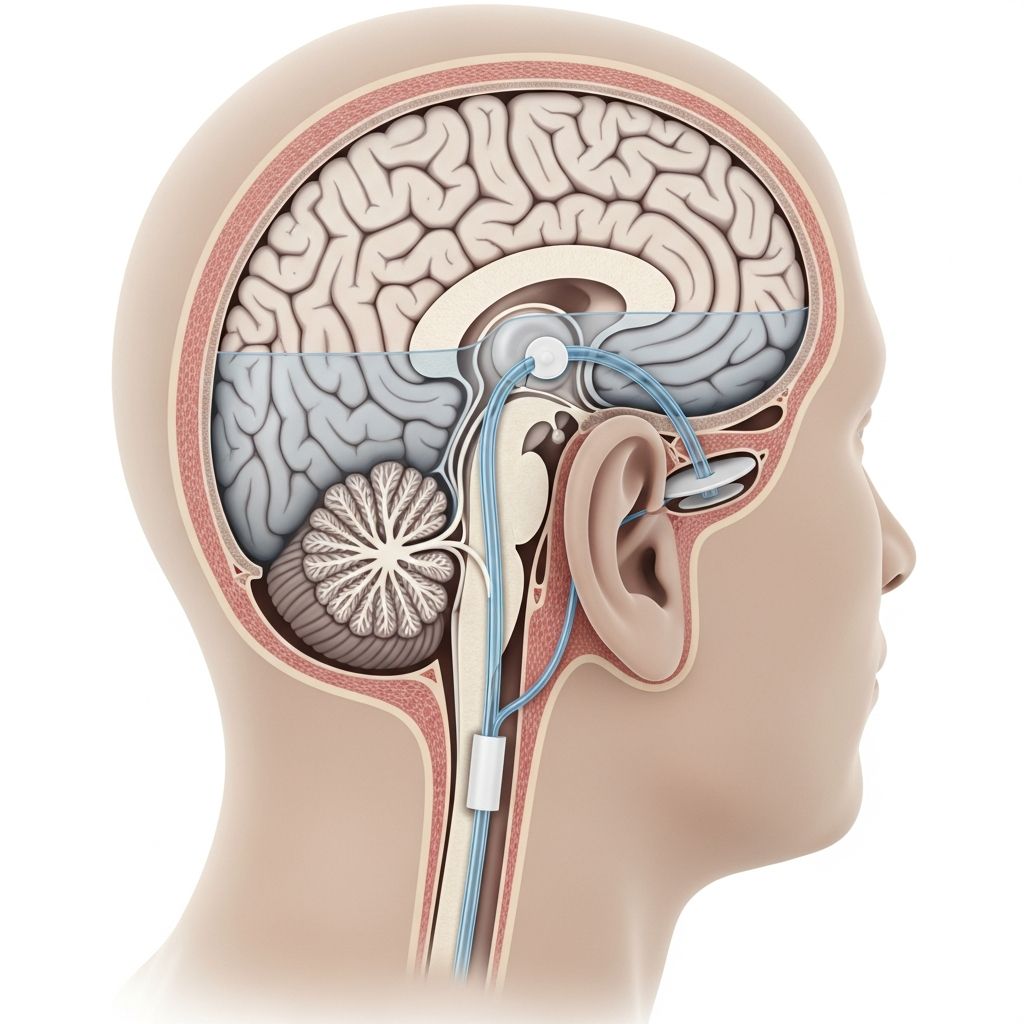
A cerebral shunt is a thin, surgically implanted tube system designed to alleviate the pressure caused by excess cerebrospinal fluid accumulation. The device consists of a sophisticated system of catheters and a one-way valve mechanism that redirects CSF from the brain’s ventricles to another part of the body where it can be safely absorbed. The shunt operates by creating a bypass pathway, allowing fluid to drain away from the brain and preventing the damaging pressure buildup that characterizes hydrocephalus.
The basic shunt system includes three main components: a ventricular catheter that is placed in the brain’s ventricles to access the excess fluid, a valve that regulates the flow and pressure of the fluid, and a distal catheter that carries the fluid to an absorption site, typically the peritoneal cavity (abdomen) or right atrium of the heart. This ingenious design has remained fundamentally unchanged since its development over 60 years ago, demonstrating the effectiveness of the original concept.
How Hydrocephalus Develops
Hydrocephalus occurs when the normal flow and absorption of cerebrospinal fluid is disrupted or blocked. The brain continuously produces and reabsorbs CSF to maintain proper intracranial pressure and provide nutrients to brain tissue. When this delicate balance is disrupted—due to obstruction, inflammation, or impaired absorption—fluid accumulates in the ventricles, causing them to widen and swell. This expansion creates increasing pressure on brain tissue, leading to progressive neurological dysfunction.
The condition can develop from various causes, including brain tumors, traumatic brain injury, spinal cord abnormalities, infections, or bleeding in the brain. In some cases, particularly in elderly patients, hydrocephalus develops without an identifiable cause, a condition known as idiopathic normal pressure hydrocephalus (iNPH). Understanding the underlying cause is crucial for determining the most appropriate treatment approach.
Types of Shunt Systems
Modern neurosurgery offers several shunt configurations tailored to individual patient needs:
Ventriculoperitoneal (VP) Shunts
VP shunts are the most commonly used type, with the distal catheter placed in the peritoneal cavity of the abdomen. This location provides ample space for CSF absorption and is relatively accessible for routine adjustments and revisions.
Ventriculoatrial (VA) Shunts
In VA shunts, the distal catheter is placed directly into the right atrium of the heart. This option is often chosen for patients who have abdominal complications or scarring from previous abdominal surgeries.
Advanced Shunt Technologies
Recent innovations have introduced programmable shunts that allow physicians to adjust pressure settings non-invasively using magnetic devices, eliminating the need for surgery to modify shunt function. These adjustable systems provide greater flexibility in managing individual patient needs as their condition evolves. Additionally, new cranial implant technologies like the VACI (Ventriculoatrial Cranial Implant) have been developed to cradle shunts invisibly within the skull space between the scalp and brain, reducing visible bumps and minimizing complications such as skin breakdown and infection that are associated with traditional external shunt designs.
Related Stories



Clinical Indications for Shunt Placement
Shunt surgery is recommended for patients experiencing symptoms directly attributable to increased intracranial pressure from CSF accumulation. Common indications include:
– Progressive gait disturbance and balance problems- Cognitive decline and memory loss- Urinary incontinence- Headaches and vision changes- Deteriorating motor function
Recent landmark clinical trials have confirmed the effectiveness of shunt treatment, particularly for idiopathic normal pressure hydrocephalus in elderly patients. A major double-blind, placebo-controlled study published in The New England Journal of Medicine demonstrated that shunt placement significantly improved walking speed, balance, and mobility in seniors with iNPH, with patients reporting fewer falls and greater independence in daily activities.
The Shunt Implantation Procedure
Shunt placement is a neurosurgical procedure typically performed under general anesthesia. The surgeon creates small incisions to access the brain’s ventricles and the target absorption cavity. Using imaging guidance, the ventricular catheter is carefully positioned within the fluid-filled ventricles, while the distal catheter is tunneled subcutaneously to the abdominal cavity or heart. The valve is positioned on the skull, usually behind the ear, where it can be easily accessed if future adjustments are needed.
The procedure generally takes one to two hours, and most patients can return home within a few days following the surgery. Recovery time varies depending on individual factors and the complexity of the procedure.
Complications and Management
While shunt placement has significantly improved outcomes for hydrocephalus patients, the procedure carries potential risks that require ongoing monitoring and management. Common complications include:
Shunt Malfunction
Shunt failure can occur due to obstruction, kinking, or valve dysfunction. Signs of malfunction include headache, vomiting, changes in mental status, and gait disturbance. Detecting shunt failure traditionally required multiple diagnostic imaging studies including X-rays, CT scans, and MRIs, causing unnecessary delays in treatment. Researchers at Johns Hopkins Medicine and the Johns Hopkins University Applied Physics Laboratory are developing innovative ultrasound-based diagnostic technology that allows physicians to quickly determine if a shunt is failing without radiation or invasive procedures, significantly reducing emergency room visits and unnecessary surgical interventions.
Infection
Shunt infections can develop during or shortly after surgery, or they may occur later due to hematogenous seeding. Infections require prompt recognition and treatment with appropriate antibiotics and, in many cases, temporary shunt externalization and eventual replacement.
Over-Drainage
Excessive fluid drainage can cause subdural hematoma, slit ventricle syndrome, or tethering of neural structures. Programmable shunts have reduced this complication by allowing pressure adjustments without surgery.
Under-Drainage
Inadequate fluid removal results in persistent symptoms and may require shunt revision to increase drainage efficiency.
Mechanical Issues
Catheter kinking, disconnection, or migration can compromise shunt function and necessitate revision surgery.
Long-Term Management and Follow-Up
Patients with cerebral shunts require lifelong follow-up care and monitoring. Regular clinical assessments help detect early signs of malfunction or complications. Imaging studies may be performed periodically to ensure proper catheter positioning and shunt function. Patients and caregivers should be educated about warning signs of shunt failure, including headaches, nausea, changes in consciousness, and deterioration of previously stable symptoms.
The development of improved diagnostic technologies continues to enhance the management of shunt patients. Advanced devices now allow non-invasive assessment of shunt integrity, reducing the burden of unnecessary emergency evaluations and procedures. Additionally, ongoing research into novel materials and designs aims to reduce infection rates and mechanical complications.
Emerging Shunt Technologies
The field of shunt technology continues to advance rapidly. Cranial implant devices like the VACI provide aesthetic improvements and reduce scalp complications by positioning shunts invisibly within the skull. Clinical trials have demonstrated that these innovations maintain the same effectiveness as traditional shunts while significantly reducing infection rates, skin breakdown, and scalp pain.
Programmable shunts with adjustable pressure settings represent another significant advancement, allowing fine-tuning of CSF drainage without surgical intervention. Magnetic adjustment capabilities enable physicians to optimize shunt function for individual patient responses, particularly important as patient needs change over time.
Recent Clinical Evidence
A landmark international clinical trial funded by the National Institutes of Health and led by Johns Hopkins University School of Medicine has provided definitive evidence of shunt effectiveness for idiopathic normal pressure hydrocephalus. The Placebo-Controlled Efficacy in iNPH Shunting (PENS) Trial, the first large double-blind, placebo-controlled study of its kind, enrolled 99 patients at 17 hospitals across the United States, Canada, and Sweden. After three months, patients with active shunts demonstrated significantly faster walking speed, improved balance, and fewer falls compared to the placebo group. These results have resolved decades of clinical debate and are expected to increase diagnosis and treatment of this condition among elderly populations.
Diagnostic Evaluation for Shunt Candidates
Identifying potential shunt candidates begins with careful clinical evaluation. Physicians assess patients for the classic triad of symptoms associated with hydrocephalus: gait disturbance, cognitive decline, and urinary incontinence. Neuroimaging, typically magnetic resonance imaging or computed tomography, confirms the presence of ventricular enlargement and CSF accumulation. Additional diagnostic tests, such as lumbar puncture with opening pressure measurement or CSF drainage trials, may help predict shunt responsiveness.
Recent evidence suggests that diagnosis can be straightforward: if a patient shows evidence of progressive imbalance or increasing memory loss, hydrocephalus can be explored through routine brain imaging. This accessibility to diagnosis means that more patients may benefit from shunt treatment if they meet appropriate diagnostic criteria.
Patient Selection and Outcomes
Optimal outcomes depend on careful patient selection and appropriate surgical technique. Patients most likely to benefit from shunting demonstrate clear neurological symptoms directly attributable to CSF accumulation and show imaging evidence of hydrocephalus. Early intervention, before permanent neurological damage occurs, generally produces better results than delayed treatment.
Functional outcomes vary based on the duration and severity of symptoms before treatment. Patients treated early typically experience restoration of mobility, improved cognition, and enhanced independence. Symptoms that have been present for longer periods may show incomplete recovery, as some neurological changes become permanent with time.
Frequently Asked Questions
Q: How long do cerebral shunts last?
A: Shunt longevity varies considerably. While some shunts function for many years, others require revision within months or years due to malfunction, infection, or growth-related changes. Most patients require at least one shunt revision during their lifetime.
Q: Can shunts be removed once they are no longer needed?
A: In rare cases where the underlying cause of hydrocephalus resolves (such as after treatment of a tumor or resolution of infection), shunts may be removed. However, most patients require permanent shunt placement.
Q: What restrictions apply to shunt patients?
A: Most patients can return to normal activities, though contact sports should be avoided to prevent shunt injury. Patients should inform healthcare providers about their shunt before undergoing certain diagnostic procedures.
Q: Are there alternatives to shunt surgery?
A: In some cases, endoscopic third ventriculostomy (ETV) may provide an alternative by creating a pathway for CSF to bypass the obstruction. However, shunts remain the most widely used treatment for hydrocephalus.
Q: What are the success rates for shunt surgery?
A: Recent clinical trials demonstrate significant improvements in walking, balance, and independence for appropriate candidates. The PENS trial showed dramatic gait velocity improvements and reduced falls in elderly patients with idiopathic normal pressure hydrocephalus.
References
- Shunts Safe And Effective For Rare Brain Condition In Elderly: Clinical Trial Concludes — Johns Hopkins Medicine/HealthDay News. 2025-09-18. https://www.powershealth.org/about-us/newsroom/health-library/2025/09/18/shunts-safe-and-effective-for-rare-brain-condition-in-elderly-clinical-trial-concludes
- Researchers Reduce Shunt Maintenance for Hydrocephalus Patients — Johns Hopkins University Applied Physics Laboratory. https://www.jhuapl.edu/news/news-releases/150211-researchers-reduce-shunt-maintenance-hydrocephalus-patients
- Study Shows Longeviti’s InvisiShunt Safely Treats Brain Swelling — Johns Hopkins University Ventures. https://ventures.jhu.edu/news/brain-swelling-longeviti-cranial-implant-study/
- Landmark Study Confirms Treatment for a Condition that Causes Dementia — Hydrocephalus Association. https://www.hydroassoc.org/treatment-for-condition-causing-dementia/
- Hydrocephalus Overview — National Institute of Neurological Disorders and Stroke (NINDS), National Institutes of Health. https://www.ninds.nih.gov/health-information/disorders/hydrocephalus
Similar Articles








Read full bio of Sneha Tete