Cerebrum: What It Is, Function & Anatomy
Discover the cerebrum: your brain's largest part controlling thoughts, movements, and consciousness.
Understanding the Cerebrum: Your Brain’s Control Center
Your cerebrum is the largest part of your brain and serves as the command center for conscious thought and action. This remarkable organ handles the processes that make you aware of your surroundings, control your movements, and process language. Different areas within your cerebrum have specialized responsibilities, including language production, behavioral control, sensory processing, and memory formation. These regions work together seamlessly to help you navigate and understand the world around you. As the uppermost and most prominent portion of the brain, the cerebrum accounts for approximately two-thirds of the brain’s total weight, making it the dominant structure in the human nervous system.
What Is the Cerebrum?
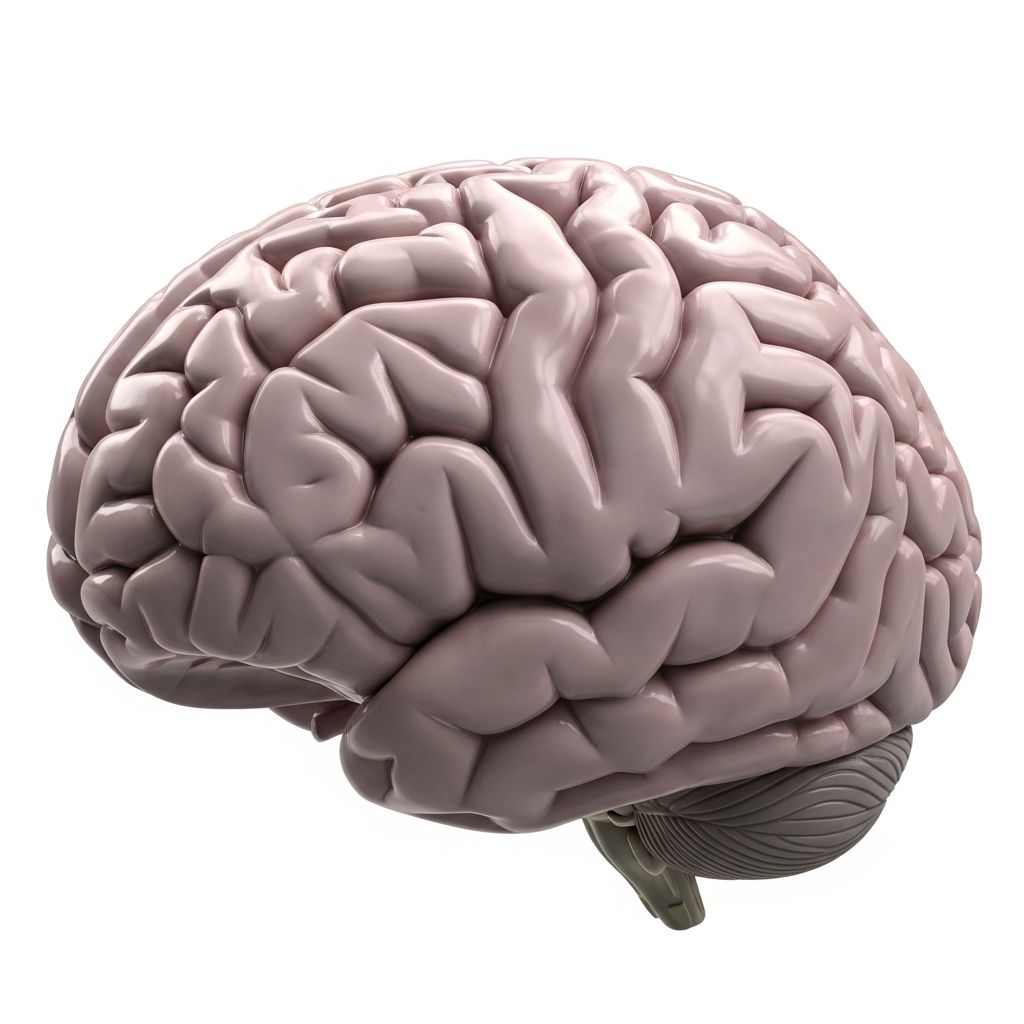
The cerebrum represents the upper and front portion of your brain, positioned inside your skull at the top and front of your head. It consists of the cerebral hemispheres and is divided lengthwise into two halves—the left and right hemispheres—separated by a deep groove called the longitudinal fissure. These two hemispheres are connected by a structure called the corpus callosum, a collection of nerve tissue that transmits signals from one side of your brain to the other, enabling the two halves to communicate and work together.
The cerebrum is distinguished by its unique appearance and structure. The outer surface of your cerebrum, known as the cerebral cortex, is mostly smooth but features numerous wrinkles and folds that give it a texture similar to a walnut without its shell. These convolutions significantly increase the surface area of the cortex, which measures approximately 2,000 square centimeters and is several centimeters thick. The extensive development of the cerebral cortex in humans is thought to distinguish the human brain from those of other animals and accounts for our advanced cognitive abilities.
Anatomy and Structure of the Cerebrum
The cerebrum exhibits a complex internal architecture consisting of distinct layers and components. The cerebral hemispheres contain an inner core of myelinated nerve fibers known as white matter, surrounded by an outer cortex of gray matter. This organization allows for efficient communication and processing throughout the brain.
The Cerebral Cortex
The cerebral cortex, or gray matter, is the outermost layer of your cerebrum and is responsible for integrating sensory impulses, directing motor activity, and controlling higher intellectual functions. This layer is divided into four main lobes, each with distinct functions and responsibilities:
The Four Lobes of the Brain
The cerebral cortex is organized into four primary lobes, roughly defined by major surface folds and fissures:
| Lobe | Location | Primary Functions |
|---|---|---|
| Frontal Lobe | Front of brain behind forehead | Motor control, speech production (Broca’s area), executive functions, decision-making, personality |
| Parietal Lobe | Between frontal and occipital lobes | Somatic senses (touch and position), sensory integration, spatial awareness |
| Temporal Lobe | Below parietal lobe | Auditory reception, memory formation, language comprehension (Wernicke’s area), emotion |
| Occipital Lobe | Back of brain | Visual reception and processing, color perception, visual memory |
Additionally, some researchers recognize a fifth lobe—the limbic lobe—which is involved with smell, taste, and emotional processing.
White Matter and Neural Connections
Related Stories



Beneath the gray matter cortex lies the white matter, composed of myelinated nerve fibers that primarily connect functional areas of the cerebral cortex. These connections enable rapid communication between different brain regions, allowing for integrated processing and coordinated responses. The corpus callosum, a thick band of white matter, is the primary structure connecting the two hemispheres and allows the integration of sensory input and functional responses from both sides of the body.
Functions of the Cerebrum
Your cerebrum is responsible for managing your brain’s “conscious” actions—those functions that require active thinking and awareness. The cerebrum orchestrates multiple complex processes that define human consciousness and behavior.
Primary Functions Include:
The cerebrum handles numerous essential functions that you engage in daily:
- Conscious thought and decision-making
- Muscle movement and voluntary motor control
- Language production and comprehension
- Processing sensory information (sight, sound, touch, taste, smell)
- Memory formation and recall
- Emotional regulation and expression
- Personality expression and behavior
- Problem-solving and reasoning
- Attention and concentration
- Learning and cognitive development
Hemispheric Specialization
One hemisphere, usually the left, is functionally dominant and controls language and speech production. This dominance is present in most right-handed individuals and many left-handed people as well. The other hemisphere interprets visual and spatial information, contributing to visual-spatial reasoning and creativity. While one hemisphere is dominant for language, the hemispheres work together to process and integrate information for a complete understanding of the world.
How the Cerebrum Works with Other Brain Structures
Your cerebrum works together with other parts of your brain, especially your cerebellum, to help you with your daily activities and maintain overall brain function. The cerebellum, a small part of your brain located at the bottom near the back of your head, processes and regulates signals between other parts of your brain and body and is involved in coordinating functions of your body, such as walking.
An Example of Brain Coordination
Consider the simple task of picking up a pencil off a table. Your cerebrum sends the signals to the muscles in your arms, initiating the voluntary movement. Simultaneously, your cerebellum helps calculate and control your movements, ensuring that your hand goes right to the pencil without missing. This coordination demonstrates how different brain regions collaborate to execute even simple tasks smoothly and accurately.
Supporting Structures and Systems
Beyond the cerebrum and cerebellum, several other crucial structures support brain function. The hypothalamus controls metabolism and maintains homeostasis, regulating body temperature, hunger, and other vital functions. The thalamus serves as a principal sensory relay center, processing and directing sensory information to appropriate brain regions.
These structures surround spaces called ventricles that are filled with cerebrospinal fluid. This fluid helps supply brain cells with nutrients and provides the brain with shock-absorbing mechanical support, protecting this delicate organ from injury.
Major Cerebral Fissures and Landmarks
The cerebrum is divided by several major fissures (deep grooves) that separate different functional regions:
- Lateral Fissure (Fissure of Sylvius): Separates the frontal and temporal lobes
- Central Fissure (Fissure of Rolando): Separates the frontal and parietal lobes, dividing the chief motor and sensory regions
- Calcarine Fissure: Located on the occipital lobe, contains the visual cortex
- Parieto-Occipital Fissure: Separates the parietal and occipital lobes
- Transverse Fissure: Divides the cerebrum from the cerebellum
- Longitudinal Fissure: Divides the cerebrum into two hemispheres
Special Functional Areas
Within the lobes are specialized regions that handle specific functions. The motor cortex, located in the frontal lobe, is responsible for controlling body movement. The prefrontal cortex, also in the frontal lobe, manages executive functions such as thinking, problem-solving, and directing other brain areas. Broca’s area, another frontal lobe region, is essential for speech production.
The somatosensory cortex, located in the parietal lobe, receives sensory information—feeling information—from all over your body. Wernicke’s area, located in the temporal lobe, is involved in language comprehension based on speech tones and sounds, linking them to previously learned sounds.
Sensory, Motor, and Association Areas
Some researchers classify the cerebral cortex by three main functional categories:
Sensory Areas: These regions of your cerebral cortex receive sensory information from your senses and environment, processing vision, hearing, touch, taste, and smell.
Motor Areas: These regions are involved in voluntary muscle movement, processed mainly by your frontal lobe.
Association Areas: These areas are spread throughout all four lobes and connect and add complexity to functions, enabling higher-level cognitive processing.
Damage to the Cerebrum
Damage to any area of your cerebral cortex typically results from tumors, trauma, autoimmune diseases, or a cerebrovascular accident such as a brain bleed or stroke. The specific symptoms that develop depend on which area of the cerebral cortex is damaged. Damage to motor areas may result in weakness or paralysis, while damage to sensory areas may cause loss of sensation. Damage to language areas may affect speech production or comprehension, and damage to memory regions may impair memory formation or recall.
Frequently Asked Questions
Q: What is the difference between the cerebrum and the cerebellum?
A: The cerebrum is the largest part of your brain, responsible for conscious thought, decision-making, movement, language, and sensory processing. The cerebellum is a smaller structure located at the back and bottom of your brain that coordinates movements, maintains balance, and processes signals between different brain regions.
Q: Why do the two cerebral hemispheres need to communicate?
A: The two hemispheres communicate through the corpus callosum to integrate information and coordinate responses. This allows the brain to combine the left hemisphere’s language and analytical abilities with the right hemisphere’s visual-spatial and creative processing for comprehensive understanding and coordinated action.
Q: What does the cerebral cortex do?
A: The cerebral cortex, the outer layer of the cerebrum, is responsible for integrating sensory impulses, directing motor activity, and controlling higher intellectual functions including language, memory, reasoning, thought, learning, decision-making, emotion, intelligence, and personality.
Q: Which lobe controls movement?
A: The frontal lobe contains the motor cortex, which controls voluntary body movement. The frontal lobe also handles speech production, executive functions, and decision-making.
Q: Can damage to the cerebrum be repaired?
A: While some brain plasticity exists and rehabilitation can help, damage to the cerebrum is often permanent. The extent of recovery depends on the location and severity of damage and the individual’s age and overall health. Medical treatment and rehabilitation therapy may help maximize recovery potential.
Q: Is one cerebral hemisphere more important than the other?
A: Both hemispheres are essential, though one (usually the left) is typically dominant for language and speech. The hemispheres have complementary functions—the left is generally more analytical and language-focused, while the right is more visual-spatial and creative. Together, they provide comprehensive brain function.
References
- Cerebrum | Description, Anatomy, & Functions — Britannica. 2024. https://www.britannica.com/science/cerebrum
- Cerebrum: What It Is, Function & Anatomy — Cleveland Clinic. 2024. https://my.clevelandclinic.org/health/body/23083-cerebrum
- Cerebral Cortex: What It Is, Function & Location — Cleveland Clinic. 2024. https://my.clevelandclinic.org/health/articles/23073-cerebral-cortex
- Cerebellum: What It Is, Function & Anatomy — Cleveland Clinic. 2024. https://my.clevelandclinic.org/health/body/23418-cerebellum
- Nervous System: What It Is, Parts, Function & Disorders — Cleveland Clinic. 2024. https://my.clevelandclinic.org/health/body/21202-nervous-system
- Frontal Lobe: What It Is, Function, Location & Damage — Cleveland Clinic. 2024. https://my.clevelandclinic.org/health/body/24501-frontal-lobe
- Cranial Nerves: Function, Anatomy & Location — Cleveland Clinic. 2024. https://my.clevelandclinic.org/health/body/21998-cranial-nerves
Similar Articles








Read full bio of medha deb