Cervical Rib: Causes, Symptoms, and Treatment
Understanding cervical ribs: an extra bone that can cause thoracic outlet syndrome and require surgical intervention.
Understanding Cervical Ribs
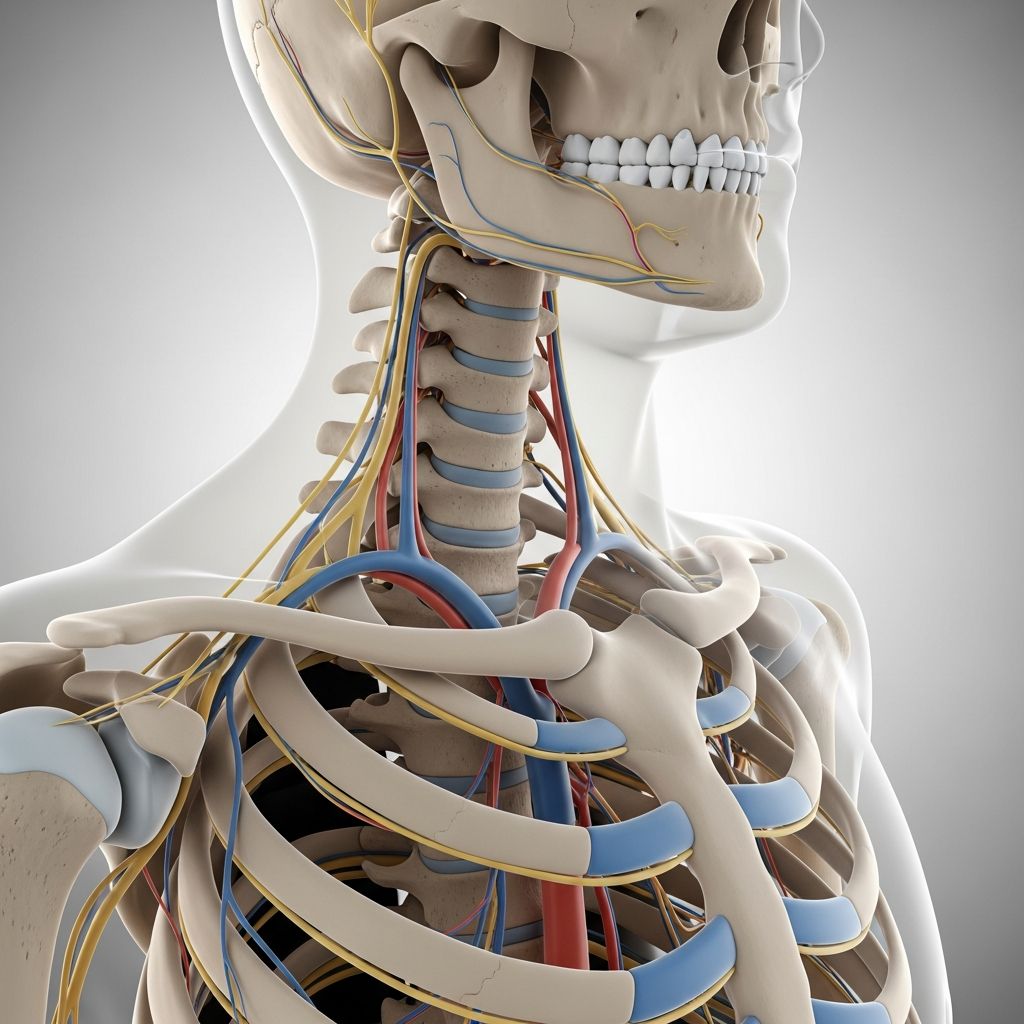
A cervical rib is an extra bone that some people are born with, extending from the lowest cervical vertebra (the seventh bone in the neck, also called C7). This anatomical variation occurs in approximately 0.5 to 1% of the population and represents a remnant of evolutionary development. Unlike normal ribs that attach to the thoracic spine in the mid-back, cervical ribs originate in the neck region and can vary significantly in size, shape, and composition. Some cervical ribs are fully formed bone, while others may be cartilaginous or partially ossified.
The cervical rib is not considered part of the standard rib cage anatomy, which typically consists of 12 pairs of ribs. Instead, it represents an anatomical anomaly that may remain asymptomatic throughout a person’s life or can cause significant complications affecting nerve and blood vessel function in the thoracic outlet—the space between the collarbone and first rib where important neurovascular structures pass.
Anatomy and Location
The cervical rib typically attaches to the seventh cervical vertebra, the lowest bone in the cervical spine. While some cervical ribs extend only partially from the vertebra as a small bony prominence, others can be nearly complete rib-like structures. The cervical spine itself consists of seven stacked vertebral bones (C1 through C7) that form the neck region of the spinal column.
The thoracic outlet is a critical anatomical region bounded by the anterior and middle scalene muscles, the first rib, and the clavicle. Through this narrow passage travel the brachial plexus (a network of nerves controlling the arm) and the subclavian artery and vein (major blood vessels supplying and draining the arm). When a cervical rib is present, it can narrow this already-tight space, creating compression and functional obstruction of these vital structures.
How Cervical Ribs Develop
Cervical ribs are congenital, meaning they are present from birth as a developmental variation. During fetal development, the embryo forms extra ribs in the cervical region that typically regress and fuse with the cervical vertebrae. In some individuals, these embryologic remnants fail to completely regress and instead develop into bony or cartilaginous structures. This developmental process explains why cervical ribs are found in a small percentage of the general population and often go undetected unless imaging studies are performed for other reasons.
The presence of a cervical rib does not indicate a genetic disorder in most cases, though rare genetic syndromes can be associated with cervical ribs. Most people with cervical ribs inherit this trait through normal human anatomical variation rather than through a specific genetic mutation.
Symptoms Associated with Cervical Ribs
Many individuals with cervical ribs experience no symptoms whatsoever and may never know they have this anatomical variation. However, when symptoms do occur, they typically result from compression of the brachial plexus or subclavian vessels, leading to thoracic outlet syndrome (TOS). Symptoms may include:
- Pain and numbness in the arm, hand, and fingers, particularly on the affected side
- Weakness in the hand and arm muscles
- Tingling or strange sensations (paresthesias) in the fingertips
- Coolness or discoloration of the affected arm or hand due to reduced blood flow
- Swelling in the arm or hand
- Pain radiating into the shoulder, neck, or chest
- Symptoms that worsen with activities involving overhead arm movement or poor posture
Related Stories



When compression involves blood vessels rather than just nerves, additional symptoms may include visible swelling, color changes in the arm or hand, or in severe cases, tissue loss from inadequate blood supply. Symptoms often develop gradually and may worsen over time, particularly if the condition goes untreated. Early recognition and treatment are important because prolonged nerve compression can lead to irreversible nerve damage.
Diagnosis of Cervical Rib
Physical Examination
Your healthcare provider will perform a thorough physical examination, including specific tests to assess nerve and blood vessel function. The EAST (Elevated Arm Stress Test) is commonly used to evaluate for thoracic outlet syndrome. This test involves holding your arms elevated with elbows bent at 90 degrees and fingers open, then making fist-opening motions. A positive test shows reproduction of symptoms or disappearance of the radial pulse at the wrist.
Other examination techniques may include palpation (feeling) of the supraclavicular area for bony prominences, assessment of arm and hand strength, evaluation of sensation, and checking for diminished or absent pulses in the affected extremity.
Imaging Studies
Several imaging techniques can confirm the presence of a cervical rib and assess its relationship to surrounding structures:
- Chest X-ray: Often the initial imaging study that incidentally discovers cervical ribs. The frontal view may show the extra rib on one or both sides.
- CT Scan with Contrast: Provides detailed three-dimensional images of the cervical rib and its relationship to blood vessels and nerves. This imaging is particularly valuable for surgical planning, allowing surgeons to visualize the anatomy before performing the procedure.
- MRI: Can show soft tissue structures and help identify nerve or blood vessel compression.
- Ultrasound: May be used to assess blood flow and detect vascular compression.
- Nerve Conduction Studies and Electromyography (EMG): These tests measure electrical activity in nerves and muscles to confirm nerve dysfunction.
Treatment Options
Conservative Management
For individuals with asymptomatic cervical ribs discovered incidentally, no treatment is necessary. For those with mild symptoms, conservative management is typically attempted first and may include:
- Physical therapy focusing on posture improvement and muscle strengthening
- Ergonomic modifications to reduce stress on the neck and shoulders
- Activity modification to avoid positions that exacerbate symptoms
- Nonsteroidal anti-inflammatory medications for pain management
- Rest and avoidance of repetitive overhead activities
However, it is important to recognize that physical therapy alone cannot remove the cervical rib or substantially enlarge the thoracic outlet. While therapy may provide temporary symptom relief, it does not address the underlying anatomical obstruction.
Surgical Treatment
Surgical removal of the cervical rib is the definitive treatment for symptomatic cases. This procedure, called cervical rib resection or cervical rib excision, involves surgically removing the extra bone to decompress the brachial plexus and restore adequate blood flow. The surgery may be performed through an anterior (front of the neck) or transaxillary (through the armpit) approach, depending on the surgeon’s expertise and the specific anatomy.
During the procedure, the surgeon carefully removes the cervical rib while protecting the adjacent nerves and blood vessels. In some cases, additional interventions may be performed, such as release of the anterior scalene muscle to further decompress the thoracic outlet. Following surgery, patients typically experience gradual improvement in symptoms over weeks to months, though nerve-related symptoms may take longer to fully resolve.
The success rate for cervical rib resection is generally high for appropriately selected patients, with most experiencing significant symptom improvement. However, complete resolution of all symptoms is not guaranteed, particularly if nerve damage has already occurred.
Complications and Urgency of Treatment
Untreated cervical ribs can lead to serious complications. Chronic compression of blood vessels can cause aneurysmal changes, blood clots, and potentially tissue loss in the hand or arm. Prolonged nerve compression can result in permanent nerve damage that may not respond to subsequent surgical treatment.
One of the most severe complications is the development of causalgia (also called complex regional pain syndrome), characterized by severe, burning pain in the affected extremity that can be completely disabling. Once causalgia develops, it is extremely difficult to treat successfully, even with surgical intervention.
Because of these potential complications and the risk of irreversible nerve injury, prompt diagnosis and treatment of symptomatic cervical ribs is important. Early surgical intervention in appropriately selected patients can prevent progression to these severe complications.
Cervical Ribs and Thoracic Outlet Syndrome
Cervical ribs represent a special category of thoracic outlet syndrome in which the underlying pathoanatomic mechanism is magnified by the presence of the extra bone. The weight of the arm combined with the narrowed thoracic outlet space stretches the brachial plexus over the cervical rib, creating trauma to the nerves. This compression is more severe and more resistant to conservative treatment than standard thoracic outlet syndrome caused by muscle tension or postural factors alone.
While physical therapy may have some benefit in standard neurologic thoracic outlet syndrome, it cannot address the mechanical obstruction created by the cervical rib. Surgical removal becomes necessary to effectively treat the condition and prevent progressive neurologic damage.
Recovery After Surgery
Recovery from cervical rib resection varies among individuals. Most patients can resume light activities within a few weeks following surgery. Full recovery and maximum symptom improvement typically take several months as the compressed nerves gradually recover function.
Physical therapy after surgery focuses on regaining strength and range of motion in the neck and shoulder. Patients are typically advised to avoid heavy lifting and strenuous upper extremity activities for 6 to 12 weeks following surgery to allow proper healing of the surgical site.
Post-operative imaging, including chest X-rays, may be performed to confirm successful removal of the cervical rib and to assess the integrity of surrounding structures, particularly the lung (to rule out pneumothorax).
Frequently Asked Questions
Q: Are cervical ribs dangerous?
A: Cervical ribs are not inherently dangerous and many people have them without ever experiencing problems. However, when they cause compression of nerves or blood vessels, they can lead to significant symptoms and complications if left untreated. Early detection and appropriate management prevent serious complications.
Q: Can cervical ribs go away on their own?
A: No, cervical ribs are a permanent anatomical structure present from birth. They cannot resolve spontaneously. However, many people with cervical ribs never develop symptoms and require no treatment. Surgical removal is the only way to eliminate a symptomatic cervical rib.
Q: Will physical therapy alone treat a cervical rib?
A: Physical therapy alone cannot remove the cervical rib or significantly enlarge the thoracic outlet. While therapy may provide temporary symptom relief, surgery is the definitive treatment for symptomatic cervical ribs causing nerve or blood vessel compression.
Q: How long does recovery take after cervical rib removal?
A: Most patients can resume light activities within a few weeks. Full recovery and maximum symptom improvement typically take 3 to 6 months. Nerve-related symptoms may take longer to fully resolve as compressed nerves gradually recover function.
Q: Can cervical ribs cause upper back or chest pain?
A: While cervical ribs typically cause arm and hand symptoms, they can occasionally contribute to referred pain in the shoulder, neck, or upper chest. Chest pain with a cervical rib may indicate compression affecting thoracic structures or referred pain from nerve irritation.
Q: Are bilateral cervical ribs common?
A: Yes, cervical ribs can occur on one side (unilateral) or both sides (bilateral). Bilateral cervical ribs are not uncommon, and patients with bilateral ribs may require staged surgical removal on each side if both are causing symptoms.
References
- Anatomy, Thorax, Cervical Rib — National Center for Biotechnology Information (NCBI), StatPearls. 2025. https://www.ncbi.nlm.nih.gov/books/NBK541001/
- Cervical Spine (Neck): What It Is, Anatomy & Disorders — Cleveland Clinic. 2025. https://my.clevelandclinic.org/health/articles/22278-cervical-spine
- Thoracic Outlet Syndrome (TOS): Symptoms and Treatment — Cleveland Clinic. 2025. https://my.clevelandclinic.org/health/diseases/17553-thoracic-outlet-syndrome-tos
- Rib Cage Anatomy and Function — Cleveland Clinic. 2025. https://my.clevelandclinic.org/health/body/rib-cage
Similar Articles








Read full bio of Sneha Tete