Cervical Spine (Neck): Anatomy, Function & Disorders
Complete guide to cervical spine anatomy, function, common disorders, and treatment options for neck health.
Understanding Your Cervical Spine: The Foundation of Neck Health
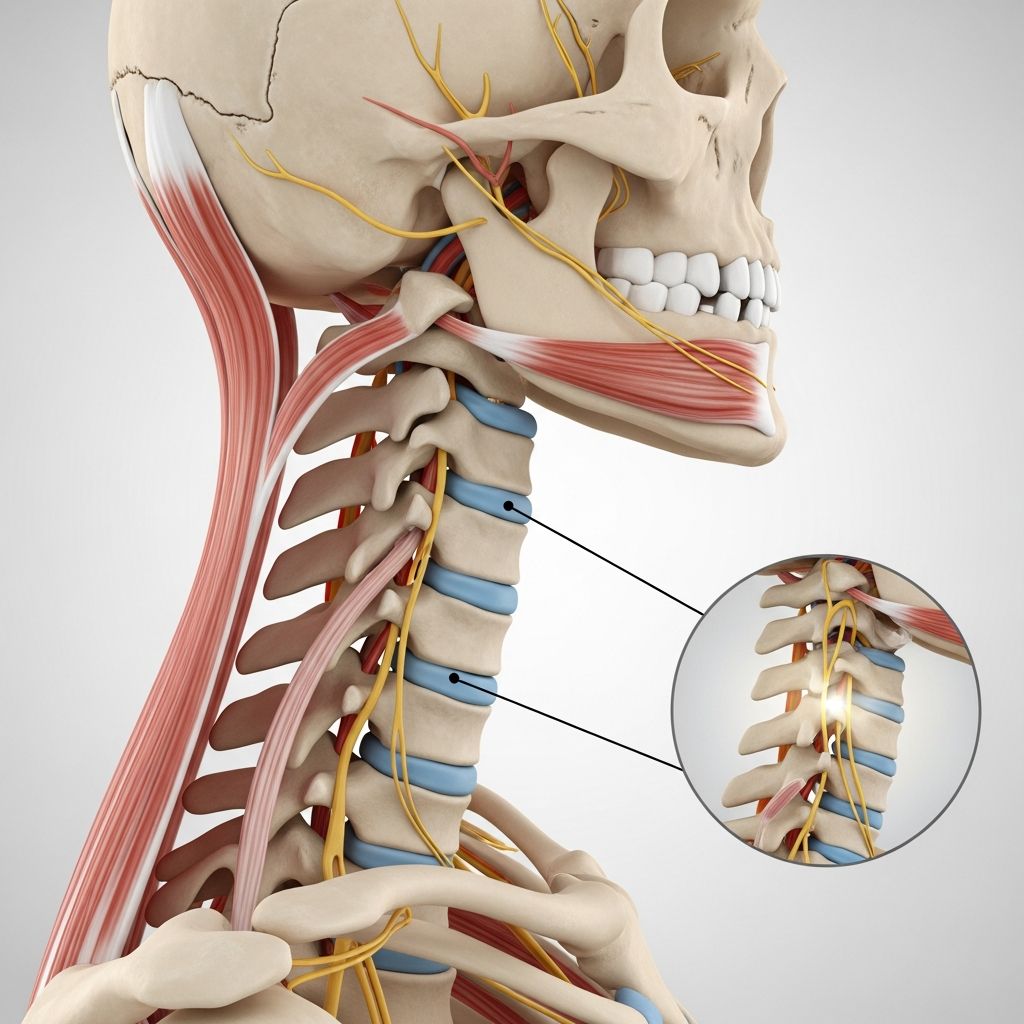
Your cervical spine is the uppermost segment of your spinal column, consisting of seven stacked bones called vertebrae. This region, commonly referred to as your neck, is one of the most important and complex areas of your body. The cervical spine provides essential support for the weight of your head, protects your delicate spinal cord, and enables a remarkable range of head movements that we often take for granted. Understanding the anatomy and function of your cervical spine is crucial for recognizing potential problems and seeking appropriate treatment when needed.
The cervical spine differs significantly from other regions of your spine due to its unique structural characteristics and vital functions. Unlike the thoracic or lumbar spine, the cervical region must balance stability with mobility, allowing your head to move freely while maintaining protective support for the spinal cord and nerve roots. This delicate balance makes the cervical spine particularly susceptible to both degenerative changes and injuries over time.
Cervical Spine Anatomy: Seven Vertebrae with Distinct Characteristics
Your cervical spine is composed of seven vertebrae labeled C1 through C7, each with specific anatomical features and functions. The first two vertebrae are particularly unique and deserve special attention.
The Atlas (C1): Your Head’s Foundation
Your first cervical vertebra, known as the atlas, is named after Atlas from Greek mythology, who was depicted carrying the world on his shoulders. This ring-shaped bone sits at the base of your skull and is responsible for holding your head upright. The atlas has a distinctive design that allows it to articulate smoothly with the skull above and the axis below, facilitating the up-and-down nodding motions of your head.
The Axis (C2): The Pivot Point
Your second cervical vertebra is called the axis, and it works in conjunction with the atlas to enable side-to-side rotation of your head, similar to the motion of shaking your head to say “no.” The axis features a unique projection called the odontoid process or dens, which acts as a pivot point for the atlas to rotate around. This innovative design allows for remarkable rotational flexibility while maintaining stability.
The Remaining Cervical Vertebrae (C3-C7)
Vertebrae C3 through C7 have a more standard vertebral structure compared to C1 and C2. These vertebrae become progressively larger as you move down the cervical spine, providing increasing support and structural stability. Each vertebra includes a body, spinous process, transverse processes, and various facets that allow for articulation with adjacent vertebrae.
Functions of Your Cervical Spine
Your cervical spine serves multiple critical functions that are essential for daily life and overall health:
- Head Support: Your cervical spine supports the weight of your head, which typically weighs between 10 and 12 pounds, requiring robust structural support and muscular control
- Spinal Cord Protection: The vertebrae form a protective channel called the spinal canal that surrounds and safeguards your delicate spinal cord
- Nerve Root Protection: The cervical spine protects eight pairs of nerve roots that branch off from the spinal cord and extend to various parts of your upper body
- Movement and Flexibility: Your cervical spine allows for an impressive range of head movements including flexion, extension, lateral flexion, and rotation
- Structural Support: The cervical spine connects the skull to the thoracic spine, providing structural continuity throughout your spinal column
Related Stories



Supporting Structures of the Cervical Spine
Intervertebral Disks: The Shock Absorbers
Between each of your seven cervical vertebrae sit six intervertebral disks, often referred to as the “shock absorber cushions” of your spine. These disks consist of a tough outer layer called the annulus fibrosus and a gel-like center called the nucleus pulposus. The cervical disks serve multiple important functions: they absorb and distribute stress placed on your neck, allow for flexibility and movement, maintain proper spacing between vertebrae, and protect nerve roots from compression. Over time, these disks can degenerate due to aging, repetitive stress, or injury, potentially leading to various cervical spine conditions.
Muscles Supporting Your Cervical Spine
Numerous muscles attach to your cervical spine and work together to support your head, stabilize your neck, and enable movement. The major muscles include the sternocleidomastoid muscle located on the front of your neck, the trapezius muscle connecting your neck to your shoulders and upper back, the levator scapulae muscle helping to elevate your shoulder blade, and various deep cervical muscles that provide stability and fine motor control. These muscles work in coordinated patterns to maintain posture and execute complex movements.
Ligaments: Connective Support
Ligaments are tough, fibrous tissues that connect bone to bone and help maintain the stability of your cervical spine. Three major cervical spine ligaments include the anterior longitudinal ligament running along the front of your vertebral bodies, the posterior longitudinal ligament running along the back of your vertebral bodies, and the ligamentum flavum connecting the laminae of adjacent vertebrae. These ligaments work together to prevent excessive movement while still allowing normal, healthy motion.
Common Cervical Spine Conditions and Disorders
Many diseases and conditions can affect your cervical spine and the surrounding soft tissues, nerves, and blood vessels. Understanding these conditions is important for recognizing symptoms and seeking appropriate treatment:
Cervical Spondylosis (Osteoarthritis of the Neck)
Cervical spondylosis is a general term for wear-and-tear changes that affect your cervical spine as you age. This degenerative condition occurs when the bones, disks, and ligaments in your neck gradually wear down over time. Age-related changes are a natural part of getting older, and cervical spondylosis is one of the most common conditions affecting the cervical spine in older adults.
Cervical Myelopathy
Cervical myelopathy is compression on your spinal cord in your neck. The most common type is cervical spondylotic myelopathy, which results from degenerative changes. In the United States, 15,000 to 20,000 people visit the hospital each year with symptoms of cervical spondylotic myelopathy. This condition can cause significant neurological symptoms that may worsen if left untreated.
Cervical Radiculopathy
This condition occurs when nerve roots in the cervical spine become irritated or compressed, typically causing pain, numbness, or weakness that radiates down your arm and into your hand. The compression can result from disk herniation, bone spurs, or other structural changes in the cervical spine.
Cervical Stenosis
Cervical stenosis happens when the spinal canal narrows, reducing the space available for your spinal cord. This narrowing can result from bone spurs, disk herniation, ligament thickening, or other structural changes, potentially causing symptoms ranging from mild to severe.
Cervical Disk Herniation
A cervical disk herniation occurs when the gel-like center of a disk protrudes through the tough outer layer, potentially irritating nearby nerve roots or the spinal cord itself. This condition can develop suddenly following an injury or gradually over time due to degenerative changes.
Cervical Vertigo (Cervicogenic Dizziness)
This condition causes both neck pain and dizziness, often accompanied by vision issues, nausea, and lack of coordination. Cervical vertigo can result from inflammation, joint issues, trauma, or misalignment of cervical structures affecting the vestibular system.
Diagnosis of Cervical Spine Conditions
When you experience neck pain or other symptoms potentially related to your cervical spine, your healthcare provider will follow a systematic diagnostic approach. First, they will gather your complete medical and medication history and ask detailed questions about your symptoms, including when they started, what makes them worse or better, and how they affect your daily activities. A thorough physical examination follows, during which your provider will assess your neck’s range of motion, test your strength and sensation, check your reflexes, and look for any abnormalities.
Imaging and Diagnostic Tests
Various imaging studies can provide detailed visualization of your cervical spine structures:
- X-rays: Often the first imaging study performed, providing basic visualization of vertebral alignment and bone structure
- Magnetic Resonance Imaging (MRI): Excellent for visualizing soft tissues including disks, spinal cord, and nerve roots
- Computed Tomography (CT) Scans: Provides detailed bone imaging and can show neural foramina and spinal canal dimensions
- Electromyography (EMG): Tests nerve and muscle function to identify areas of nerve compression or damage
- Nerve Conduction Studies: Measures how well electrical signals travel along nerves
Treatment Options for Cervical Spine Conditions
Nonsurgical Treatment Approaches
For many cervical spine conditions, healthcare providers typically begin with conservative, noninvasive treatments. These approaches focus on managing symptoms, reducing inflammation, and improving function without requiring surgery. Common nonsurgical treatment options include physical therapy and neck exercises designed to improve strength, flexibility, and posture; nonsteroidal anti-inflammatory drugs (NSAIDs) to reduce pain and inflammation; neck immobilization using collars or braces to limit motion and promote healing; heat and cold therapy to manage pain and reduce inflammation; and cervical epidural steroid injections or radiofrequency ablation for more significant pain management.
Nonsurgical treatments address immediate symptoms but may not provide long-term relief or address underlying structural problems like a significantly narrowed spinal canal. However, these approaches are valuable first-line treatments for many conditions and can provide significant symptom relief for many patients.
Surgical Treatment Options
You may be a candidate for cervical spine surgery if you have severe symptoms unresponsive to conservative treatment, progressive neurological deficits, significant functional impairment, or structural problems requiring intervention. The specific surgical procedure recommended depends on your symptoms, general health, age, and the underlying condition.
Cervical Decompression Surgery
Cervical decompression refers to various procedures designed to relieve pressure or compression on your spinal cord or nerve roots. Common decompression techniques include anterior cervical diskectomy and fusion (ACDF), posterior cervical laminectomy and fusion, cervical laminoplasty, and cervical foraminotomy.
Cervical Disk Replacement Surgery
This procedure involves removing a diseased cervical disk and replacing it with an artificial disk. The primary reason for this procedure is cervical disk degeneration, and it offers an alternative to traditional fusion surgery in selected cases.
Cervical Spinal Fusion
Cervical spinal fusion is surgery that permanently connects one or more cervical vertebrae together. The surgery eliminates motion between the fused vertebrae, which can reduce pain caused by abnormal motion but also slightly decreases overall neck mobility.
Functional Electrical Stimulation
For patients with spinal cord injury affecting cervical nerves, this procedure uses small electrical impulses to activate specific muscles and nerves, potentially restoring function to upper body muscles controlled by cervical nerves.
Outlook and Prognosis
Your outlook for cervical spine conditions depends on the underlying cause, severity, and how promptly you seek treatment. Mild cases of cervical myelopathy that respond well to nonsurgical management typically have positive outcomes, especially if surgical treatment is pursued when necessary. However, cervical myelopathy can worsen if left untreated, potentially causing permanent, irreversible nerve damage leading to intense pain and difficulty moving. This underscores the importance of early diagnosis and appropriate treatment.
Frequently Asked Questions About Cervical Spine Health
Q: What are the seven cervical vertebrae labeled as?
A: The seven cervical vertebrae are labeled C1 through C7, starting from the top at the skull base and moving down toward the thoracic spine. C1 and C2 have unique characteristics, with C1 (atlas) supporting your head and C2 (axis) enabling rotation.
Q: What causes cervical spondylosis?
A: Cervical spondylosis is caused by age-related wear and tear of your cervical spine. As you get older, your bones, disks, and ligaments naturally become thinner, lose flexibility and strength, and develop degenerative changes such as bone spurs.
Q: Can cervical spine problems cause dizziness?
A: Yes, cervical vertigo (cervicogenic dizziness) is a condition where neck problems cause both neck pain and dizziness, often accompanied by vision issues and lack of coordination. This condition typically responds well to physical therapy and specific inner ear exercises.
Q: How many intervertebral disks are in the cervical spine?
A: There are six intervertebral disks in the cervical spine, positioned between the seven cervical vertebrae. These disks act as shock absorbers and allow for neck flexibility and movement.
Q: When is cervical spine surgery necessary?
A: Cervical spine surgery may be recommended if you have severe symptoms unresponsive to conservative treatment, progressive neurological deficits, significant functional impairment, or structural problems like severe spinal cord compression that cannot be adequately addressed with nonsurgical approaches.
Q: What is the difference between cervical myelopathy and cervical radiculopathy?
A: Cervical myelopathy involves compression of the spinal cord itself, often causing widespread symptoms affecting both arms and legs. Cervical radiculopathy involves compression of specific nerve roots, typically causing pain and symptoms that radiate into one arm following a specific nerve distribution pattern.
References
- Cervical Spine (Neck): What It Is, Anatomy & Disorders — Cleveland Clinic. Accessed 2025-12-01. https://my.clevelandclinic.org/health/articles/22278-cervical-spine
- Cervical Myelopathy: What It Is, Symptoms & Treatment — Cleveland Clinic. Accessed 2025-12-01. https://my.clevelandclinic.org/health/diseases/cervical-myelopathy
- Cervical Spondylosis: What It Is, Symptoms & Treatment — Cleveland Clinic. Accessed 2025-12-01. https://my.clevelandclinic.org/health/diseases/17685-cervical-spondylosis
- Cervical Vertigo (Cervicogenic Dizziness): Symptoms & Treatment — Cleveland Clinic. Accessed 2025-12-01. https://my.clevelandclinic.org/health/diseases/23174-cervical-vertigo
- Spinal Stenosis: What It Is, Causes, Symptoms & Treatment — Cleveland Clinic. Accessed 2025-12-01. https://my.clevelandclinic.org/health/diseases/17499-spinal-stenosis
- Spine: Anatomy, Function, Parts, Segments & Disorders — Cleveland Clinic. Accessed 2025-12-01. https://my.clevelandclinic.org/health/body/10040-spine-structure-and-function
Similar Articles








Read full bio of medha deb