Testosterone Levels By Age: Chart And Normal Ranges
Understand normal testosterone ranges across all life stages, from infancy to adulthood, and recognize signs of imbalance.
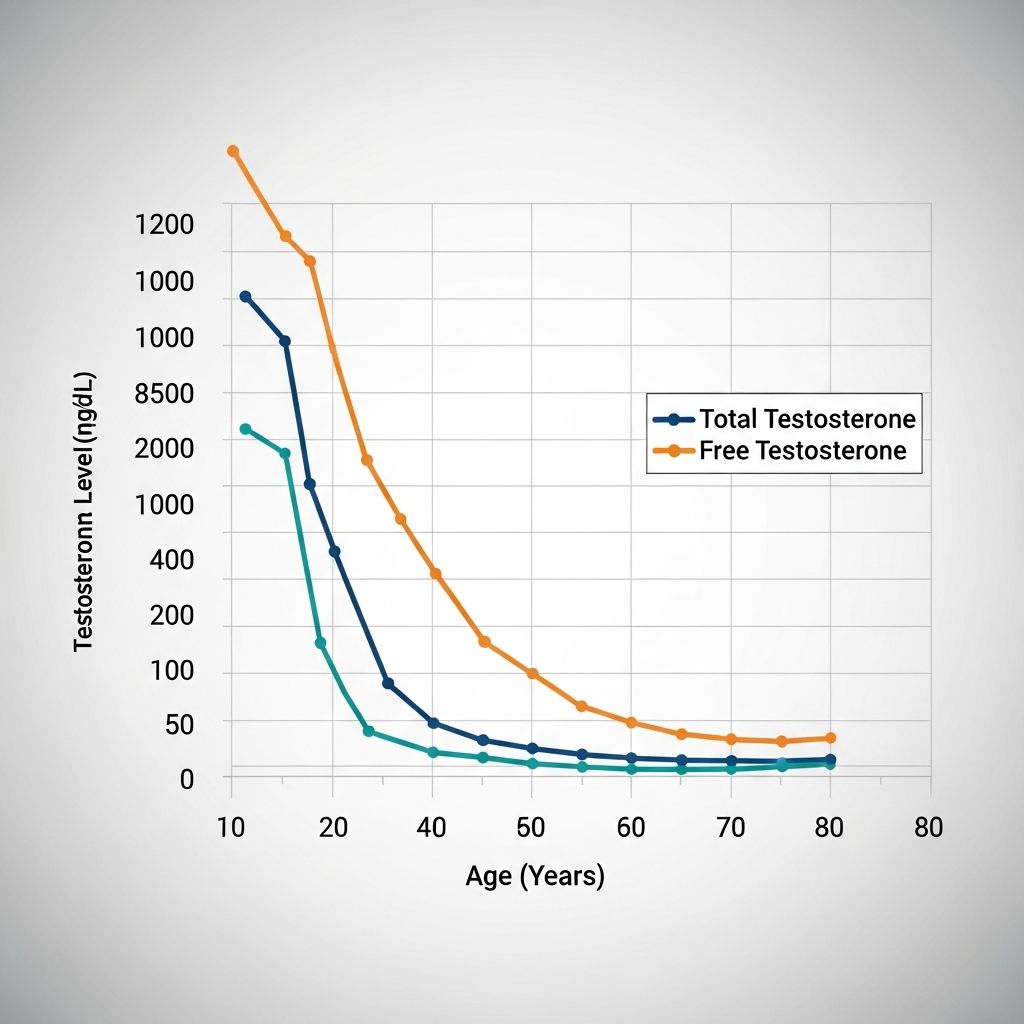
Testosterone, the primary male sex hormone, plays a crucial role in muscle mass, bone density, red blood cell production, and sexual function. Levels fluctuate naturally across life stages, peaking in early adulthood and declining with age. Understanding these ranges helps identify potential deficiencies or excesses, guiding medical evaluation.
What Are Normal Testosterone Levels?
Normal testosterone levels vary by age, sex, time of day, and lab standards. Total testosterone measures bound and unbound hormone, while free testosterone reflects the active form. For adult men, total levels typically range from 300–1,000 ng/dL, but age-specific benchmarks provide better context.
Measurements use nanograms per deciliter (ng/dL) or nanomoles per liter (nmol/L). Labs often report reference ranges based on the middle tertile of healthy populations, excluding extremes.
Testosterone Levels by Age Chart
Here’s a synthesized chart of average total testosterone levels by age group for males, drawn from multiple clinical sources. Ranges represent typical healthy values; individual results should be interpreted by a healthcare provider.
| Age Group | Normal Total Testosterone (ng/dL) | Notes |
|---|---|---|
| Infants (0-6 months) | 75–400 | Initial surge post-birth |
| Children (1-10 years) | <25 | Low prepubertal levels |
| Early Teens (11-13 years) | 7–800 | Puberty onset |
| Mid Teens (14-16 years) | 100–1,200 | Rapid rise |
| Late Teens (17-19 years) | 300–1,200 | Approaching adult peak |
| 20-24 years | 409–558 | Peak levels |
| 25-29 years | 413–575 | Young adult high |
| 30-34 years | 359–498 | Gradual decline begins |
| 35-39 years | 352–478 | Mid-adult range |
| 40-49 years | 252–916 | Decline accelerates |
| 50-59 years | 215–878 | Noticeable drop |
| 60-69 years | 196–859 | Senior adjustment needed |
| 70+ years | 156–819 | Lowest natural range |
Free testosterone, the unbound portion (1-2% of total), also declines: e.g., 5.3–26.3 pg/mL for ages 40-49, dropping to 2.2–14.7 pg/mL by 70-79.
How Testosterone Changes Throughout Life
Testosterone production begins in utero, surges in infancy, remains low until puberty (around age 10-14), then peaks in the early 20s. Levels decline 1-2% annually after 30-40, dropping 30% by age 70.
Factors influencing changes include genetics, lifestyle, obesity, chronic illness, sleep, stress, and environment. Young men today may have lower levels due to poor sleep and stress.
- Childhood: Minimal production until puberty activation via hypothalamic-pituitary signals.
- Puberty: 10-20x increase drives growth spurts, voice deepening, muscle development.
- Adulthood: Stabilizes for reproductive health, energy, cognition.
- Aging: Gradual decline linked to reduced Leydig cell function in testes.
Symptoms of Abnormal Testosterone Levels
Low Testosterone (Hypogonadism)
Below age-adjusted norms (often <300 ng/dL in adults) can cause:
- Fatigue and low energy
- Reduced libido and erectile dysfunction
- Muscle loss, increased body fat
- Mood changes: depression, irritability
- Bone density loss (osteoporosis risk)
- Sleep disturbances, hot flashes
- Hair loss, gynecomastia
Symptoms may appear even in ‘normal’ ranges if suboptimal for the individual.
High Testosterone Levels
Rare naturally; often from supplements or tumors. Signs include:
- Acne, oily skin
- Aggression, mood swings
- Infertility, testicular shrinkage
- Prostate enlargement
- Sleep apnea
Causes of Low Testosterone
Primary (testicular issues): injury, infection, chemotherapy.
Secondary (pituitary/hypothalamus): tumors, medications, obesity.
Lifestyle: poor diet, inactivity, alcohol, opioids, endocrine disruptors.
When to Get Tested
Test if symptoms persist despite healthy habits, especially over 40 or with risk factors. Morning blood draw (7-10 AM) captures peak levels. Repeat for confirmation; include free T, LH, FSH, SHBG.
Related Stories



- Family history of hypogonadism
- Unexplained fatigue/infertility
- Age 40+ with symptoms
Testosterone Replacement Therapy (TRT)
TRT restores levels via gels, injections, patches for symptomatic low T. Benefits: improved energy, muscle, mood, sex drive. Risks: prostate issues, blood clots, infertility. Monitored by endocrinologists.
Not for age-related decline alone; lifestyle first: weight loss, exercise, sleep.
How to Boost Testosterone Naturally
- Exercise: Resistance training, HIIT (30-45 min, 3-4x/week)
- Diet: Healthy fats (avocados, nuts), zinc (oysters), vitamin D
- Sleep: 7-9 hours/night
- Weight management: Reduce abdominal fat
- Stress reduction: Meditation, avoid endocrine disruptors
Frequently Asked Questions
What is a normal testosterone level for a 30-year-old man?
Around 359–498 ng/dL total; consult lab-specific ranges.
Do testosterone levels drop after 50?
Yes, to 215–878 ng/dL, with 1-2% annual decline.
Can low T cause depression?
Yes, linked to mood disorders; testing recommended.
Is 250 ng/dL low?
Potentially, especially under 40; symptoms matter.
How accurate are at-home tests?
Convenient but less reliable than lab; confirm clinically.
References
- What Are Normal Testosterone Levels by Age? — GameDay Men’s Health. 2023. https://gamedaymenshealth.com/blog/what-are-normal-testosterone-levels-by-age/
- What Is A Normal Testosterone Level For Your Age? — Medichecks. 2023. https://www.medichecks.com/blogs/testosterone/what-is-a-normal-testosterone-level-for-your-age
- Testing for Testosterone by Age — Labcorp OnDemand. 2023. https://www.ondemand.labcorp.com/blog/testing-for-testosterone-by-age
- What Are Normal Testosterone Levels By Age in Men? — Hone Health. 2023. https://honehealth.com/edge/testosterone-levels-by-age/
- Normal Testosterone Levels by Age — Baptist Health. 2023. https://www.baptisthealth.com/blog/mens-health/normal-testosterone-levels-by-age
- Testosterone: What It Is, Function & Levels — Cleveland Clinic. 2023-10-29. https://my.clevelandclinic.org/health/articles/24101-testosterone
- What Is a Normal Testosterone Level for Young Men? Rethinking the 300 ng/dL Cutoff — AUA Journals. 2022. https://www.auajournals.org/doi/10.1097/JU.0000000000002928
Similar Articles








Read full bio of Sneha Tete