Cherry Angioma Pathology: What You Need To Know
Detailed histopathological analysis of cherry angiomas, benign vascular skin tumours common in older adults.
Author: Dr Harriet Cheng, Dermatopathologist, Hamilton, New Zealand. February 2023. Updated January 2026.
Introduction
Cherry angiomas, also known as
Campbell de Morgan spots
, are common benign vascular tumours that increase in frequency with age. These lesions represent proliferations of capillaries in the superficial dermis and are among the most prevalent acquired vascular skin growths in adults over 30 years. They typically present as small, bright red to purple papules scattered across the body, most commonly on the trunk, and pose no malignant potential. Understanding their pathology is essential for accurate diagnosis, differentiation from other vascular lesions, and appropriate management.Histologically, cherry angiomas are characterised by dilated, interconnecting capillary loops within the papillary dermis, often with an atrophic overlying epidermis. These features distinguish them from other haemangiomas and vascular malformations. While clinically benign and asymptomatic, they may bleed upon trauma, prompting removal for cosmetic or functional reasons. Genetic studies have identified somatic mutations in GNAQ and GNA11 genes, shedding light on their pathogenesis.
Clinical features
Cherry angiomas manifest as firm, dome-shaped papules measuring 0.1–1 cm in diameter, with colours ranging from bright red to blue, purple, or even black if thrombosed. They are usually multiple and scattered over the trunk, proximal extremities, shoulders, and arms, sparing the face, hands, feet, and mucous membranes. The lesions are asymptomatic but can bleed profusely if traumatised due to their superficial dermal location and proximity to the epidermis.
- Size: 1–5 mm typically, occasionally larger.
- Shape: Circular or oval, dome-shaped or polypoid when clustered.
- Colour: Ruby red (classic), purple, blue; thrombosed lesions appear darker.
- Surface: Smooth, glossy; may blanch partially with pressure.
- Distribution: Trunk (most common), upper limbs; rare on acral sites.
In older adults, dozens to hundreds may be present, increasing with age. Sudden eruption or rapid increase in number warrants evaluation to exclude associations with systemic conditions, though most occur in healthy individuals.
Etiology and pathophysiology
The exact cause of cherry angiomas remains unknown, but several factors contribute to their development. Aging is the strongest association, with prevalence rising sharply after age 30 and affecting nearly all individuals over 70. Genetic analyses reveal somatic missense mutations in
GNAQ
(e.g., Q209H, Q209R, R183G) andGNA11
(Q209H) genes in a significant proportion of lesions. These mutations, also seen in uveal melanoma and other vascular proliferations, suggest dysregulated endothelial cell growth.Other proposed associations include:
- Pregnancy: Hormonal changes may trigger eruption, resolving postpartum in some cases.
- Chemical exposure: Limited evidence links mustard gas or bromides, but not substantiated.
- Genetics: Familial clustering observed, supporting hereditary predisposition.
- Malignancy: Rare reports of eruption preceding internal cancers, but causal link unproven.
Pathophysiologically, lesions evolve from flat red macules to raised papules via proliferation of post-capillary venules in dermal papillae. They comprise tortuous, dilated capillary loops with prominent endothelial cells, forming a lobular architecture. Perivascular hyalinisation and type VI collagen deposition stabilise the structure. Trauma induces bleeding due to epidermal atrophy and vessel fragility.
Histopathology
Cherry angioma specimens are often polypoid with a characteristic
epidermal collarette
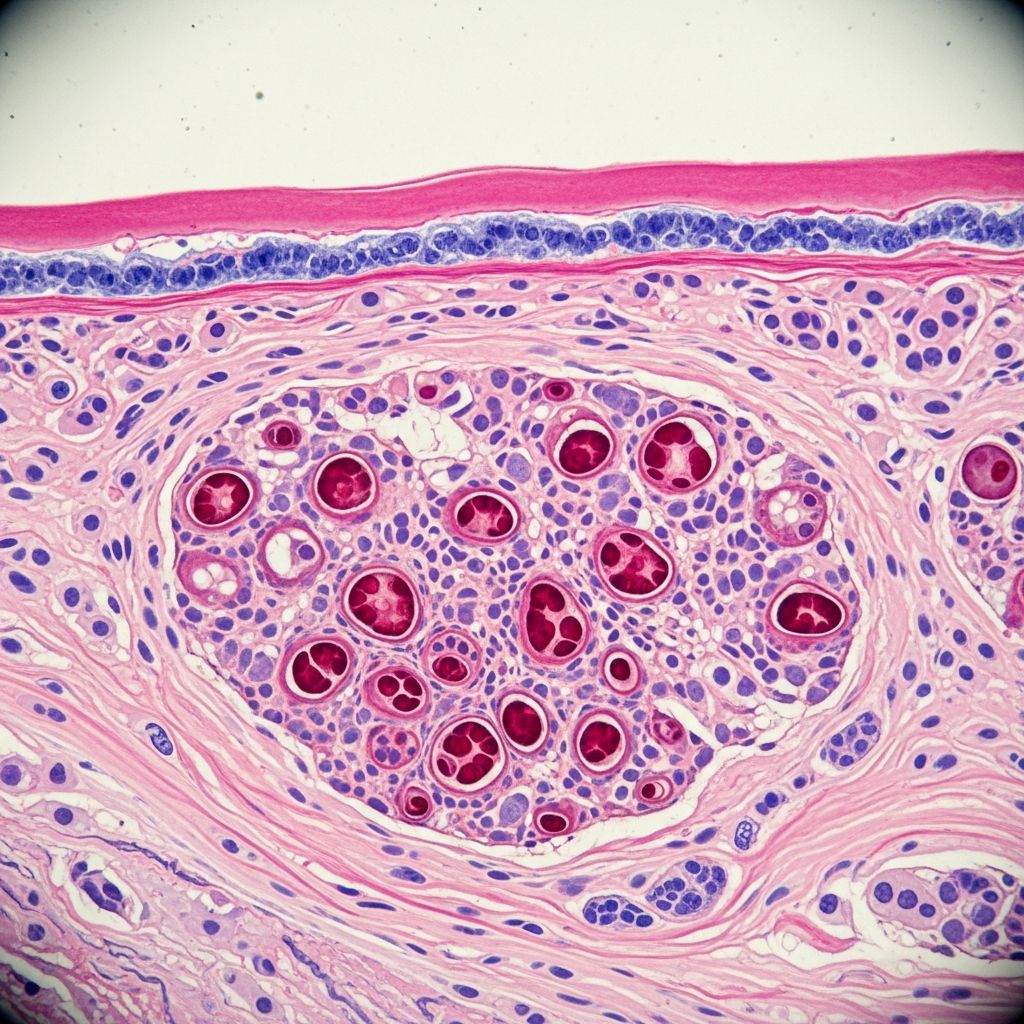
—a rim of thickened epidermis at the base. The overlying epidermis is atrophic, showing loss of rete ridges. In the superficial papillary dermis, dilated, interconnecting capillaries form a labyrinthine or lacunar pattern (Figure 1 description: low-power view showing well-circumscribed dermal nodule of vascular channels beneath thinned epidermis).Related Stories



Key microscopic features include:
- Dilated thin-walled capillaries with narrow lumens.
- Prominent endothelial cells without atypia or mitoses.
- Lobular arrangement in papillary dermis.
- Perivascular hyalinised sheaths positive for type VI collagen.
- Homogenised, oedematous collagen between vessels.
- Absence of inflammation or ulceration.
Immunohistochemistry confirms endothelial markers (CD31, CD34, ERG) with normal alpha-smooth muscle actin in pericytes and type IV collagen in basement membranes. No proliferative activity (Ki-67 low).
| Feature | Cherry Angioma | Lobular Capillary Haemangioma (Pyogenic Granuloma) |
|---|---|---|
| Capillary dilation | Marked, interconnecting | Less dilated, organised lobules |
| Endothelial cells | Prominent, bland | Cytological atypia, mitoses |
| Epidermis | Atrophic, collarette | Ulcerated, hyperplastic |
| Inflammation | Minimal/absent | Prominent, neutrophilic |
Differential diagnosis
Cherry angiomas are usually diagnosed clinically by their uniform appearance and multiplicity. Dermoscopy reveals a
red lacunar pattern
with well-defined red globules. Key differentials include:- Spider telangiectasia (spider naevus): Central arteriole with radiating legs; blanches fully; hormonal association.
- Pyogenic granuloma: Rapid growth, friable, ulcerated; history of trauma.
- Glomus tumour: Painful, blue-red nodule under nail.
- Angioma serpiginosum: Grouped pinpoint red dots in dermatomal distribution.
- Melanoma/nodular BCC: Atypical features prompt biopsy.
Biopsy is reserved for solitary, changing, or atypical lesions.
Investigations
No routine investigations needed. Dermoscopy suffices for confirmation. Histology if diagnostic uncertainty: excisional or shave biopsy. Genetic testing not clinically indicated.
Management
Benign and require no treatment. Options for cosmetic removal or bleeding:
- Cryotherapy: Liquid nitrogen; simple office procedure.
- Electrosurgery/electrocautery: Precise vessel coagulation.
- Laser (pulsed dye): Targets haemoglobin; minimal scarring.
- Curettage ± cautery: For larger lesions.
- Sclerotherapy: Rare, specialist use.
For bleeding: firm pressure 10–20 mins; silver nitrate if persists. Refer suspicious lesions urgently.
Frequently asked questions
Q: Are cherry angiomas cancerous?
A: No, they are entirely benign with no malignant potential.
Q: Why do they bleed easily?
A: Superficial dilated vessels beneath thin epidermis rupture with minor trauma.
Q: Do they go away on their own?
A: No, they persist lifelong but may thrombose and darken.
Q: Can they be prevented?
A: No known prevention; normal aging process.
Q: When to see a doctor?
A: Sudden increase, bleeding, colour/shape change, or solitary lesion.
Complications
Rare: recurrent bleeding, cosmetic concern, scarring post-treatment. No systemic associations proven.
References
- Cherry Hemangioma – StatPearls — Almazan E, et al. NCBI Bookshelf, NIH. 2023-10-01. https://www.ncbi.nlm.nih.gov/books/NBK563207/
- Cherry angioma pathology — DermNet NZ. 2023-02. https://dermnetnz.org/topics/cherry-angioma-pathology
- Cherry Angioma: Features, Causes, and Removal — DermNet NZ. 2024. https://dermnetnz.org/topics/cherry-angioma
- Angioma — WHO/IARC Skin Tumour Classification. 2024-01. https://publications.iarc.who.int/Book-And-Report-Series/Who-Classification-Of-Tumours/Skin-Tumours-2024
- Vascular Skin Lesions — British Association of Dermatologists Guidelines. 2025-03. https://www.bad.org.uk/pils/cherry-angioma/
Similar Articles








Read full bio of medha deb