Childhood Bullous Pemphigoid: Diagnosis, Treatment, Prognosis
Rare autoimmune blistering skin disorder in children: causes, symptoms, diagnosis, and effective treatments for remission.
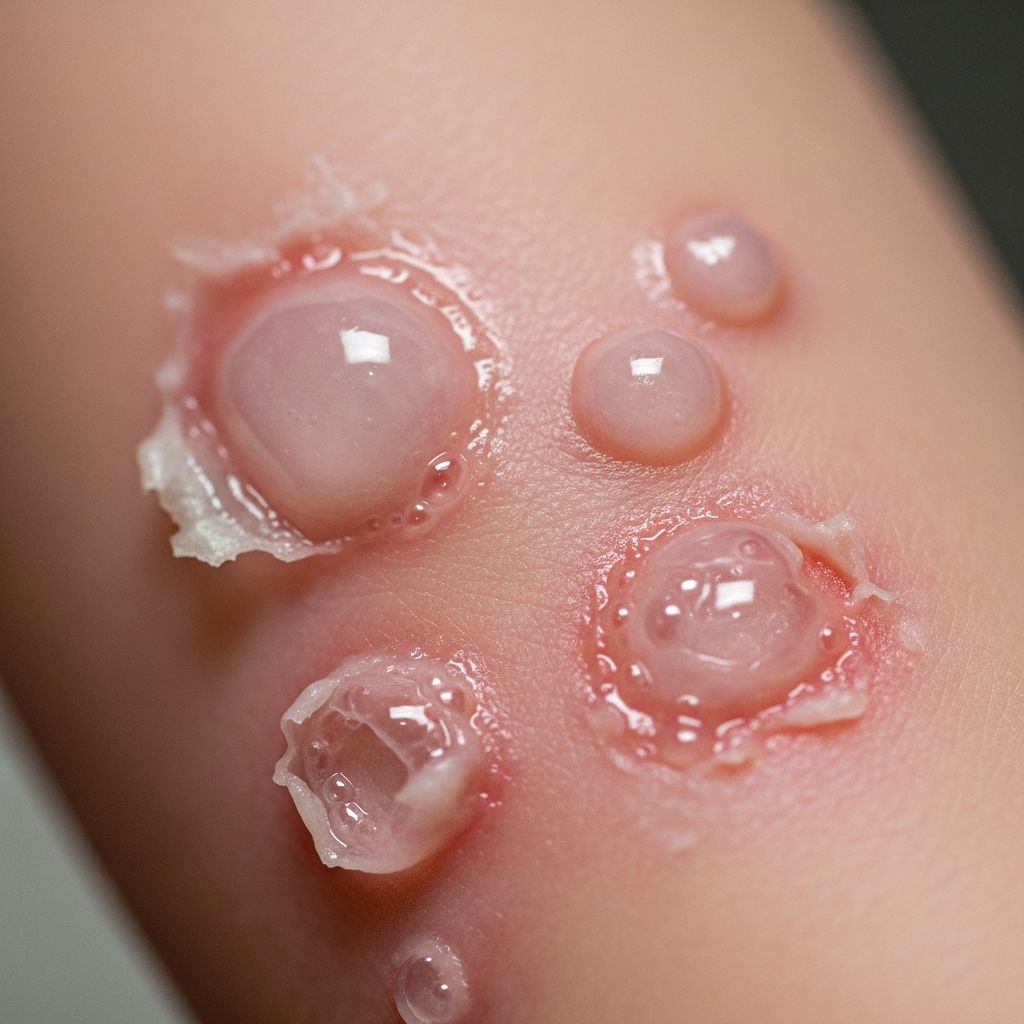
Childhood bullous pemphigoid is a rare autoimmune blistering skin disorder primarily affecting infants and young children under 7 years old. It manifests as tense blisters on an urticarial or erythematous base, often intensely pruritic, distinguishing it from adult forms which typically occur in the elderly.
What is Childhood Bullous Pemphigoid?
Childhood bullous pemphigoid (CBP) represents less than 10% of all bullous pemphigoid cases, with an estimated incidence of 0.35 per million children annually. Unlike adult bullous pemphigoid, which accounts for 80% of subepidermal immunobullous disorders in the elderly, CBP is characterized by autoantibodies targeting basement membrane components, specifically BP180 (collagen XVII NC16A domain) and less commonly BP230. This immune reaction leads to subepidermal separation, resulting in tense bullae that heal with minimal scarring.
The condition is self-limited in most cases, resolving within months to 3 years, with a favourable prognosis. However, it causes significant morbidity due to pruritus and secondary infections if untreated.
Who Gets Childhood Bullous Pemphigoid?
CBP predominantly affects children aged 2 months to 7 years, with a median onset around 2.5 years. It is exceedingly rare in neonates and adolescents. There is no strong gender predilection, though some series report a slight female predominance. Familial cases are exceptional, and no clear ethnic predisposition exists.
Risk factors mirror adult BP, including prior skin trauma or UV exposure, but in children, vaccination or minor infections may precede onset in anecdotal reports. Unlike chronic bullous disease of childhood (linear IgA disease), CBP shows no association with gluten sensitivity or IBD.
What Causes Childhood Bullous Pemphigoid?
CBP is an autoimmune disorder where IgG autoantibodies attack hemidesmosomal proteins BP180 and BP230 in the epidermal-dermal junction. BP180, a transmembrane collagen, is the primary antigen, with epitopes in the NC16A domain triggering complement activation and inflammatory infiltrate recruitment.
Genetic factors like HLA-DR4 may predispose, but environmental triggers—medications, infections, or vaccinations—remain speculative. The pathogenesis involves eosinophil-rich inflammation, protease release, and dermo-epidermal cleavage, sparing adnexal structures hence minimal scarring.
What are the Clinical Features of Childhood Bullous Pemphigoid?
- Prodrome: Preceding 1-2 weeks of nonspecific pruritic urticaria or eczematous eruption.
- Blisters: Tense, clear or haemorrhagic bullae (0.5-3 cm) on erythematous/urticarial plaques; fragile in flexures.
- Distribution: Acral predilection—hands, feet, face; progresses centripetally to trunk/thighs; mucosal rare (<10%).
- Morphology: Polymorphous: urticaria, vesicles, erosions, milia; Nikolsky negative.
- Symptoms: Severe pruritus; irritability in infants.
Atypical variants include vegetative (hyperkeratotic plaques) or erythrodermic forms. Healing occurs without atrophy or milia formation typically.
Diagnosis of Childhood Bullous Pemphigoid
Clinical suspicion prompts skin biopsy from perilesional skin for histopathology and direct immunofluorescence (DIF). Key findings:
- Histology: Subepidermal blister with eosinophils; papillary dermal oedema.
- DIF: Linear C3 ± IgG basement membrane zone (BMZ); salt-split skin indirect IF shows roof staining (epidermal BP180).
- Immunoblot/ELISA: Anti-BP180 NC16A IgG confirms.
| Test | Finding in CBP | Differential Distinction |
|---|---|---|
| Histology | Subepidermal bulla + eosinophils | vs. dermatitis herpetiformis (neutrophils) |
| DIF | Linear IgG/C3 BMZ | vs. Linear IgA (IgA) |
| Salt-split | Epidermal roof | vs. Mucous membrane pemphigoid (dermal) |
Serology ELISA >90% sensitive; biopsy differentiates from linear IgA bullous dermatosis (chronic bullous disease of childhood), epidermolysis bullosa acquisita.
Related Stories



Treatment of Childhood Bullous Pemphigoid
The goal is blister suppression and pruritus relief. Treatment mirrors adult BP but prioritizes steroid-sparing agents due to growth concerns.
First-line: Topical Corticosteroids
Ultra-potent agents like clobetasol propionate 0.05% ointment monotherapy suffices for mild/limited disease (<10% BSA). Apply BD to lesions until clearance, then taper. Effective in 50-70% cases with fewer systemic effects.
Systemic Corticosteroids
For moderate-severe/extensive disease: Prednisone/prednisolone 1-2 mg/kg/day (max 60 mg) rapidly controls (<2 weeks). Taper over 4-12 weeks guided by response; pulse IV methylprednisolone for fulminant cases.
Steroid-sparing Agents
- Dapsone: 1-2 mg/kg/day; first-line alternative/adjunct. Monitor G6PD, CBC (haemolysis risk).
- Sulfapyridine/Sulfonamides: 50-100 mg/kg/day divided doses.
- Antibiotics: Erythromycin 50 mg/kg/day, dicloxacillin/oxacillin 50 mg/kg/day (anti-inflammatory).
- Immunosuppressants: Azathioprine 1-2 mg/kg/day, mycophenolate, methotrexate (recalcitrant).
Emerging/Refractory
- Biologics: Dupilumab (IL-4/13 inhibitor), omalizumab, rituximab (B-cell depletion)—case reports in severe pediatric BP.
- IVIG/Immunoadsorption: Limited pediatric data.
Supportive: Emollients, antihistamines, wound care, infection prophylaxis. Multidisciplinary input (dermatology, immunology).
Prognosis and Complications of Childhood Bullous Pemphigoid
Excellent prognosis: 80-90% remit within 1-3 years; treatment withdrawn gradually. Minimal scarring/mil Milia rare. Complications: Secondary infection, steroid side-effects (Cushingoid, growth delay)—minimized by rapid taper/adjuncts.
Relapse <20%; monitor 6-12 months post-remission. No increased malignancy risk unlike adults.
Frequently Asked Questions (FAQs)
Q: How long does childhood bullous pemphigoid last?
A: Most cases resolve spontaneously within 1-3 years with treatment accelerating clearance to weeks-months.
Q: Is childhood bullous pemphigoid contagious?
A: No, it is an autoimmune condition, not infectious.
Q: Can it recur after treatment?
A: Relapses occur in <20%, usually milder; long-term monitoring advised.
Q: What is the difference from adult bullous pemphigoid?
A: CBP affects young children, acral distribution, better prognosis; adults: elderly, flexural, higher mortality from comorbidities.
Q: Are vaccinations safe in CBP?
A: Generally yes post-control; consult dermatologist for live vaccines on immunosuppressants.
Patient Resources
- Avoid triggers: Trauma, irritants.
- Daily emollient baths.
- Compliance key to rapid healing.
References
- Childhood Bullous Pemphigoid — DermNet NZ. 2023. https://dermnetnz.org/topics/childhood-bullous-pemphigoid
- Bullous Pemphigoid – StatPearls — Baigrie D, et al. NCBI Bookshelf. 2023-10-01. https://www.ncbi.nlm.nih.gov/books/NBK535374/
- Treatment of Chronic Bullous Disease of Childhood — Plastic Surgery Key. 2023. https://plasticsurgerykey.com/treatment-of-chronic-bullous-disease-of-childhood-2/
- Bullous Pemphigoid: Diagnosis and Treatment — American Academy of Dermatology (AAD). 2023. https://www.aad.org/public/diseases/a-z/bullous-pemphigoid-treatment
- Chronic Bullous Disease of Childhood — Great Ormond Street Hospital (GOSH). 2023. https://www.gosh.nhs.uk/conditions-and-treatments/conditions-we-treat/chronic-bullous-disease-childhood/
- Childhood Bullous Pemphigoid: Clinical and Immunopathologic Features — Martinez-De Pablo MI, et al. JAMA Dermatology. 2007-01-01. https://jamanetwork.com/journals/jamadermatology/fullarticle/411069
Similar Articles








Read full bio of medha deb