Cholesteatoma: Causes, Symptoms, and Treatment
Understanding cholesteatoma: A comprehensive guide to diagnosis and surgical management.
What is Cholesteatoma?
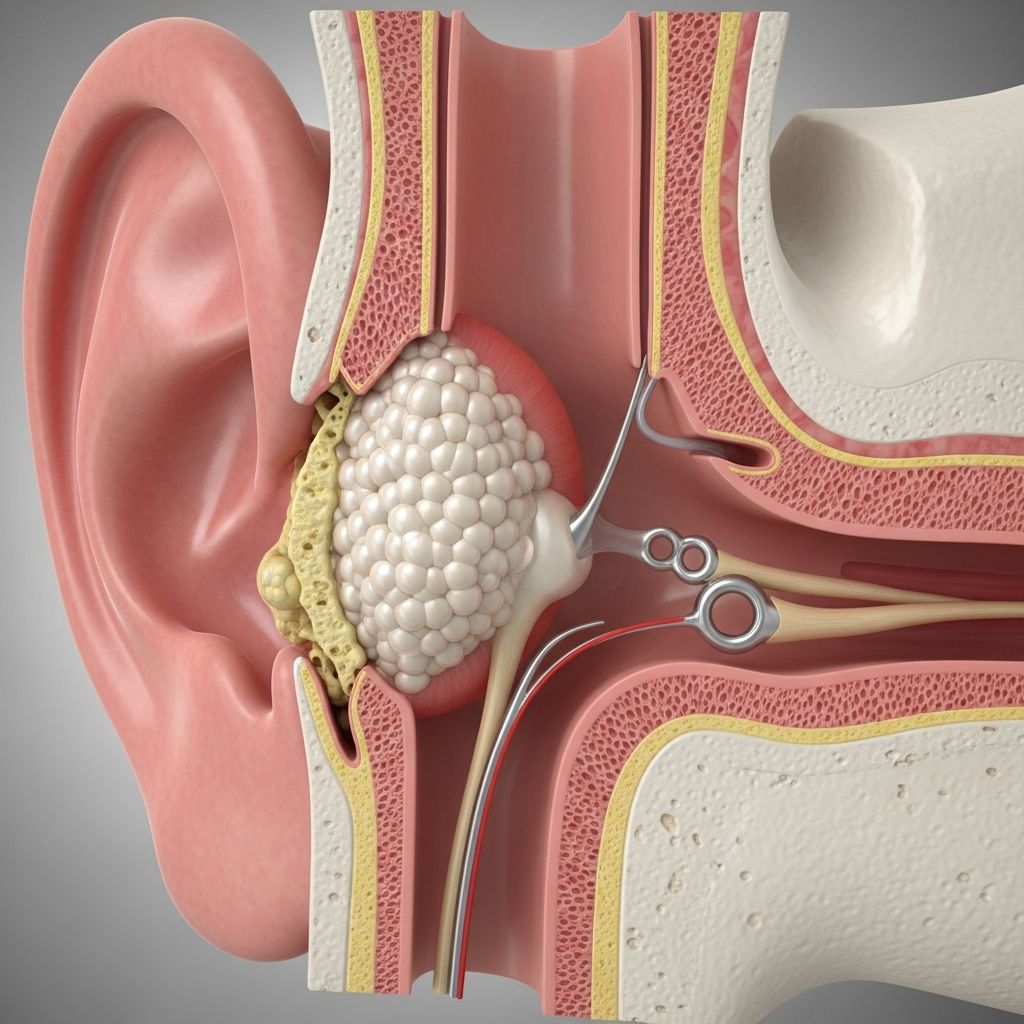
Cholesteatoma is an abnormal skin growth that develops in the middle ear, specifically behind the eardrum (tympanic membrane). This condition occurs when skin cells accumulate and form a mass that can gradually expand over time. The growth typically appears as a pearly white or yellowish mass and can range from small and asymptomatic to large and problematic, depending on its size and location within the ear canal and middle ear space.
The condition can be classified into two main types: congenital cholesteatoma, which is present from birth and appears as a white mass behind an intact eardrum without any history of ear infection, and acquired cholesteatoma, which develops as a result of chronic ear infection or tympanic membrane retraction. Acquired cholesteatoma is far more common than the congenital form and typically develops over years of chronic ear problems.
Causes and Risk Factors
Cholesteatoma can develop through several different mechanisms. In acquired cholesteatoma, the primary cause is often related to chronic ear infections or persistent drainage from the ear. When the middle ear becomes infected repeatedly, the eustachian tube may not function properly, leading to negative pressure that causes the tympanic membrane to retract inward. This retraction can trap skin cells and other debris, eventually forming a cholesteatoma.
Another pathway for developing acquired cholesteatoma involves a perforation or hole in the eardrum. When the eardrum is perforated due to infection, trauma, or previous ear surgery, skin cells from the ear canal can migrate into the middle ear space and accumulate over time. Additionally, poorly healed or inadequately repaired tympanic membranes can predispose individuals to cholesteatoma formation.
Congenital cholesteatoma, though less common, can occur even in patients with no history of ear infections or eardrum problems. The exact cause of congenital cholesteatoma remains unclear, but it is believed to result from incomplete reabsorption of embryologic remnants during fetal development.
Risk factors for developing acquired cholesteatoma include:
- Chronic ear infections or recurrent otitis media
- History of eardrum perforation
- Previous ear surgery or mastoidectomy
- Chronic drainage from the ear
- Poor eustachian tube function
- Chronic water exposure or frequent ear canal irritation
Symptoms and Complications
Many patients with cholesteatoma may not experience symptoms, particularly in early stages when the growth is small. However, as the cholesteatoma enlarges, it can cause a variety of symptoms related to its expansion and potential complications.
Common symptoms of cholesteatoma include:
- Chronic ear drainage or discharge, often foul-smelling
- Ear pain or pressure sensation
- Hearing loss in the affected ear
- Tinnitus (ringing in the ear)
- Vertigo or dizziness
- Sensation of fullness in the ear
- Facial nerve weakness or paralysis in severe cases
If left untreated, cholesteatoma can erode through the temporal bone structures and create serious complications. The expanding mass can erode the small bones of the middle ear (ossicles), leading to progressive hearing loss. More seriously, the cholesteatoma can erode through the inner ear structures, potentially causing sensorineural hearing loss, vertigo, and perilymphatic fistula. In rare cases, the disease can extend intracranially, leading to meningitis, cerebrospinal fluid leaks, or brain abscess.
Related Stories



Diagnosis of Cholesteatoma
Diagnosis of cholesteatoma typically begins with a thorough history and physical examination. During the ear examination, an otolaryngologist may observe signs such as a retracted tympanic membrane, a perforation with white debris, or drainage from the ear canal. However, definitive diagnosis usually requires imaging studies.
Computed tomography (CT) of the temporal bones is the gold standard imaging modality for diagnosing and evaluating cholesteatoma. CT imaging can reveal the exact location and extent of the disease, including whether the cholesteatoma has eroded adjacent bone structures such as the ossicles, the stapes, or the mastoid bone. The imaging can also show if the disease extends near critical structures like the facial nerve canal or the inner ear.
In some cases, magnetic resonance imaging (MRI) may be used to complement CT findings, particularly to assess for potential complications or when there is concern about intracranial extension. Audiometry (hearing tests) may also be performed to document any hearing loss associated with the cholesteatoma and to establish a baseline before treatment.
Treatment Options
The primary treatment for cholesteatoma is surgical removal. Medical therapy alone cannot cure cholesteatoma, as the abnormal skin growth will not resolve without intervention. The goal of surgery is complete disease ablation while preserving or restoring hearing when possible.
Observation
In rare cases where the cholesteatoma is small, asymptomatic, and not progressing, some surgeons may recommend careful observation with regular follow-up imaging rather than immediate surgery. However, most cases eventually require surgical intervention, particularly if the disease is enlarging or causing symptoms.
Surgical Procedures
Several surgical approaches exist for treating cholesteatoma, and the choice depends on the size, location, and extent of the disease.
Tympanoplasty (Exploratory Tympanotomy): For limited disease confined to the anterior middle ear without ossicular involvement, tympanoplasty alone may be sufficient. This procedure involves elevating the tympanic membrane to access and remove the cholesteatoma intact from the middle ear. Exploratory tympanotomy is often used as an initial staging procedure and is successful in controlling disease in approximately 36-40% of cases, particularly when the cholesteatoma is small and well-localized.
Canal Wall Up Tympanomastoidectomy (CWU): When the cholesteatoma involves the mastoid or extends into the attic and posterior superior quadrant of the middle ear, a canal wall up procedure is often performed. This approach opens the mastoid bone and middle ear while maintaining the integrity of the posterior and superior portions of the external auditory canal. The CWU approach preserves normal ear canal anatomy and function but has a higher recurrence rate compared to canal wall down procedures, typically requiring a planned second-look surgery 9-12 months later to ensure complete disease eradication and remove any residual cholesteatoma.
Canal Wall Down Tympanomastoidectomy (CWD): In more extensive disease or when there is ossicular erosion, a canal wall down procedure may be performed. This technique involves removing the posterior and superior portions of the external auditory canal, creating a common cavity between the ear canal and mastoid. While the CWD approach has a lower recurrence rate and typically requires fewer overall procedures, it can result in chronic ear drainage and impaired water resistance of the ear.
Ossicular Reconstruction: When cholesteatoma erodes the middle ear bones, ossicular chain reconstruction may be necessary during or after disease removal. Surgeons may use ossicular replacement prostheses (ORPs) to restore the mechanical chain of bone conduction and improve hearing outcomes.
Surgical Outcomes and Recurrence
Surgical outcomes for cholesteatoma vary depending on the disease extent and surgical approach selected. Complete disease eradication is achieved in the majority of cases, though recurrence rates differ significantly between surgical techniques.
Studies comparing surgical outcomes demonstrate important differences between approaches. Tympanoplasty alone has lower total surgical procedures than more extensive techniques, particularly when used for limited disease. Canal wall down procedures have the lowest recurrence rates, sometimes eliminating residual or recurrent disease entirely, though this comes at the cost of potential chronic ear drainage. Canal wall up procedures preserve canal anatomy but require second-look surgery and have higher recurrence rates, particularly for type 2 congenital cholesteatomas involving the attic and ossicular chain, which demonstrate recurrence rates around 34%.
Hearing outcomes also vary by surgical approach. Patients undergoing ossicular reconstruction may experience significant hearing improvement postoperatively, with some achieving normal air-bone gaps after successful reconstruction. However, some patients may ultimately require hearing aids if hearing restoration is incomplete or if preoperative hearing loss was severe.
Recovery and Postoperative Care
After cholesteatoma surgery, patients wake in recovery where medical staff monitor their progress. Most patients are discharged on the same day or after an overnight stay, depending on the complexity of the procedure and individual factors.
Postoperative guidelines typically include:
- Keeping the ear dry for several weeks to protect the surgical site
- Avoiding strenuous activity and heavy lifting during the initial recovery period
- Taking prescribed antibiotics and pain medication as directed
- Attending follow-up appointments as scheduled
- Using ear protection when showering or bathing
- Avoiding water activities until cleared by the surgeon
Full healing typically occurs over 4-6 weeks, though complete hearing assessment may take several months. Patients undergoing canal wall up procedures should anticipate a second-look surgery approximately 9-12 months after the initial procedure to confirm disease eradication and remove any residual cholesteatoma that may have been left intentionally during the first surgery to minimize complications.
Complications and When to Seek Medical Care
While cholesteatoma surgery is generally safe and effective, potential complications can include infection, hearing loss, vertigo, and facial nerve injury. Patients should seek immediate medical attention if they experience severe pain, fever, facial weakness or paralysis, significant vertigo, or sudden changes in hearing following surgery.
Untreated cholesteatoma carries risks of serious complications including middle ear infections that spread to surrounding structures, erosion through the mastoid bone into the brain cavity potentially causing meningitis, sensorineural hearing loss from inner ear damage, and perilymphatic fistula. These potential complications underscore the importance of timely diagnosis and treatment.
Frequently Asked Questions
Q: Can cholesteatoma go away on its own?
A: No, cholesteatoma cannot resolve spontaneously and will not go away without surgical intervention. The abnormal skin growth will continue to accumulate and potentially cause progressive damage to surrounding ear structures.
Q: Is cholesteatoma surgery dangerous?
A: Cholesteatoma surgery is generally safe and effective when performed by experienced otolaryngologists. Serious complications are rare, though infection, hearing changes, and facial nerve issues are potential risks that your surgeon will discuss before surgery.
Q: Will I need a second surgery for cholesteatoma?
A: If your surgeon performs a canal wall up (CWU) procedure, a planned second-look surgery is typically recommended 9-12 months later to ensure complete disease eradication. Canal wall down (CWD) procedures may not require second surgery, though some patients may develop chronic ear drainage.
Q: Can cholesteatoma affect hearing?
A: Yes, cholesteatoma commonly causes conductive hearing loss by eroding the small bones of the middle ear. In some cases, it can also cause sensorineural hearing loss if it damages inner ear structures. Ossicular reconstruction during surgery can help restore hearing in many cases.
Q: What is the difference between congenital and acquired cholesteatoma?
A: Congenital cholesteatoma is present from birth without prior ear infection history, while acquired cholesteatoma develops from chronic ear infections or eardrum retraction. Acquired cholesteatoma is far more common and typically develops over years.
Q: Can I get water in my ear after cholesteatoma surgery?
A: You should keep your ear dry during the initial recovery period. If you had a canal wall down procedure, you may need to protect your ear from water long-term with earplugs during bathing and swimming.
References
- Congenital Cholesteatoma: Classification, Management, and Outcome — Koltai et al., JAMA Otolaryngology—Head & Neck Surgery, via Koltai, MD, Section of Pediatric Otolaryngology, The Cleveland Clinic. 1995-2015. https://jamanetwork.com/journals/jamaotolaryngology/fullarticle/482957
- Outcomes in Pediatric Cholesteatoma — National Institutes of Health (NIH), PMC, 2024. https://pmc.ncbi.nlm.nih.gov/articles/PMC11697529/
- Cholesteatoma — Cleveland Clinic Journal of Medicine, Cleveland Clinic, 2018. https://www.ccjm.org/content/90/5/279
- Mastoidectomy: Definition, Surgery & Recovery — Cleveland Clinic, 2024. https://my.clevelandclinic.org/health/treatments/22593-mastoidectomy
- Mastoiditis: Symptoms, Causes & Treatment — Cleveland Clinic, 2024. https://my.clevelandclinic.org/health/diseases/24469-mastoiditis
Similar Articles








Read full bio of medha deb