Chondrodermatitis Nodularis Pathology: Clinical Histology Guide
Detailed histopathological analysis of chondrodermatitis nodularis, a benign yet painful ear nodule condition.
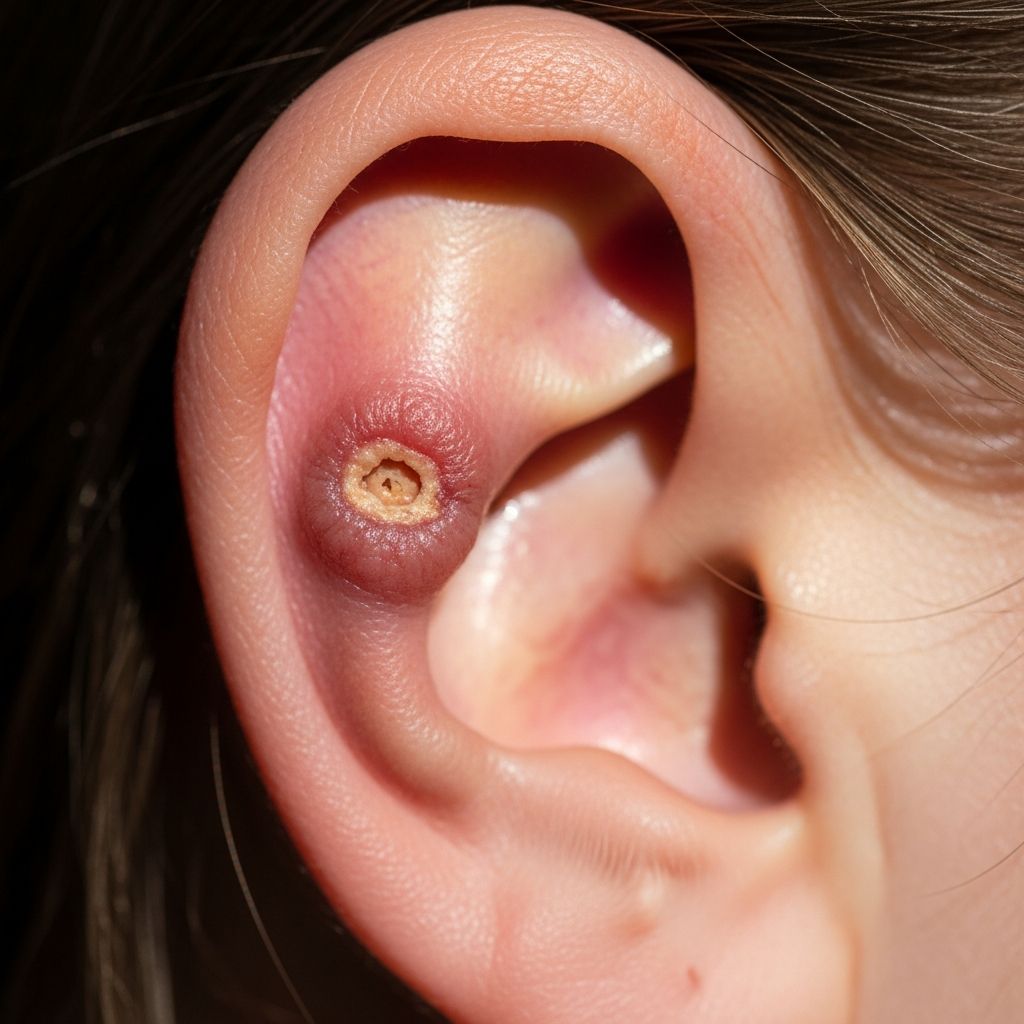
Chondrodermatitis nodularis (CNH), also known as chondrodermatitis nodularis helicis or nodular chondrodermatitis, is a benign inflammatory condition characterised by a painful nodule on the helix or antihelix of the ear. It predominantly affects middle-aged to elderly individuals, especially men, and is often linked to mechanical pressure during sleep. This article delves into its pathology, covering clinical presentation, histopathology, aetiology, differential diagnosis, and management.
Introduction
Chondrodermatitis nodularis represents a common yet underdiagnosed dermatological condition presenting as a tender, ulcerated nodule on the ear. Histologically distinct from malignancies, it features epidermal hyperplasia, dermal sclerosis, and cartilage involvement, often mimicking skin cancers clinically. Understanding its pathology is crucial for accurate diagnosis and conservative management, avoiding unnecessary biopsies.
Clinical Features
Patients typically report a spontaneously appearing painful nodule on the ear that enlarges rapidly to 3-20 mm, stabilising thereafter. Nocturnal pain, exacerbated by side-sleeping on the affected ear, is hallmark, disturbing sleep. Daytime tenderness occurs with pressure or cold exposure.
On examination, a solitary, firm, well-demarcated nodule, often 4-6 mm, appears on the helix apex or antihelix. It is erythematous, scaly, or crusted centrally, revealing a raw ulcer or core upon crust removal. The lesion adheres to underlying cartilage, lacking discharge unless manipulated.
- Common sites: Helix (outer rim, apex), antihelix (more in females).
- Size: 3-20 mm, average 6 mm.
- Appearance: Raised, tender, inflamed; central crust/ulcer.
- Symptoms: Sharp pain on pressure/sleep; occasional bleeding.
Histopathology
Microscopically, CNH exhibits a characteristic triad: marked hyperkeratosis and parakeratosis with epithelial hyperplasia forming a “plug” over a dermal defect; deep dermal sclerosis and fibrosis; and variable cartilage degeneration or perichondritis. The ulcer base shows fibrinoid necrosis, granulation tissue, and vascular proliferation. Neural hyperplasia may explain heightened pain.
Key features include:
- Epidermis: Acanthosis, hypergranulosis, compact orthokeratosis with central parakeratotic plug.
- Dermis: Sclerotic collagen bundles, vertical orientation; mixed inflammatory infiltrate.
- Cartilage: Erosion, chondrocyte degeneration, replacement by fibrocartilage.
- Vessels: Dilated, ectatic with perivascular lymphocytes.
Low-power view reveals a crateriform lesion with overhanging epidermis. High-power shows dyskeratosis and civatte bodies occasionally. This distinguishes CNH from carcinomas, lacking atypia or mitoses.
| Feature | Description |
|---|---|
| Epidermal changes | Hyperkeratosis, parakeratosis, acanthosis |
| Dermal changes | Sclerosis, fibrosis, inflammation |
| Cartilage | Degeneration, perichondritis |
| Other | Neural hyperplasia, vascular proliferation |
Aetiology and Pathophysiology
Mechanical trauma from prolonged pressure, especially nocturnal on the dependent ear, is primary. Men favour right-side sleeping, women left, explaining laterality. Contributing factors: thin ear skin, prominent ears (prominauris), hearing aids, spectacles, cold exposure, or vascular compromise.
Pathogenesis involves ischemia from pressure, leading to necrosis, inflammation, and reparative fibrosis. Autoimmune links (e.g., systemic sclerosis, granuloma annulare) noted in younger patients suggest vascular aetiology. Actinic damage may predispose via elastosis.
Related Stories



Clinical Variants
Classic CNH is nodular on helix/antihelix. Variants include:
- Cystic CNH: Pseudocyst with fluid-filled cavity, less painful.
- Bullous CNH: Rare vesicular form.
- Antihelix predominant: More in females.
- Bilateral: Infrequent, 10-20% cases.
In pediatrics/young adults, associate with collagen diseases.
Differential Diagnosis
CNH mimics malignancies due to ulceration/crusting:
| Condition | Key Distinguishers |
|---|---|
| Basal cell carcinoma | Pearly border, telangiectasia; biopsy shows basaloid nests. |
| Squamous cell carcinoma | Indurated, larger; keratin pearls, atypia. |
| Actinic keratosis | Scaly plaque, no nodule. |
| Gouty tophi | Multiple, chalky; high uric acid. |
| Elastotic nodules | Non-tender, multiple. |
| Keratoacanthoma | Rapid growth, crater; regresses. |
Biopsy if sun-damaged skin, cancer history, or non-response to pressure relief.
Investigations
Diagnosis is clinical, based on history (sleep position pain) and exam. Biopsy for uncertainty: punch/shave excision reveals pathognomonic features. No routine labs unless young patient (screen collagen vascular disease: ANA, etc.). Dermoscopy shows central white core, peripheral vessels.
Treatment
Conservative first-line:
- Pressure offloading: Opposite-side sleeping, soft pillow, ear guards, silicone protectors.
- Topicals: Potent steroids, tacrolimus under occlusion.
- Intralesional steroids: Triamcinolone 10-40 mg/mL.
Surgical if refractory: Core extirpation (remove ulcer/cartilage plug), wedge excision, laser ablation. Recurrence 20-50% post-surgery; conservative success 70-90%.
Prognosis
Benign, self-limiting rarely; persists without intervention. No malignant potential. Pain resolves with management; cosmetic outcome good post-excision.
Frequently Asked Questions
Is chondrodermatitis nodularis cancerous?
No, it is a benign inflammatory condition, not linked to skin cancer, though biopsy may be needed to confirm.
What causes chondrodermatitis nodularis?
Primarily pressure from sleeping on the ear, plus factors like cold, trauma, or vascular issues.
How is it treated?
Start with avoiding pressure (sleep position change, protectors); if needed, steroids or surgery.
Does it go away on its own?
Rarely; most require management to alleviate pain.
Can it affect both ears?
Yes, though usually unilateral.
Conclusion
Chondrodermatitis nodularis pathology underscores a mechanical-inflammatory process yielding distinctive histopathology. Early recognition enables non-invasive relief, improving quality of life.
References
- Chondrodermatitis Nodularis | Doctor – Patient.info — Patient.info. 2023. https://patient.info/doctor/dermatology/chondrodermatitis-nodularis
- Chondrodermatitis nodularis helicis — Cleveland Clinic Journal of Medicine. 2022-05-01. https://www.ccjm.org/content/90/5/277
- Chondrodermatitis Nodularis Helicis – StatPearls — NCBI Bookshelf (NIH). 2023. https://www.ncbi.nlm.nih.gov/books/NBK482507/
- Chondrodermatitis nodularis — Skin Health Info (BAD Patient Hub). 2016-08. https://www.skinhealthinfo.org.uk/wp-content/uploads/2018/11/Chondrodermatitis-nodularis-Update-Aug-2016-lay-reviewed-Jul-20163.pdf
- Chondrodermatitis: Causes, Treatment, Prevention — WebMD. 2023. https://www.webmd.com/skin-problems-and-treatments/what-is-chondrodermatitis
Similar Articles








Read full bio of Sneha Tete