Circadian Rhythms and Arthritis: Timing Your Health
Understanding how your body's internal clock affects arthritis symptoms and treatment effectiveness.
Understanding Circadian Rhythms and Arthritis
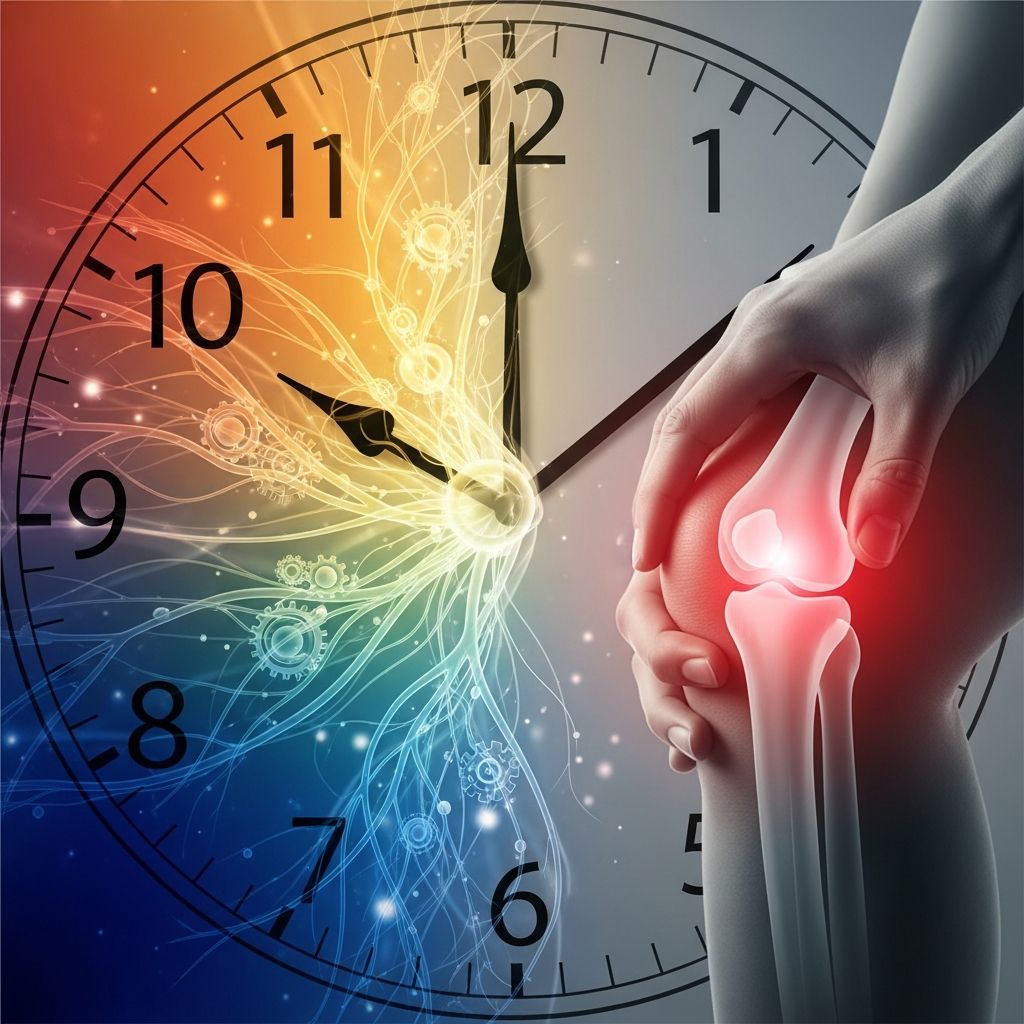
Circadian rhythms are biological processes that guide your body through a 24-hour cycle, regulating when you eat, sleep, and wake up. These internal clocks do far more than manage your sleep schedule—they influence immune function, inflammation levels, and the severity of arthritis symptoms throughout the day. For individuals living with arthritis, particularly rheumatoid arthritis (RA), understanding these daily cycles can provide valuable insights into symptom management and treatment optimization.
The connection between circadian rhythms and arthritis has become increasingly clear to researchers and clinicians. Studies show that arthritis symptoms and inflammation follow predictable patterns throughout the day, with many patients experiencing worse symptoms at specific times. This discovery opens new possibilities for timing treatments, lifestyle modifications, and therapeutic interventions to align with your body’s natural rhythms.
How Circadian Rhythms Affect Inflammation
Inflammation in arthritis is not constant throughout the day. Instead, it fluctuates in a rhythmic pattern controlled by your circadian clock. Research has demonstrated that inflammatory markers in patients with rheumatoid arthritis show significant daily variation, with the highest levels typically occurring in the early morning hours. This explains why many RA patients wake up with stiffness and pain that gradually improves as the day progresses.
The circadian clock regulates inflammation through several mechanisms. Within the inflamed joint, daily rhythmicity occurs in a wide range of proinflammatory markers, including IL-6, TNF-α, and other cytokines. Studies show that during daytime hours, proinflammatory processes in joints are actively elevated, but they become repressed during nighttime hours. This natural oscillation is driven by clock genes expressed within the joint itself, suggesting that local circadian clocks play a crucial role in controlling inflammation at the site of disease.
When circadian rhythm disruption occurs—whether from shift work, jet lag, or other factors—this natural anti-inflammatory pattern breaks down. Without proper circadian control, the nighttime decrease in inflammatory markers fails to occur, leading to heightened and more persistent inflammation. This explains why disruption of the circadian clock results in a heightened inflammatory state and loss of the disease rhythmicity typically observed in well-controlled arthritis.
The Connection Between Microbiome and Circadian Health
An often-overlooked aspect of the arthritis-circadian rhythm connection involves the microbiome—the vast communities of microorganisms that live in and on your body. The immune system and circadian rhythms interact in complex ways through the microbiome, creating a three-way relationship that significantly impacts arthritis development and progression.
From birth, your microbiome is precisely tuned to train your immune system to distinguish between harmful and helpful microbes. This training prevents immune cells from attacking beneficial bacteria or your body’s own tissues. However, when the microbiome becomes unbalanced—characterized by fewer anti-inflammatory microbes, a weakened intestinal lining, and overall loss of diversity—inflammation can flare significantly. This imbalance creates a direct pathway to rheumatoid arthritis and other autoimmune diseases. Since circadian rhythms regulate both immune function and microbiome composition, maintaining healthy circadian patterns supports a balanced microbiome and reduces autoimmune-driven inflammation.
Systemic Changes in Gene Expression During Arthritis
Chronic inflammatory arthritis drives profound changes in how genes are expressed throughout your body, particularly affecting the circadian control of cellular processes. Research analyzing gene expression patterns in arthritic conditions found that nearly 80% of rhythmically expressed genes either lost rhythmicity, gained rhythmicity, or showed significant changes in their rhythmic profile with disease development.
Related Stories



Within the inflamed joint, there is clear disturbance of the molecular clockwork itself. While rhythmic expression of core circadian clock components is widely maintained, there is significant reduction in overall expression and amplitude. This altered activity reflects the changing metabolic and inflammatory states characteristic of disease, with altered dominance of non-clock regulators driving time-of-day differences in gene expression.
Beyond the joint, systemic effects extend to muscle and liver tissues, where newly rhythmic patterns emerge or existing rhythmicity becomes enhanced. This convergence of a rhythmic inflammatory state with natural day-to-night changes in physiology—such as transitions from fasted to fed states—creates additional layers of complexity in how arthritis affects whole-body metabolism and energy regulation.
Circadian Disruption and RA Development
Mounting evidence suggests that disruption of the circadian clock is an aggravating factor in inflammatory arthritis development. When circadian timekeeping is disturbed, the body loses its ability to maintain the normal rhythmic suppression of inflammation that occurs at night.
Studies of rheumatoid arthritis patients have revealed abnormal molecular clockwork in synovial membrane tissue and cells derived from the joint. The clock dysfunction appears both in tissues and at the cellular level, with certain clock genes—particularly ARNTL2 and NPAS2—showing the strongest associations with inflammatory conditions. Importantly, some clock genes like PER1 fail to respond appropriately to inflammatory stimulation in RA patient fibroblasts, indicating a cell-autonomous defect in circadian timekeeping.
This disruption creates a situation where RA patients experience fatigue and dysfunction as if they were in constant jet lag. The de-synchronization of endogenous and geophysical time leads to persistent fatigue, immune cell dysfunction, and pathogenic production of inflammatory mediators—all effects that are partially controlled by the molecular clock.
Timing-Based Treatment Approaches
Understanding circadian rhythms has practical implications for arthritis treatment. A significant advance has been the development of modified-release medications that capitalize on natural rhythmic patterns of inflammation.
Modified-release prednisone exemplifies this approach. Unlike standard prednisone taken throughout the day, modified-release (MR) formulations deliver medication at night when inflammation peaks. Clinical studies demonstrate impressive results: patients taking MR prednisone experienced a 50% reduction in morning stiffness and a nearly 30% drop in IL-6 levels compared to those taking regular prednisone, with similar side effect profiles. When compared to placebo, MR prednisone led to significantly less disease activity, reduced fatigue, better physical function, and even remission in some patients.
This success with timing-based medication delivery has important implications for other arthritis treatments. The principle of aligning medication timing with circadian patterns of inflammation offers a path toward improving treatment effectiveness without necessarily increasing medication doses.
The Role of Clock Genes in Joint Inflammation
Recent research has identified specific mechanisms through which clock genes control inflammation in the joint. Profiling of core circadian clock components reveals that while rhythmic expression is maintained during arthritis, there is notable reduction in overall expression levels and amplitude. This dampening may result from increased cellularity in inflamed limbs and an influx of non-rhythmic inflammatory cells, or from the chronic inflammatory environment’s impact on peripheral clock function.
When local clock function is disrupted—either through genetic targeting or pharmacological manipulation—proinflammatory markers in severely affected joints increase and lose their normal rhythmicity. Simultaneously, the nighttime increase in anti-inflammatory markers is abolished. This clearly demonstrates the importance of an intact local clock for generating and maintaining the rhythmic inflammatory signature characteristic of controlled arthritis.
Multiple cell types within joints contribute to rhythmic cytokine signaling and inflammation patterns. Migratory immune cells including T cells, monocytes, neutrophils, and eosinophils, along with resident cells such as tissue macrophages, osteoclasts, osteoblasts, and osteocytes, all participate in creating the daily rhythm of joint inflammation.
Practical Implications for Arthritis Management
For individuals living with arthritis, understanding circadian rhythm principles suggests several practical strategies:
- Maintain consistent sleep-wake schedules: Regularity helps stabilize circadian rhythms and may reduce inflammation fluctuations.
- Discuss medication timing with your rheumatologist: Your doctor can evaluate whether timing-adjusted formulations might benefit your specific situation.
- Consider light exposure: Morning light exposure helps synchronize circadian rhythms and may support immune regulation.
- Prioritize sleep quality: Adequate sleep supports circadian function and immune regulation.
- Maintain stable meal times: Regular eating patterns support circadian alignment in peripheral tissues.
- Minimize circadian disruption: Avoiding shift work and frequent travel helps maintain consistent rhythmic patterns.
Chronotherapy as a Treatment Frontier
The emerging field of chronotherapy—treatment timed to align with circadian patterns—represents a significant frontier in arthritis care. The principle is straightforward: delivering treatment when the body is most receptive or when the condition is most active maximizes effectiveness and may reduce side effects.
For RA patients experiencing constant fatigue due to disrupted circadian timekeeping, chronotherapy approaches that take altered rhythms into account and attempt to correct them could prove beneficial. This might involve not only timing medication delivery but also implementing behavioral interventions designed to restore normal circadian function.
Frequently Asked Questions
Q: Why do arthritis symptoms tend to be worse in the morning?
A: Inflammation in arthritis follows a circadian rhythm, with inflammatory markers at their highest during early morning hours when you wake up. This natural pattern explains morning stiffness and pain that often improves throughout the day as inflammation naturally decreases.
Q: Can shift work worsen arthritis symptoms?
A: Yes. Shift work disrupts circadian rhythms, which impairs the body’s ability to maintain normal rhythmic patterns of inflammation control. Circadian disruption results in heightened and more persistent inflammation.
Q: How does modified-release medication work differently than regular medication?
A: Modified-release formulations deliver medication at night when inflammation naturally peaks, aligning treatment timing with disease patterns. This approach reduces morning stiffness by 50% and inflammatory markers by nearly 30% compared to regular dosing.
Q: What is the relationship between the microbiome and arthritis?
A: The microbiome trains your immune system and interacts with circadian rhythms. When the microbiome becomes imbalanced with fewer anti-inflammatory microbes, inflammation flares directly, leading to autoimmune diseases like RA.
Q: Can I reset my circadian rhythm if I have arthritis?
A: Yes. Maintaining consistent sleep-wake schedules, regular meal times, morning light exposure, and minimizing circadian disruption from shift work can help stabilize your circadian rhythms and potentially reduce inflammation fluctuations.
Q: What is chronotherapy?
A: Chronotherapy is treatment timed to align with your body’s circadian patterns or when your condition is most active. Modified-release prednisone that releases at night exemplifies this approach.
Conclusion: Taking Control Through Timing
The relationship between circadian rhythms and arthritis is complex but increasingly well understood. Your body’s internal 24-hour clock profoundly influences inflammation, immune function, and arthritis severity through effects on gene expression, immune regulation, and microbiome composition. Recognizing this connection opens new avenues for management beyond traditional medications.
By working with healthcare providers to maintain healthy circadian rhythms, considering timing-based treatment approaches, and understanding how your daily schedule affects your condition, you can optimize arthritis management and potentially improve outcomes. As chronotherapy research continues to advance, timing-based interventions may become an increasingly important part of comprehensive arthritis care.
References
- Chronic inflammatory arthritis drives systemic changes in circadian rhythms at the molecular level — Proceedings of the National Academy of Sciences (PNAS). 2022. https://www.pnas.org/doi/10.1073/pnas.2112781119
- The circadian clock regulates inflammatory arthritis — PubMed Central (PMC). 2016. https://pmc.ncbi.nlm.nih.gov/articles/PMC5067252/
- Circadian Timekeeping Is Disturbed in Rheumatoid Arthritis — PLOS ONE. 2013. https://journals.plos.org/plosone/article?id=10.1371%2Fjournal.pone.0054049
- Perfect Timing: Circadian Rhythms, Your Health and Your Arthritis — Arthritis Foundation. https://www.arthritis.org/health-wellness/about-arthritis/understanding-arthritis/circadian-rhythms-and-arthritis
- Circadian rhythms in rheumatoid arthritis: Implications for pathophysiology and therapeutic interventions — Arthritis & Rheumatism. 2011. https://onlinelibrary.wiley.com/doi/full/10.1002/art.22368
- Rheumatology with Rhythm: Circadian Considerations in Clinical Practice — The Rheumatologist. https://www.the-rheumatologist.org/article/rheumatology-with-rhythm/
Similar Articles








Read full bio of Sneha Tete