Circumscribed Palmar Hypokeratosis: Definition & Management
Rare benign skin condition on palms: erythematous depressed patches with unique stair-like epidermal thinning.
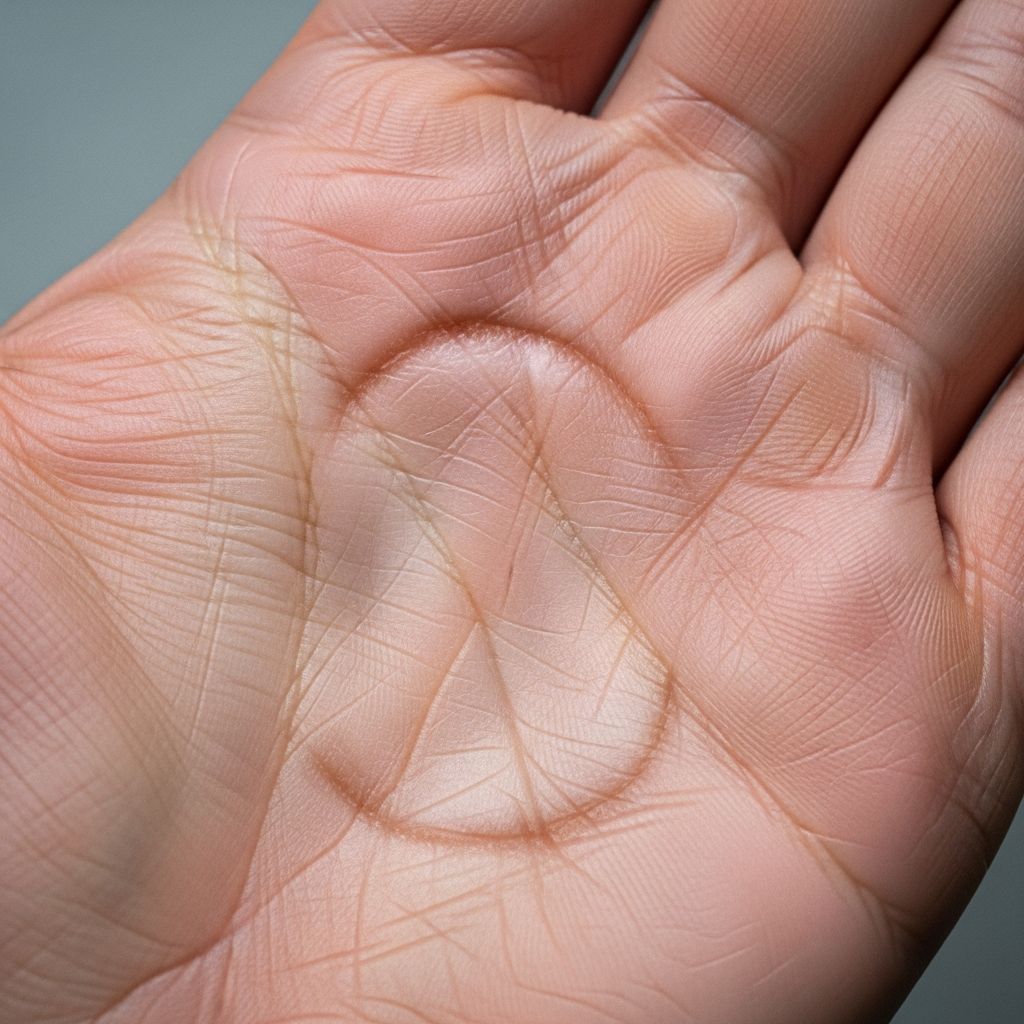
Circumscribed palmar hypokeratosis (CPH), also known as circumscribed acral hypokeratosis or circumscribed palmoplantar hypokeratosis, is a rare, benign epidermal disorder primarily affecting the palms and occasionally the soles. First described in 2002, it manifests as well-circumscribed, erythematous, depressed patches with a characteristic sharp stair-like border due to abrupt thinning of the stratum corneum. This condition predominantly impacts middle-aged women and remains largely asymptomatic, though mild tenderness or pruritus may occur.
What is Circumscribed Palmar Hypokeratosis?
Circumscribed palmar hypokeratosis represents a distinctive epidermal malformation characterized by localized reduction in the horny layer thickness. Clinically, it appears as solitary or occasionally multiple round plaques, typically 5-15 mm in diameter, with a depressed center and slightly raised, scaly rim. The lesions are persistent, often lasting years without significant change, and are most common on the thenar or hypothenar eminences of the palms. Plantar involvement is rarer, usually on the medial sole.
Histopathologically, the hallmark feature is a sharp demarcation between normal and affected skin, forming a ‘stair-like’ configuration. The stratum corneum in the lesion is markedly thinned (hypokeratosis), with orthokeratosis and no parakeratosis. The granular layer may be slightly reduced (hypogranulosis), and there is often mild superficial dermal vascular dilatation with sparse lymphocytic infiltrate. Vacuolization of corneocytes and eosinophilic changes at the edges are additional microscopic findings. Importantly, no cornoid lamella is present, distinguishing it from porokeratosis.
Who gets Circumscribed Palmar Hypokeratosis (Epidemiology)?
CPH primarily affects women, with most cases reported in individuals aged 51-70 years, though exceptional congenital instances exist. The female predominance is notable, with ratios often exceeding 4:1. Lesions are typically solitary, but multiple lesions occur in a minority of patients. No strong ethnic or geographic predisposition is evident from available data. The condition is rare, with fewer than 100 cases documented in medical literature since its initial description.
- Age: Predominantly 50-70 years; rare in younger adults or congenital.
- Sex: Overwhelmingly female (90%+ cases).
- Site: Palms (thenar/hypothenar) > soles (medial aspect).
- Number: Usually one; 10-20% multiple.
Clinical Features
Lesions present as asymptomatic, sharply demarcated, circular erythematous patches with central depression and a fine hyperkeratotic rim. The depression creates a palpable ‘step’ at the border, visible on dermoscopy as a pink-red center with white spots and peripheral scaling. Size stabilizes after slow initial enlargement, rarely exceeding 2 cm. Symptoms, if present, include mild pruritus, tenderness, or pain upon pressure, but most remain unnoticed for years until routine examination.
Dermoscopic features include a round erythematous area with structured white spots centrally and desquamative stair-like periphery, aiding non-invasive diagnosis in experienced hands.
Diagnosis
Diagnosis relies on characteristic clinical appearance and confirmatory histopathology via punch biopsy from the lesion edge. Key histopathological criteria include:
- Epidermal depression with abrupt stratum corneum thinning.
- Sharp stair-like transition to normal skin.
- Hypogranulosis without atypia or cornoid lamella.
- Mild dermal changes: vascular ectasia, perivascular lymphocytes.
Mycologic exams and HPV immunohistochemistry are negative, ruling out infection. VisualDx and similar tools describe it as a ‘circumscribed depression’ consistent in size/shape.
Differential Diagnosis
| Condition | Key Differentiators from CPH |
|---|---|
| Porokeratosis of Mibelli | Cornoid lamella on histo; thread-like rim clinically. |
| Bowen’s Disease (SCC in situ) | Atypia, hyperkeratosis/parakeratosis; scaling plaque. |
| Pitted Keratolysis | Multiple pits; bacterial (Corynebacterium); malodorous. |
| Blister Base/Erosion | History of trauma/blister; resolves spontaneously. |
| Actinic Keratosis (rare on palms) | UV exposure history; atypical keratinocytes. |
Related Stories



CPH’s unique stair-like hypokeratosis excludes mimics.
Pathogenesis / Cause
The etiology remains unclear, with leading hypotheses including:
- Keratinization Defect: Primary disorder of epidermal maturation, evidenced by reduced keratin bundles, keratohyaline granules, and increased lipids in stratum corneum via electron microscopy.
- Clonal Keratinocyte Expansion: Slow growth suggests mutated keratinocyte clone, potentially post-trauma.
- Desquamation Abnormality: Disordered shedding leading to apparent thinning.
- Trauma/Viral: Subclinical friction or HPV dismissed by negative IHC and lack of trauma history.
Most evidence supports an acquired, non-inflammatory keratinization anomaly on acral skin.
Treatment
As CPH is benign and asymptomatic, intervention is optional. When pursued for cosmetics or symptoms:
- Cryotherapy: Effective in case reports; destroys altered keratinocytes, replaced by normal ones. Complete resolution in some, hypopigmented scar in others.
- Excision: Surgical removal for solitary lesions; curative but leaves scar.
- Topical Calcipotriol: Vitamin D analog; limited evidence for promoting normalization.
- Observation: Preferred; no progression in most over years.
Corticosteroids ineffective. Follow-up monitors rare malignant potential (one actinic keratosis case).
Clinical Images
Typical presentation: 1-2 cm erythematous depressed plaque on thenar eminence with scaly rim and sharp borders. Histology: Low-power view shows stair-like drop in stratum corneum thickness.
Frequently Asked Questions
Q: Is circumscribed palmar hypokeratosis cancerous?
A: No, it is benign, but one case of (pre)malignant change reported; long-term follow-up advised.
Q: Does CPH resolve on its own?
A: Lesions persist chronically but stabilize; spontaneous resolution unreported.
Q: Can CPH affect soles?
A: Yes, though rarer than palms; medial plantar arch common site.
Q: Is biopsy always needed?
A: Yes for confirmation, especially to exclude malignancy/porokeratosis.
Q: Who is at risk for CPH?
A: Middle-aged women; no clear risk factors identified.
Prognosis and Complications
Excellent; lesions benign, non-progressive after stabilization. Rare enlargement or neoplastic change warrants vigilance. No systemic associations.
References
- Circumscribed palmar or plantar hypokeratosis — Nishimori K et al. Dermatol Online J. 2011. https://pmc.ncbi.nlm.nih.gov/articles/PMC3108526/
- Circumscribed palmoplantar hypokeratosis — Orphanet. 2022-12. https://www.orpha.net/en/disease/detail/69744
- Circumscribed Palmar Hypokeratosis: Treatment with Cryotherapy — Actas Dermo-Sifiliográficas. 2019. https://www.actasdermo.org/es-circumscribed-palmar-hypokeratosis-treatment-with-articulo-S1578219019300101
- Circumscribed palmar hypokeratosis: new observations — PubMed. 2006. https://pubmed.ncbi.nlm.nih.gov/16625071/
- Circumscribed acral hypokeratosis — VisualDx. Recent. https://www.visualdx.com/visualdx/diagnosis/circumscribed+acral+hypokeratosis
Similar Articles








Read full bio of Sneha Tete