Clavicle: Anatomy, Function, and Clinical Importance
Explore the structure, function, and clinical significance of the clavicle in human anatomy.
Introduction to the Clavicle
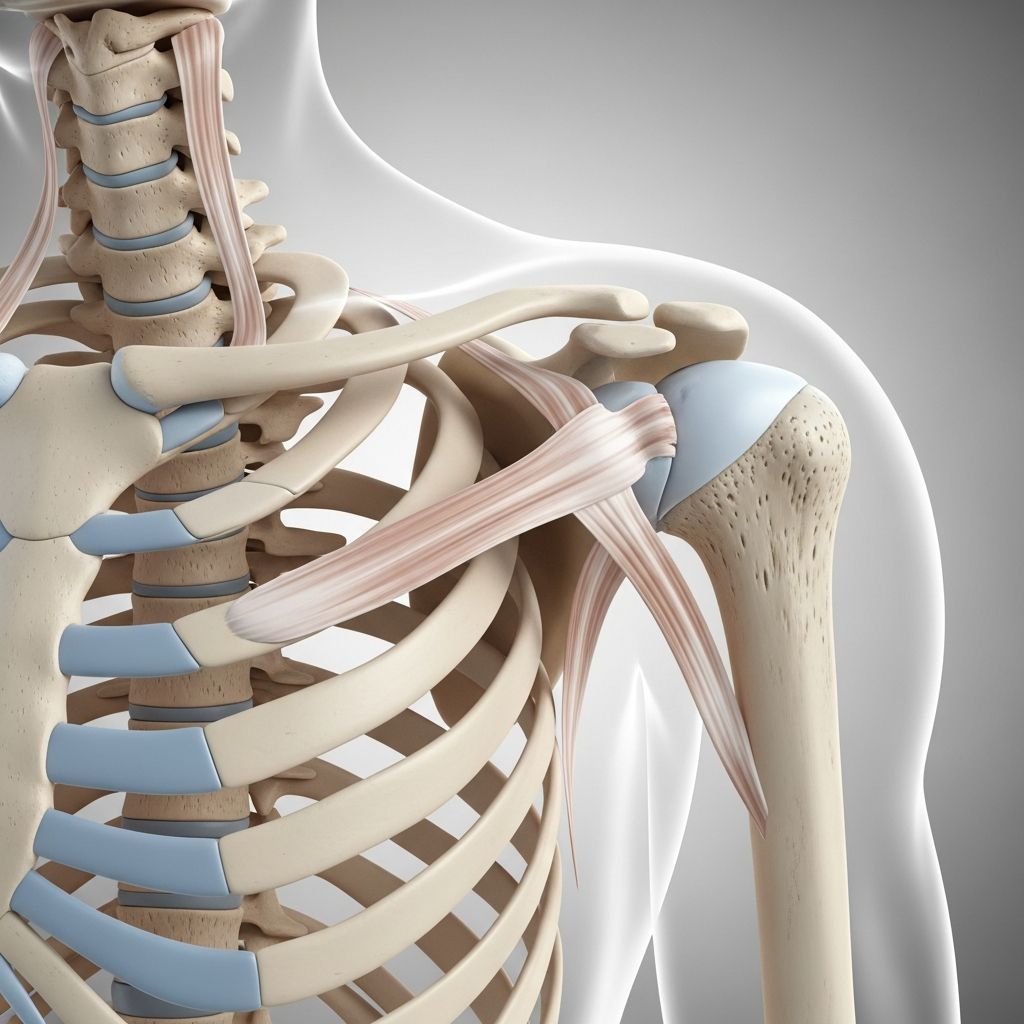
The clavicle, commonly known as the collarbone, is a unique long bone that lies horizontally across the upper chest. It connects the arm to the trunk and is a vital component of the shoulder girdle. The clavicle is the only long bone in the human body that lies horizontally, and it plays a crucial role in supporting the upper limb and protecting important neurovascular structures.
Anatomy of the Clavicle
The clavicle is a sigmoid-shaped bone with a convex surface along its medial end and a concave surface along its lateral end. It is divided into two main regions: the medial two-thirds and the lateral third. The medial region is the longest and is also known as the sternal region, while the lateral region is the widest and thinnest, known as the acromial region.
Medial End (Sternal End)
The medial end of the clavicle articulates with the manubrium of the sternum, forming the sternoclavicular joint (SC joint). This joint is surrounded by a fibrous capsule and contains an intra-articular disc that provides additional stability. The interclavicular ligament connects the ipsilateral and contralateral clavicles, further stabilizing the joint.
Lateral End (Acromial End)
The lateral end of the clavicle articulates with the acromion of the scapula, forming the acromioclavicular joint (AC joint). This joint is also lined by fibrocartilage and contains an intra-articular disc. The three main ligaments supporting this joint are the acromioclavicular ligament, the coracoclavicular ligament, and the coracoacromial ligament.
Shaft of the Clavicle
The shaft of the clavicle is clinically divided into two parts: the medial two-thirds and the lateral third. The medial two-thirds have attachment sites for the sternocleidomastoid (SCM) muscle and the subclavius muscle. The anterior surface is an attachment for the pectoralis major, and the posterior surface is an attachment for the sternohyoid muscle. The costal tuberosity, where the costoclavicular ligament inserts, is found on the inferior surface.
The lateral third of the clavicle serves as attachments for the deltoid and trapezius muscles anteriorly and posteriorly, respectively. Inferiorly, the conoid and trapezoid components of the coracoclavicular ligament provide stability between the clavicle and the coracoid process of the scapula.
Function of the Clavicle
The clavicle serves several important functions:
- It acts as a rigid support from which the scapula and free limb are suspended, keeping the upper limb away from the thorax and allowing for maximum range of movement.
- It covers the cervicoaxillary canal, protecting the neurovascular bundle that supplies the upper limb.
- It transmits physical impacts from the upper limb to the axial skeleton.
- It allows the scapula to glide smoothly along the posterior wall, which is critical for full upper extremity motion.
Protection of Neurovascular Structures
The anatomical location of the clavicle protects important neurovascular structures, including the brachial plexus, subclavian artery, and subclavian vein. Disruption of these structures can lead to significant morbidity.
Related Stories



Muscles Attached to the Clavicle
The clavicle has multiple attachments for musculature:
- Superior Surface: The anterior deltoid originates on the anterior aspect and assists in flexion of the shoulder. The trapezius muscle inserts on the posterior aspect and is responsible for stabilizing the scapula.
- Inferior Surface: The subclavius muscle resides in the subclavian groove and functions to depress the shoulder and pull the clavicle anteroinferiorly.
- Anterior Surface: The clavicular part of the pectoralis major muscle originates from the medial clavicle anteriorly. The clavicular head contributes to flexion, horizontal adduction, and inward rotation of the humerus.
- Posterior Surface: The trapezius inserts posterosuperior on the clavicle. The clavicular head of the sternocleidomastoid (SCM) muscle is found along the medial third of the clavicle. The SCM, when contracting alone, causes the head to rotate to the opposite side and laterally side bend ipsilaterally. When both SCM muscles contract, this causes head flexion.
Clinical Significance of the Clavicle
The clavicle is involved in several clinical conditions:
- Acromioclavicular Dislocation (AC Separation): This occurs when the clavicle separates from the scapula, commonly due to a fall directly on the shoulder.
- Clavicle Fracture (Broken Collarbone): This is a common injury that happens when the bone between the shoulder blade and breastbone breaks. The most common site of fracture is the junction between the two curvatures of the bone, which is the weakest point.
- Degeneration of the Clavicle: This can occur due to aging or repetitive stress.
- Osteolysis: This is the loss of bone tissue, which can affect the clavicle.
- Sternoclavicular Dislocations: These are rare but can occur due to trauma.
Reference Lines in Clinical Practice
A vertical line drawn from the mid-clavicle, called the mid-clavicular line, is used as a reference in describing cardiac apex beat during medical examination. It is also useful for evaluating an enlarged liver and for locating the gallbladder, which is between the mid-clavicular line and the transpyloric plane.
Common Injuries and Conditions
The clavicle is susceptible to various injuries and conditions:
- Clavicle Fracture: This is one of the most common fractures in the human body, especially in children and young adults. Treatment often involves immobilization with a sling and, in severe cases, surgical intervention.
- AC Separation: This injury can range from mild to severe and may require surgical repair in more serious cases.
- Clavicle Osteolysis: This condition is often seen in athletes and can be managed with rest and physical therapy.
Diagnosis and Treatment
Diagnosis of clavicle injuries typically involves physical examination and imaging studies such as X-rays. Treatment depends on the severity of the injury and may include:
- Immobilization with a sling
- Pain management
- Physical therapy
- Surgical intervention in severe cases
Frequently Asked Questions (FAQs)
Q: What is the clavicle?
A: The clavicle, or collarbone, is a long bone that connects the arm to the trunk and is a vital component of the shoulder girdle.
Q: What are the main functions of the clavicle?
A: The clavicle supports the upper limb, protects neurovascular structures, and allows for a wide range of arm movements.
Q: What are common injuries to the clavicle?
A: Common injuries include clavicle fractures, AC separations, and clavicle osteolysis.
Q: How is a clavicle fracture treated?
A: Treatment may involve immobilization with a sling, pain management, physical therapy, and, in severe cases, surgical intervention.
Q: What is the mid-clavicular line used for?
A: The mid-clavicular line is used as a reference in medical examination to describe the cardiac apex beat and to evaluate an enlarged liver or locate the gallbladder.
References
- Anatomy, Shoulder and Upper Limb, Clavicle — StatPearls, NCBI, NIH. 2023-05-01. https://www.ncbi.nlm.nih.gov/books/NBK525990/
- Clavicle — Wikipedia. 2023-09-15. https://en.wikipedia.org/wiki/Clavicle
- AC Joint (Acromioclavicular Joint): What It Is & Function — Cleveland Clinic. 2023-07-10. https://my.clevelandclinic.org/health/body/ac-joint-acromioclavicular-joint
- Shoulder Muscles: Anatomy, Function & Common Conditions — Cleveland Clinic. 2023-06-20. https://my.clevelandclinic.org/health/body/21798-shoulder-muscles
- Shoulder Joint: What It Is, Anatomy & How It Works — Cleveland Clinic. 2023-05-15. https://my.clevelandclinic.org/health/body/24780-shoulder-joint
- Clavicle Fracture (Broken Collarbone): Treatment & Recovery — Cleveland Clinic. 2023-04-05. https://my.clevelandclinic.org/health/diseases/16874-broken-collarbone-clavicle-fracture
- AC Separation — Cleveland Shoulder Institute. 2023-03-10. https://clevelandshoulder.com/ac-separation/
- Clavicle (Collarbone): Function, Location and Anatomy — Narayana Health. 2023-02-15. https://www.narayanahealth.org/blog/clavicle-collarbone-function-location-and-anatomy
Similar Articles








Read full bio of medha deb