Clavicle Fracture: Open Reduction and Internal Fixation
Surgical treatment for severe clavicle fractures: restoring bone alignment and healing.
The clavicle, commonly known as the collarbone, is one of the most frequently fractured bones in the human body. While many clavicle fractures heal well with conservative treatment such as rest, ice, and immobilization, some fractures are too severe or displaced to heal properly without surgical intervention. In these cases, your orthopedic surgeon may recommend a procedure called open reduction and internal fixation (ORIF) to realign the broken bone fragments and promote proper healing.
Understanding Clavicle Fractures
A clavicle fracture occurs when the collarbone breaks, typically from a direct impact to the shoulder, a fall onto an outstretched arm, or trauma to the chest. Fractures are classified into two main categories: non-displaced fractures, where the bone pieces remain aligned, and displaced fractures, where the bone fragments have shifted out of their normal position.
Displaced clavicle fractures are more likely to result in complications such as nonunion (where the bone fails to heal), malunion (where the bone heals in an incorrect position), and functional impairment. These complications can lead to chronic pain, weakness, and reduced shoulder mobility. When a fracture is significantly displaced or fails to heal with conservative treatment, surgical intervention becomes necessary.
What is ORIF?
Open reduction and internal fixation is a surgical procedure designed to restore proper bone alignment and stability. The procedure consists of two main components:
Open Reduction
Open reduction refers to the process of surgically exposing the fractured bone by making an incision through the skin and muscle tissue. This allows your orthopedic surgeon to directly visualize the fracture site and carefully reposition the broken bone fragments back into their correct anatomical alignment. This direct visualization is critical for achieving an accurate reduction, which is essential for optimal healing and functional recovery.
Internal Fixation
Internal fixation involves stabilizing the repositioned bone fragments using specialized hardware. This hardware prevents the bone pieces from shifting during the healing process and promotes bony union. The goal is to maintain perfect alignment while the fracture heals, preventing complications such as nonunion or malunion that can occur with inadequate fixation.
Indications for ORIF Surgery
Your surgeon may recommend ORIF for clavicle fractures in specific situations. The absolute indications for surgical treatment include open fractures (where the broken bone has pierced the skin) and fractures associated with evolving skin compromise that requires urgent intervention.
Relative indications for ORIF include displaced midshaft clavicle fractures with significant shortening (typically 15 to 20 millimeters or more), completely displaced fractures, fractures with substantial comminution (bone fragmentation), far lateral fractures, fractures in elderly patients, and fractures occurring in polytrauma scenarios. Additionally, if conservative treatment has failed and the fracture has not healed after an appropriate period, surgical intervention may be recommended.
Related Stories



Pre-Operative Preparation
Before undergoing ORIF surgery, your healthcare team will conduct a thorough evaluation. This typically includes physical examination, imaging studies such as X-rays or computed tomography (CT) scans to assess the fracture pattern, and routine laboratory tests. Your surgeon will discuss the procedure, potential risks and benefits, and answer any questions you may have. You will receive specific preoperative instructions, which may include fasting, medication adjustments, and cessation of certain activities.
The ORIF Procedure: Step-by-Step
Understanding what happens during your surgery can help reduce anxiety and prepare you for the recovery process. Here is how the procedure typically progresses:
Anesthesia and Patient Positioning
The procedure takes place while you are asleep under general anesthesia, ensuring your comfort and safety throughout the surgery. You will be positioned supine or in a modified position that provides your surgeon optimal access to the clavicle.
Surgical Incision and Exposure
Your surgeon makes a curvilinear incision above or along the clavicle, typically measuring 3 to 4 inches in length. The incision is strategically placed to minimize visible scarring and to provide adequate exposure of the fracture site. The surgeon carefully dissects through the skin and underlying muscle layers, taking care to avoid important structures such as the supraclavicular nerve and blood vessels in the subcutaneous tissue.
Fracture Reduction
Once the fracture site is exposed, your surgeon carefully repositions the broken bone fragments back into their correct anatomical alignment. For initial stabilization, the surgeon may use temporary reduction aids such as pointed tenaculum clamps, K-wires, or racking half-hitch cerclage sutures. These temporary devices help hold the reduction in place while the surgeon prepares for definitive fixation. The length of the clavicle is restored by gently extending the shoulder and arm to achieve the correct curvature and dimensions.
Internal Fixation
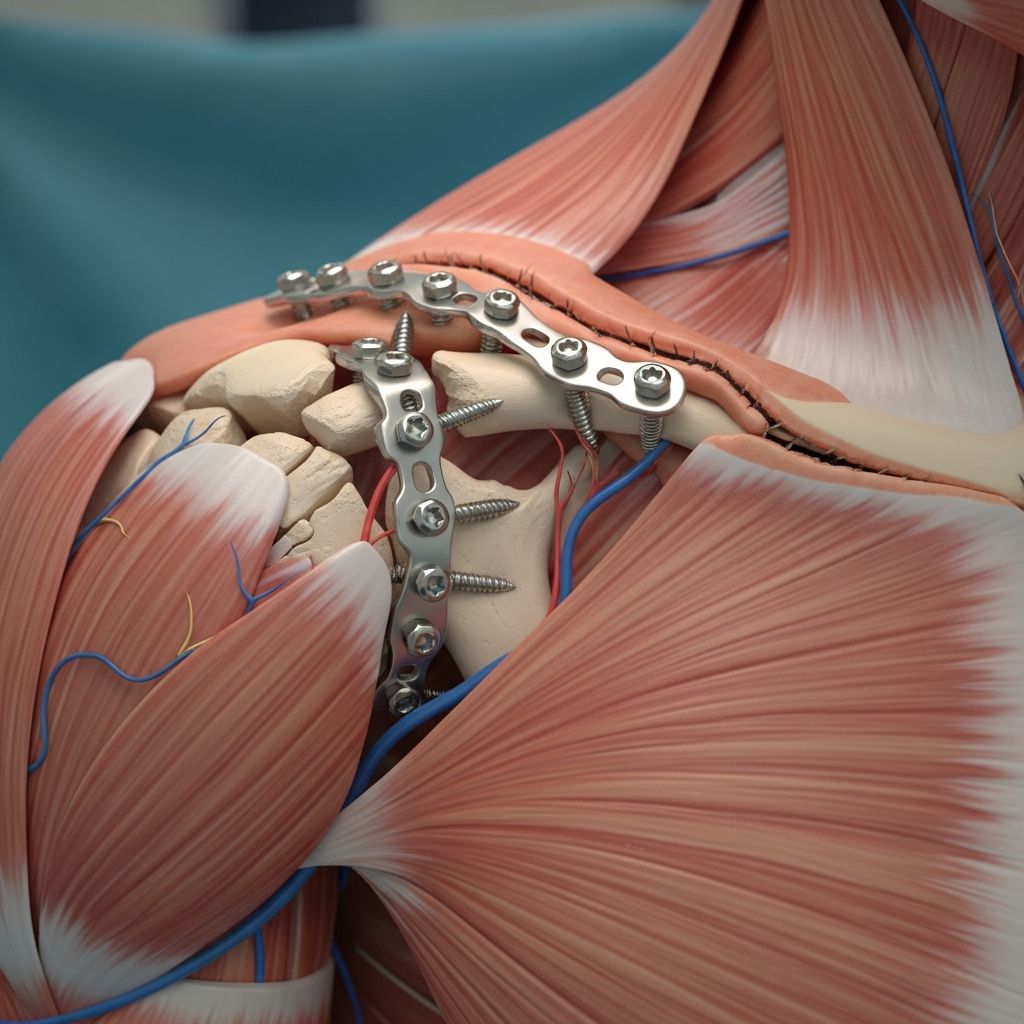
After achieving accurate reduction, your surgeon secures the bone fragments using specialized hardware. The choice of fixation method depends on the fracture pattern and bone quality. Common fixation options include:
- Plate and Screw Fixation: A 3.5-millimeter dynamic compression plate or locking plate is placed on the anterosuperior surface of the clavicle. At least six cortices of screw purchase are placed on either side of the fracture to ensure maximum stability. In cases of poor bone quality or severe comminution, eight cortices may be preferred. Locking plates are particularly useful when dealing with excessive comminution or compromised bone quality, as they provide fixed-angle construct stability.
- Intramedullary Fixation: Alternatively, an intramedullary pin or nail may be inserted through the clavicle. This method offers the advantage of smaller scars and potentially lower refracture rates, but it carries a slightly higher risk of nonunion and hardware prominence.
- Lag Screws and Cerclage: In simple fracture patterns, lag screws alone may provide sufficient fixation. For more complex fractures, lag screws are combined with plate fixation for maximum stability.
Wound Closure
Once secure fixation is achieved, your surgeon carefully closes the surgical wound in multiple layers. The platysma muscle layer is meticulously closed over the plate using absorbable sutures (typically 0 Vicryl), followed by the subcutaneous layer with 2-0 Vicryl in an interrupted fashion. Finally, the epidermis is closed with a running subcuticular monofilament suture such as 4-0 absorbable Monocryl, which minimizes visible scarring. Careful layered closure is essential to provide soft tissue coverage over the hardware and reduce the risk of wound complications.
Recovery and Rehabilitation
Immediate Post-Operative Period
Immediately after surgery, a sling is applied to reduce tension on the fracture site and provide comfort. Pain management is addressed with appropriate medications as prescribed by your surgeon. Most patients are discharged on the same day or after an overnight hospital stay, depending on individual circumstances and surgeon preference.
Early Mobilization
Your surgeon will provide specific rehabilitation instructions based on the fracture type and fixation method used. In general, passive and active-assisted range of motion exercises, such as pendulum exercises, can begin within the first week. However, more aggressive range of motion and strengthening exercises are typically delayed to allow initial fracture healing. Sutures are typically removed around 14 days after surgery.
Progressive Rehabilitation
Recovery typically progresses over several months. During the first 4 to 6 weeks, you should avoid heavy lifting and strenuous upper extremity activities. Gradual progression to active range of motion exercises occurs around 4 to 6 weeks post-operatively. By 8 to 12 weeks, most patients can resume light activities and progressive strengthening exercises. Full recovery and return to unrestricted activities typically occurs by 3 to 6 months post-operatively, depending on individual healing rates and the nature of your activities.
Expected Outcomes
ORIF for clavicle fractures demonstrates excellent outcomes in most patients. Studies show high rates of bone union, typically exceeding 95 percent when appropriate surgical technique is employed. Most patients experience early pain relief and restoration of functional shoulder motion. By six months post-operatively, the vast majority of patients report significant improvement in arm strength, range of motion, and overall shoulder function. Patient satisfaction rates are generally high, with most individuals returning to their desired activities without significant limitations.
Potential Complications
While ORIF is generally a safe and effective procedure, like any surgery it carries certain risks. Possible complications include infection, hardware irritation or prominence, nerve injury affecting sensation in the shoulder region, blood vessel injury, hardware failure or loosening, and inadequate fracture reduction. Additionally, some patients may experience adhesive capsulitis (shoulder stiffness) during recovery. Your surgeon will discuss these risks before surgery and take appropriate measures to minimize them through careful surgical technique and meticulous wound closure.
Return to Activities
The timeline for returning to specific activities varies based on individual healing and the nature of the activity. Most patients can return to desk work within 2 to 3 weeks. Light recreational activities typically resume around 6 to 8 weeks, while more demanding sports or heavy labor activities may require 3 to 6 months. Your surgeon and physical therapist will guide you on the appropriate progression and provide clearance for specific activities based on your individual recovery.
Frequently Asked Questions
Q: How long does the ORIF procedure take?
A: The procedure typically takes 45 minutes to 90 minutes, depending on the complexity of the fracture and the fixation method used. The time includes anesthesia induction, surgical preparation, the actual procedure, and wound closure.
Q: Will the hardware need to be removed after healing?
A: This depends on your specific situation and surgeon preference. Many surgeons leave the plate and screws in place permanently, as they rarely cause problems. However, hardware removal may be considered if it causes irritation, interferes with specific activities, or in cases where the patient strongly prefers removal after complete healing. Hardware removal is typically performed only after complete fracture healing, which usually requires at least 12 months.
Q: How long will I wear a sling?
A: Most patients wear a sling for approximately 2 to 3 weeks following surgery. Your surgeon will provide specific guidance based on your individual fracture and fixation. The sling provides comfort and reduces tension on the healing fracture during the critical early healing phase.
Q: When can I drive after surgery?
A: Most patients can resume driving within 2 to 3 weeks, provided they are no longer taking prescription pain medications that impair alertness and their surgeon has cleared them to do so. Some insurance companies and local regulations may have specific requirements regarding return to driving after surgery.
Q: What if the fracture doesn’t heal properly even after surgery?
A: Nonunion after properly performed ORIF is relatively uncommon, occurring in less than 5 percent of cases. If nonunion occurs, revision surgery may be necessary, which might involve different fixation hardware, bone grafting, or other techniques to promote healing. Your surgeon will discuss these options if this complication develops.
Q: Can I use my arm normally after recovery?
A: Yes, most patients achieve essentially normal arm and shoulder function after complete recovery from ORIF. The goals of surgery include not only bony healing but also restoration of full functional capacity. With appropriate rehabilitation, the vast majority of patients return to their desired activities without significant limitations.
References
- Clavicle Fracture Open Reduction and Internal Fixation — University of Rochester Medical Center. Accessed 2025. https://www.urmc.rochester.edu/encyclopedia/content?contenttypeid=135&contentid=322
- Midshaft Clavicle Fracture Open Reduction and Internal Fixation — American Academy of Orthopaedic Surgeons (AAOS). https://drmillett.com/wp-content/uploads/2017/04/midshaft-clavicle-fracture-open-reduction-internal-fixation.pdf
- Functional Outcomes of Clavicle Open Reduction and Internal Fixation — National Center for Biotechnology Information (NCBI). 2024. https://pmc.ncbi.nlm.nih.gov/articles/PMC11578535/
- Anterior Approach to the Clavicle — AO Surgery Reference / AO Foundation. https://surgeryreference.aofoundation.org/orthopedic-trauma/adult-trauma/clavicle-fractures/approach/anterior-approach-to-the-clavicle
- Rehabilitation Protocol for Clavicle ORIF — Massachusetts General Hospital Department of Orthopedic Surgery. https://www.massgeneral.org/assets/MGH/pdf/orthopaedics/sports-medicine/physical-therapy/rehabilitation-protocol-for-clavicle-ORIF.pdf
- Clavicle Fractures – Midshaft — Orthobullets. https://www.orthobullets.com/trauma/1011/clavicle-fractures–midshaft
Similar Articles








Read full bio of medha deb