Clear Cell Acanthoma: Complete Guide To Diagnosis And Treatment
Rare benign skin tumour on lower legs: symptoms, diagnosis, histopathology and treatment options explained.
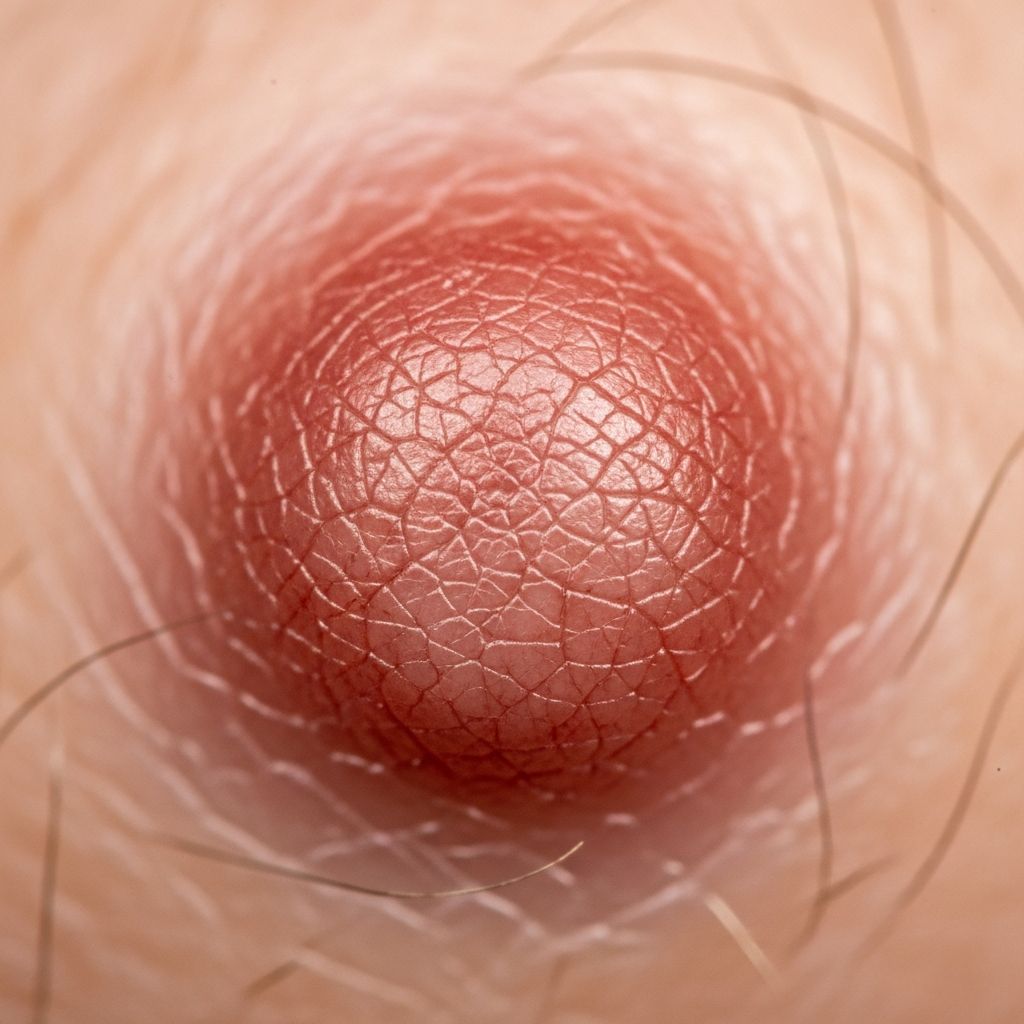
Clear cell acanthoma is a rare benign epithelial skin tumour that typically presents as a solitary lesion on the lower legs of middle-aged and elderly individuals. Also known as acanthoma of Degos or pale cell acanthoma, it features distinctive clear glycogen-rich cells visible under microscopy and a characteristic dermatoscopic pattern aiding diagnosis.
What is clear cell acanthoma?
Clear cell acanthoma, first described by Degos et al in 1962, represents an uncommon benign proliferation of epidermal keratinocytes characterized by pale, glycogen-filled clear cells. It usually manifests as a single, well-circumscribed nodule or plaque, most frequently on the lower extremities such as the legs or feet, though rare cases occur on the trunk, arms, or face. The lesion grows slowly over years, persisting without spontaneous resolution, and poses no malignant potential.
Clinically, it appears as a dome-shaped or slightly elevated papule/plaque, 3–20 mm in diameter, with a shiny, erythematous (red) to brown surface often covered by a thin, adherent crust or scale resembling a stuck-on wafer. The scale, when removed, reveals a moist, bleeding surface due to telangiectatic vessels beneath. It may be asymptomatic or mildly pruritic/tender. Multiple lesions are exceptional, reported in fewer than 5% of cases, sometimes linked to eruptive variants or giant forms exceeding 3 cm.
Who gets clear cell acanthoma?
This condition predominantly affects adults over 40 years, with a peak incidence in the 50–70 age group and no strong gender predilection, though slight male predominance is noted in some series. It is rare in children or young adults. No clear risk factors like sun exposure or genetics are established, but lesions favor the lower legs, possibly due to local trauma or venous stasis in older patients.
- Age: Middle-aged to elderly (mean ~60 years)
- Sex: Equal or slight male bias
- Site: Lower legs (90%), feet, rarely elsewhere
- Associations: None definitive; occasional with psoriasis-like changes
Clinical features of clear cell acanthoma
The hallmark presentation is a solitary, sharply demarcated, erythematous nodule or plaque with a stuck-on scale. Key features include:
- Size: 3–20 mm (giant forms up to 30 mm)
- Shape: Dome-shaped papule to flat plaque
- Colour: Bright red/pink (vascular), tan/brown, rarely pigmented
- Surface: Shiny, glazed; peripheral collarette scale
- Other: May ooze/bleed if scaled off; slow growth over years
It mimics basal cell carcinoma, pyogenic granuloma, or irritated seborrhoeic keratosis, prompting biopsy for confirmation. Rare variants include pigmented, cystic, eruptive (multiple), or verrucous types.
Dermatoscopy of clear cell acanthoma
Dermatoscopy reveals a highly specific pattern facilitating non-invasive diagnosis in experienced hands. The classic “pearl necklace” or “string of pearls” consists of curvilinear rows of glomerular/pinpoint red vessels arranged in a reticular fashion around the periphery, distinguishing it from other vascular lesions.
Related Stories



- Vascular pattern: Pearl necklace (glomerular vessels in lines)
- Background: Homogeneous red or white structureless area
- Scale: Peripheral white collarette
- Sensitivity/Specificity: High for experts; aids biopsy avoidance if classic
This feature, combined with sharp borders, supports clinical suspicion before biopsy.
Diagnosis of clear cell acanthoma
Diagnosis is rarely clinical alone due to mimics; skin biopsy is confirmatory. Dermatoscopy raises suspicion, but histopathology is gold standard.
Histology
Microscopy shows a well-demarcated psoriasiform epidermal hyperplasia with abrupt transition to pale keratinocytes filled with glycogen (PAS-positive, diastase-sensitive). Features include:
- Epidermis: Acanthosis, elongated rete ridges, absent granular layer
- Cells: Large clear/pale keratinocytes (glycogen-rich)
- Infiltrate: Neutrophils in parakeratosis, spongiotic vesicles
- Dermis: Dilated capillaries, mild chronic inflammation
Psoriasiform architecture with neutrophils mimics psoriasis plaque.
Differential diagnosis
| Condition | Key Distinguishers |
|---|---|
| Basal cell carcinoma | Pearled border, ulceration; blue pigment; dermoscopy: arborizing vessels |
| Pyogenic granuloma | Collarette scale, rapid growth, bleeding; dermoscopy: white rail |
| Seborrhoeic keratosis | Stuck-on, waxy; dermoscopy: comedo-like openings |
| Amelanotic melanoma | Asymmetry, irregular vessels; biopsy essential |
| Psoriasis plaque | Multiple, scaly; no clear cells on biopsy |
Treatment of clear cell acanthoma
As benign and asymptomatic often, observation suffices if diagnosis certain. Removal is indicated for cosmetics, irritation, or diagnostic uncertainty. Options include:
- Excision: Shave, full-thickness; curative, allows histology
- Curettage/Electrocautery: Quick for small lesions; minimal scarring
- Cryotherapy: Liquid nitrogen; good for multiple; risk hypopigmentation
- Laser: CO2 ablation; precise, less bleeding
- Observation: For small, stable lesions
Excision under local anaesthetic involves scalpel removal with margins, sutures (3–14 days), and wound care. Complications: scarring, infection, pigment change (hypo/hyper). No recurrence post-removal.
Prognosis and complications
Excellent prognosis: benign, no malignant transformation (one disputed case report). Lesions persist/grow slowly without intervention. Post-treatment: minor scarring common; cryotherapy risks hypopigmentation in dark skin. Patient education emphasizes biopsy for mimics and non-spontaneous resolution.
Prevention
No known prevention as etiology unclear (possible reactive hyperplasia). Sun protection and irritant avoidance may indirectly help skin health.
Frequently Asked Questions
Is clear cell acanthoma cancerous?
No, it is a benign tumour with no malignant potential.
Does it go away on its own?
No, it persists indefinitely without treatment.
How is it diagnosed?
By biopsy; dermatoscopy shows pearl necklace vessels.
What does treatment involve?
Simple excision or curettage under local anaesthetic.
Can it recur?
Rare if completely removed; new lesions possible but unrelated.
Who is at risk?
Middle-aged/elderly adults, especially on lower legs.
References
- Clear Cell Acanthoma – Treating Clear Cell Acanthoma — Perri Dermatology. 2023. https://perridermatology.com/dr-perris-blog/treating-clear-cell-acanthoma/
- Clear Cell Acanthoma — StatPearls [Internet]. NCBI Bookshelf. 2023-07-17. https://www.ncbi.nlm.nih.gov/books/NBK542214/
- Clear Cell Acanthoma: Symptoms, Diagnosis, and Treatment — Rabkin Dermatopathology. 2023. https://rabkindermpath.com/clear-cell-acanthoma-symptoms-diagnosis-and-treatment/
- Clear cell acanthoma — DermNet NZ. 2023. https://dermnetnz.org/topics/clear-cell-acanthoma
- Clear Cell Acanthoma: Dermpath in 5 Minutes — YouTube (transcript). 2023. https://www.youtube.com/watch?v=FZeMIYVwth0
- Clear cell acanthoma of Degos — Primary Care Dermatology Society (PCDS). 2023. https://www.pcds.org.uk/clinical-guidance/clear-cell-acanthoma-of-degos
- Dermoscopic features of clear cell acanthoma — PMC – NIH. 2018-05-28. https://pmc.ncbi.nlm.nih.gov/articles/PMC6001098/
Similar Articles








Read full bio of Sneha Tete