Clear Cell Fibrous Papule Pathology: Key Features And Diagnosis
Detailed pathology of clear cell fibrous papule, a rare benign facial lesion variant, including histology, IHC, and differentials.
Author: Dr. Harriet Cheng, Dermatopathologist, Reviewed: 28 August 2024
What is clear cell fibrous papule?
Clear cell fibrous papule is a rare histopathological variant of fibrous papule, characterised by the presence of cells with clear cytoplasm within the lesion. Fibrous papule (also known as pleomorphic fibroma, fibroangioma or angiofibroma) is a common benign skin lesion usually found on the nose in early to middle-aged adults. It is a dermal lesion composed of fibroblasts, capillary dilatation and thick collagen bundles. Several histological variants of fibrous papule have been described, including clear cell, granular cell, hypercellular, epithelioid, pigmented, calcifying and oste Cartilaginous.
The clear cell variant was first described by Meigel and Ackerman in 1979. It is distinguished from the usual fibrous papule by the presence of clear fibrocytes containing periodic acid–Schiff (PAS)-negative cytoplasmic material. These clear cells are thought to represent a degenerative change or lipid accumulation within fibroblasts. The lesion is entirely benign with no risk of malignant transformation.
Clear cell fibrous papules typically measure 2–6 mm in diameter and present as dome-shaped, firm, skin-coloured to red papules on the nose or face. They are asymptomatic and often noticed incidentally or for cosmetic reasons. The rarity of this variant underscores the importance of recognising it to avoid misdiagnosis as a clear cell neoplasm such as balloon cell naevus, clear cell hidradenoma or metastatic renal cell carcinoma.
Clinical features
Clear cell fibrous papules share the same clinical presentation as conventional fibrous papules. They occur predominantly on the nose (90% of cases) but may also appear on the cheeks, forehead, chin or upper lip. The lesions are:
- Solitary (most common) or rarely multiple
- 2–6 mm diameter
- Dome-shaped papule
- Firm and nontender to palpation
- Skin-coloured, pink, red or rarely pigmented
- Smooth surfaced
- Asymptomatic
Patients typically present in the third to fifth decades of life with no gender predilection. The clinical differential diagnosis includes basal cell carcinoma, intradermal naevus, sebaceous hyperplasia, syringoma, trichoepithelioma, adnexal naevus and melanocytic naevus. Excisional or shave biopsy is required for definitive diagnosis.
Pathology
Microscopic
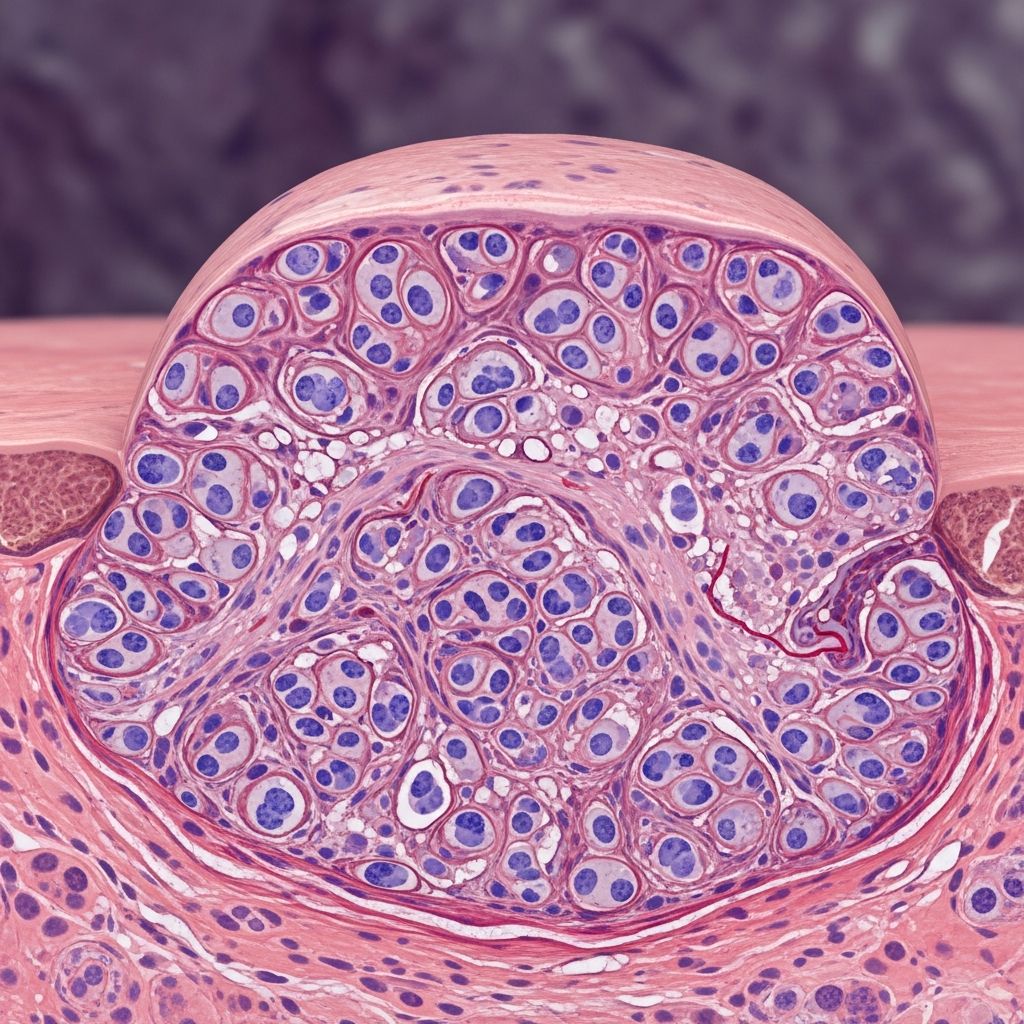
Scanning magnification shows a well-circumscribed dermal nodule often displaying a peripheral collarette (epidermal invagination) (figure 1). The epidermis may be normal, show hyperkeratosis, erosion or ulceration. There is often increased basal layer pigmentation.
The dermis contains a proliferation of bland fibroblasts and numerous dilated thin-walled blood vessels within a collagenous stroma. The key diagnostic feature is the presence of scattered to numerous clear cells arranged singly, in small clusters or sheets (figure 2). These cells have abundant clear to pale cytoplasm, distinct cell borders and small central or eccentric bland nuclei without atypia, pleomorphism, hyperchromasia or mitoses (figure 3).
The clear cytoplasm contains fine vacuoles or granular material. The surrounding stroma shows thickened, sclerotic collagen bundles and variable mucin deposition. Multinucleate fibroblasts may be present. Older lesions may show haemorrhage, haemosiderin deposition or patchy chronic inflammation.
Related Stories





Special stains
Periodic acid-Schiff (PAS) with diastase digestion is negative in the clear cells, helping distinguish from glycogen-rich tumours like renal cell carcinoma. Mucicarmine is negative. Oil Red O on frozen section may show lipid droplets within clear cells, supporting degenerative change.
Histopathology — images
- Figure 1. Low power H&E showing well-circumscribed dermal papule with peripheral collarette
- Figure 2. Medium power H&E showing clear cells in clusters within collagenous stroma
- Figure 3. High power H&E showing bland clear cells with central nuclei
- Figure 4. CD68 immunohistochemistry highlighting clear cells
- Figure 5. NKI/C3 strongly positive in clear cells
Immunohistochemistry
Clear cells in fibrous papule show a distinctive immunoprofile confirming their fibroblastic/histiocytic differentiation:
| Antibody | Staining pattern |
|---|---|
| Vimentin | Strong diffuse positive in clear cells |
| CD68 | Positive in most cases (5/6) |
| NKI/C3 (CD63) | Strong diffuse positive (5/5 tested) |
| Factor XIIIa | Negative in clear cells, positive in dendritic cells |
| S-100 | Negative (may be focally positive) |
| MART-1 | Negative |
| Cytokeratins | Negative |
| EMA | Negative |
| CEA | Negative |
| HMB-45 | Negative |
The strong NKI/C3 positivity is particularly characteristic and helps distinguish from melanocytic and epithelial clear cell tumours.
Differential diagnosis
The main histopathological differential diagnoses include:
Balloon cell naevus
Similar clear cells but with more rounded nuclei, junctional activity or dermal nests of conventional naevus cells. S-100 and SOX10 strongly positive. No collarette or prominent vascularity.
Clear cell hidradenoma
Adnexal tumour with two cell populations, cystic spaces, ductal differentiation and squamoid areas. Positive for epithelial markers (AE1/AE3, EMA).
Renal cell carcinoma metastasis
Larger lesion with more cytological atypia. PAS-positive intracytoplasmic glycogen, positive for PAX8, CD10 and RCC antigen.
Balloon cell melanoma
Rare; shows cytological atypia, mitoses and invasive growth. Positive for S-100, SOX10, Melan-A.
XH elastosis (solar elastosis)
Clear spaces contain elastin fibres (Verhoeff positive), associated with photodamaged skin.
Lipidised dermatofibroma
Usually on limbs, epidermal hyperplasia, more storiform pattern, factor XIIIa positive throughout.
Key distinguishing features of clear cell fibrous papule:
- Facial location (nose)
- Peripheral collarette
- Prominent dilated vessels
- PAS-negative clear cells
- NKI/C3+, CD68+/-, S-100-
- No atypia or mitoses
Pathology description
Histology
Dermal papule composed of spindle and clear cells with increased vascularity and thick collagen bundles. PAS negative.
Immunohistochemistry
Clear cells: vimentin+, NKI/C3+, CD68+/-, factor XIIIa-, S-100-, cytokeratin-, HMB-45-
Frequently asked questions
Q: Is clear cell fibrous papule malignant?
No, it is a completely benign lesion with no potential for malignant transformation. Complete excision is curative.
Q: What causes the clear cells in this variant?
The clear cytoplasm likely represents degenerative changes, lipid accumulation or glycogen depletion within fibroblasts. The exact mechanism is unclear.
Q: Can clear cell fibrous papule recur?
Recurrence is rare if completely excised. Incomplete shave removal may lead to regrowth.
Q: How do you distinguish it from renal cell carcinoma metastasis?
RCC metastasis shows PAS-positive glycogen, nuclear atypia, and positive IHC for PAX8, CD10 and RCC. Clinical history of renal primary is usually known.
Q: Is NKI/C3 staining specific for clear cell fibrous papule?
No, but strong diffuse NKI/C3 positivity combined with the clinical context and other negative stains is very supportive of this diagnosis.
References
- Clear cell fibrous papule with NKI/C3 expression — Busch J, et al. Journal of Cutaneous Pathology. 2005-08-01. https://pubmed.ncbi.nlm.nih.gov/16121048/
- Clear Cell Fibrous Papule — Yu R, et al. Cutis. 2010-04-01. https://mdedge.com/cutis/article/88567/dermatopathology/clear-cell-fibrous-papule
- Clear cell fibrous papule: report of a case mimicking a balloon cell nevus — Park S, et al. Journal of Cutaneous Pathology. 2009-02-01. https://pubmed.ncbi.nlm.nih.gov/19220636/
- Clear cell fibrous papule: report of a case mimicking a balloon cell nevus — Lee AN, et al. Journal of Cutaneous Pathology. 2008-10-28. https://onlinelibrary.wiley.com/doi/10.1111/j.1600-0560.2008.01038.x
Similar Articles








Read full bio of medha deb