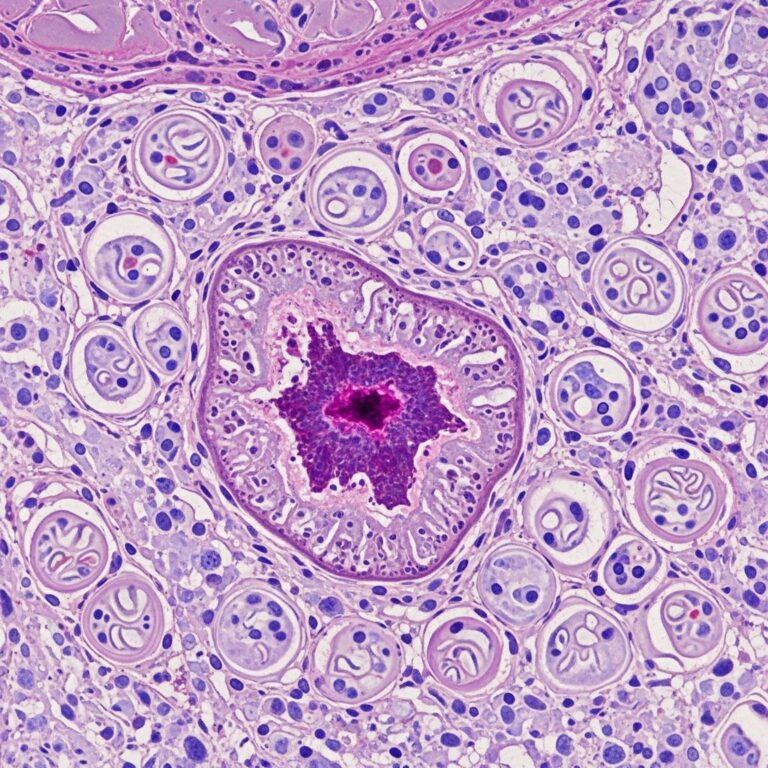
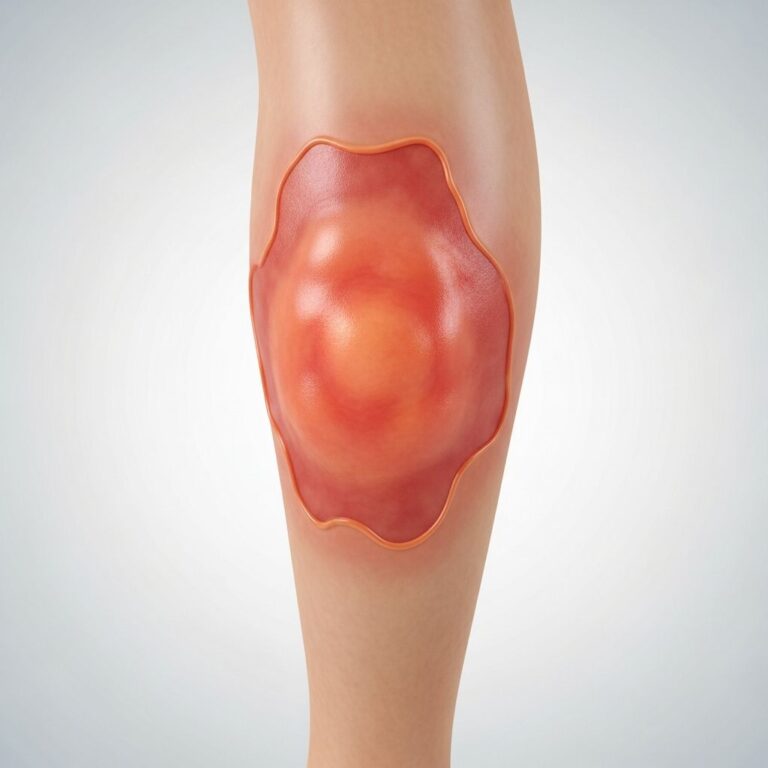
Clear Cell Mesenchymal Neoplasm Pathology
Comprehensive pathology guide to distinctive dermal clear cell mesenchymal neoplasm: clinical features, histopathology, diagnosis, and management.
Author: Dr. Harriet Cheng, Dermatopathologist
Reviewed: 2025
Introduction
Clear cell mesenchymal neoplasm, also known as
distinctive dermal clear cell mesenchymal neoplasm (DDCCMN)
, represents a rare and recently described entity in dermatopathology. First reported in 2004, this tumor is characterized by a proliferation of large cells with abundant optically clear cytoplasm situated predominantly in the reticular dermis. It typically presents as a smooth cutaneous nodule on the lower extremities of adults, with a benign clinical course following local excision. Recognition of this neoplasm is crucial to distinguish it from more aggressive clear cell tumors, such as metastatic clear cell renal cell carcinoma or clear cell melanoma, which share cytological similarities but differ in prognosis and management.The histogenesis of DDCCMN remains uncertain, but its mesenchymal nature is supported by immunohistochemical profiles showing positivity for vimentin and NKI-C3, with negativity for epithelial, melanocytic, and lymphoid markers. Over the past two decades, additional cases have expanded the clinical spectrum, including rare occurrences on the scalp and eruptive forms, though the core pathological features remain consistent. This article provides a comprehensive review of its clinical presentation, histopathological findings, diagnostic criteria, and differential diagnosis, drawing from peer-reviewed case series and pathology resources.
Clinical features
DDCCMN typically affects adults with a median age of 45 years (range: 38–70 years), showing a slight male predominance (3:2 male-to-female ratio in initial series). Nearly all cases arise on the
lower limbs
, presenting as solitary, smooth-surfaced dermal nodules measuring 0.5–2.5 cm in diameter. Lesions are often present for weeks to 5 years before excision, clinically described as non-ulcerated, mobile subcutaneous masses without overlying skin changes.Rare variants include scalp involvement in elderly patients and eruptive multiple lesions, as reported in exceptional cases. Patients are generally asymptomatic, though tenderness or slow growth may prompt biopsy. No systemic associations or predisposing factors, such as sun exposure or trauma, have been identified. Complete surgical excision is curative, with no recurrences reported in follow-up periods up to 11 years.
Histopathology
Microscopic description
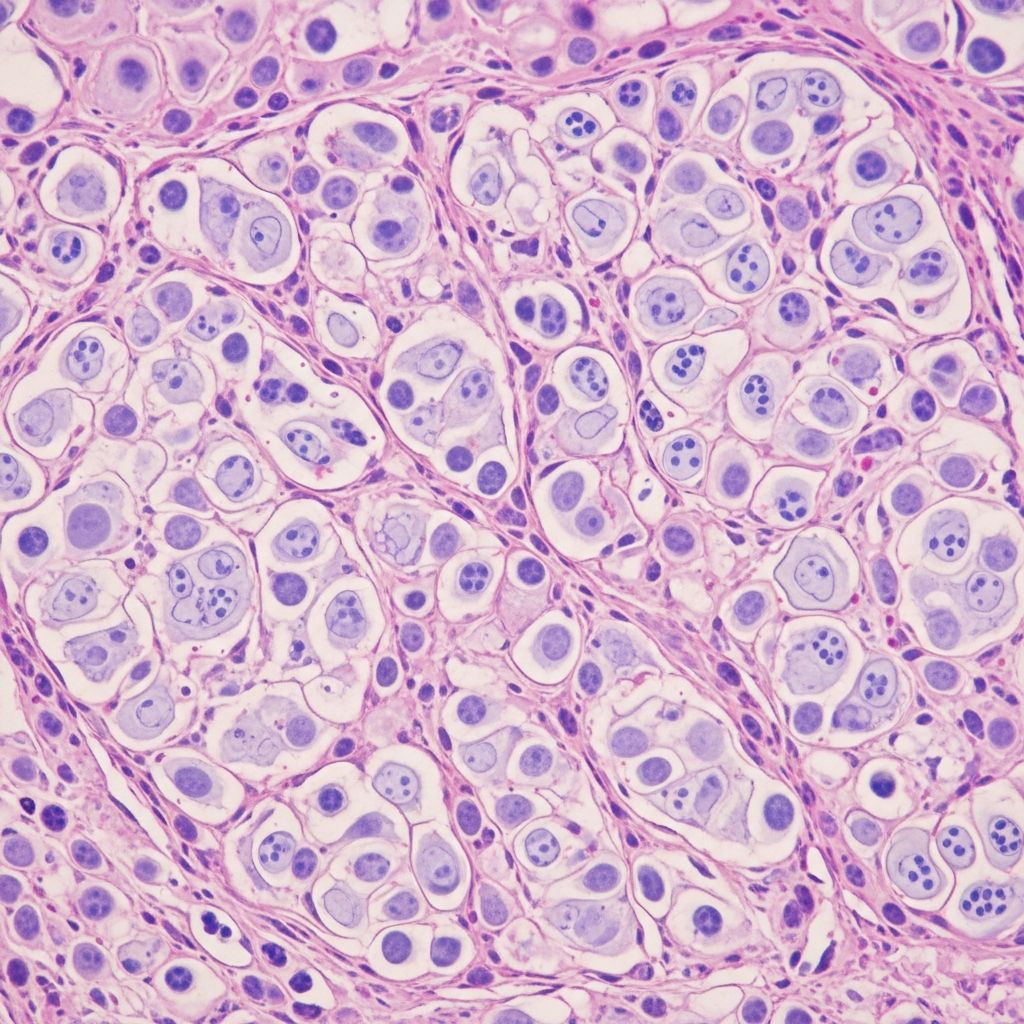
At low magnification, DDCCMN appears as a well-circumscribed nodular proliferation confined to the reticular dermis, often extending into the superficial subcutis while sparing the papillary dermis. The tumor entraps adnexal structures and thin collagen fibers, imparting a lacelike or sieve-like architecture.
Cytologically, the neoplasm is composed of uniform
large clear cells
with abundant optically clear to pale cytoplasm, distinct cell borders, and vesicular nuclei with inconspicuous nucleoli. Nuclear pleomorphism is minimal in typical cases, and mitoses are rare (<1 per 25 high-power fields). Rare atypical variants exhibit nuclear enlargement, hyperchromasia, and increased mitotic activity, raising concerns for uncertain malignant potential.No necrosis, vascular invasion, or significant stromal desmoplasia is observed. The clear cytoplasm results from glycogen accumulation or lipid content, though special stains for these are not routinely performed.
Microscopic images
- Low power: Nodular dermal proliferation with entrapment of collagen and adnexa.
- Medium power: Sheets of clear cells with lacelike pattern.
- High power: Bland vesicular nuclei in clear cytoplasm; rare mitoses.
Cytology descriptions
Cytological preparations, if available, show dispersed large cells with fragile, clear cytoplasm that may artifactually rupture, mimicking lipidized histiocytes. Nuclei remain bland and vesicular. Fine-needle aspiration is rarely performed due to the superficial location.
Osmium stain
Osmium tetroxide staining highlights lipid content in the clear cytoplasm, supporting a mesenchymal or histiocyte-like differentiation. However, this is not a standard diagnostic tool and is reserved for research settings.
Related Stories



Immunohistochemistry
DDCCMN displays a limited immunoprofile consistent with mesenchymal origin:
| Marker | Result | Notes |
|---|---|---|
| NKI-C3 | Positive (5/5) | Strong cytoplasmic staining; melanoma-associated antigen. |
| CD68 | Focal positive (2/5) | Histiocytic marker; nonspecific. |
| Vimentin | Positive (2/3) | Mesenchymal marker. |
| S100, Melan-A, HMB45 | Negative | Excludes melanoma. |
| Cytokeratins (AE1/AE3, CAM5.2) | Negative | Excludes carcinoma. |
| LCA (CD45) | Negative | Excludes lymphoid lesions. |
| EMA, SMA, Desmin | Negative | Further supports mesenchymal nature. |
NKI-C3 positivity is the most consistent finding, aiding distinction from mimics. Molecular studies are lacking, with no recurrent fusions identified to date.
Ultrastructure
Electron microscopy reveals abundant cytoplasmic glycogen granules and rough endoplasmic reticulum, without melanosomes, tonofilaments, or desmosomes, reinforcing non-melanocytic, non-epithelial differentiation.
Differential diagnosis
Clear cell tumors in dermis require a broad differential. Key discriminators include location, IHC, and behavior:
| Diagnosis | Key Features | IHC | Distinguishing Notes |
|---|---|---|---|
| Clear cell hidradenoma | Adnexal differentiation, ductal structures | CK+, EMA+, CEA+ | Epidermal connection; PAS+ diastase-resistant material. |
| Balloon cell nevus | Melanocytic, junctional component | S100+, HMB45+ | Melanosomes on EM. |
| Metastatic clear cell RCC | Deeper invasion, vascular spaces | CK+, CD10+, PAX8+ | Systemic workup positive. |
| Xanthoma | Multinucleated touton giant cells | CD68+, lipid stains + | Hyperlipidemia history. |
| Clear cell sarcoma | Deep soft tissue, nested growth | S100+, SOX10+, melanoma markers | TYR gene rearrangement. |
| PEComa | Perivascular arrangement | HMB45+, melan-A+ | Smooth muscle actin +. |
DDCCMN is favored by reticular dermal location, NKI-C3+, and negativity for lineage-specific markers.
Clinicopathologic variants
- Atypical DDCCMN: Nuclear pleomorphism, increased mitoses; uncertain potential; requires wide re-excision ± radiation.
- Eruptive form: Multiple lesions; desmoplastic stroma.
- Scalp variant: Older patients; identical histology.
Management and prognosis
Local excision suffices for typical cases, with no recurrences in long-term follow-up. Atypical lesions warrant wider margins and close surveillance. No role for adjuvant therapy in benign cases.
Frequently Asked Questions (FAQs)
Q: What is the most common site for clear cell mesenchymal neoplasm?
A: The lower extremities, presenting as smooth nodules.
Q: Is DDCCMN malignant?
A: Typically benign; rare atypical cases have uncertain potential but no metastases reported.
Q: What is the key immunohistochemical marker?
A: NKI-C3 positivity with negativity for melanocytic and epithelial markers.
Q: How does it differ from clear cell renal cell carcinoma metastasis?
A: Negative cytokeratins and PAX8; no vascular invasion or systemic disease.
Q: What is the treatment of choice?
A: Complete surgical excision; excellent prognosis.
References
- Distinctive dermal clear cell mesenchymal neoplasm — Lazar AJ, Fletcher CD. Am J Surg Pathol. 2004-07-01. https://pubmed.ncbi.nlm.nih.gov/15249856/
- Atypical distinctive dermal clear cell mesenchymal neoplasm arising in the scalp — Gavino AC, Pitha JV, Bakshi NA. J Cutan Pathol. 2008-04-01. https://pubmed.ncbi.nlm.nih.gov/18333905/
- Dermal Clear Cell Mesenchymal Neoplasm — Basicmedical Key. 2016. https://basicmedicalkey.com/dermal-clear-cell-mesenchymal-neoplasm/
- Clear cell tumours — Libre Pathology. Accessed 2026. https://librepathology.org/wiki/Clear_cell_tumours
- Eruptive dermal clear cell desmoplastic mesenchymal tumors — Wiley Online Library. 2013. https://onlinelibrary.wiley.com/doi/10.1111/cup.12240
Similar Articles








Read full bio of Sneha Tete