Collagen: What It Is, Types, Function & Benefits
Understand collagen's role in your body, its types, functions, and how to maintain healthy levels.
What Is Collagen?
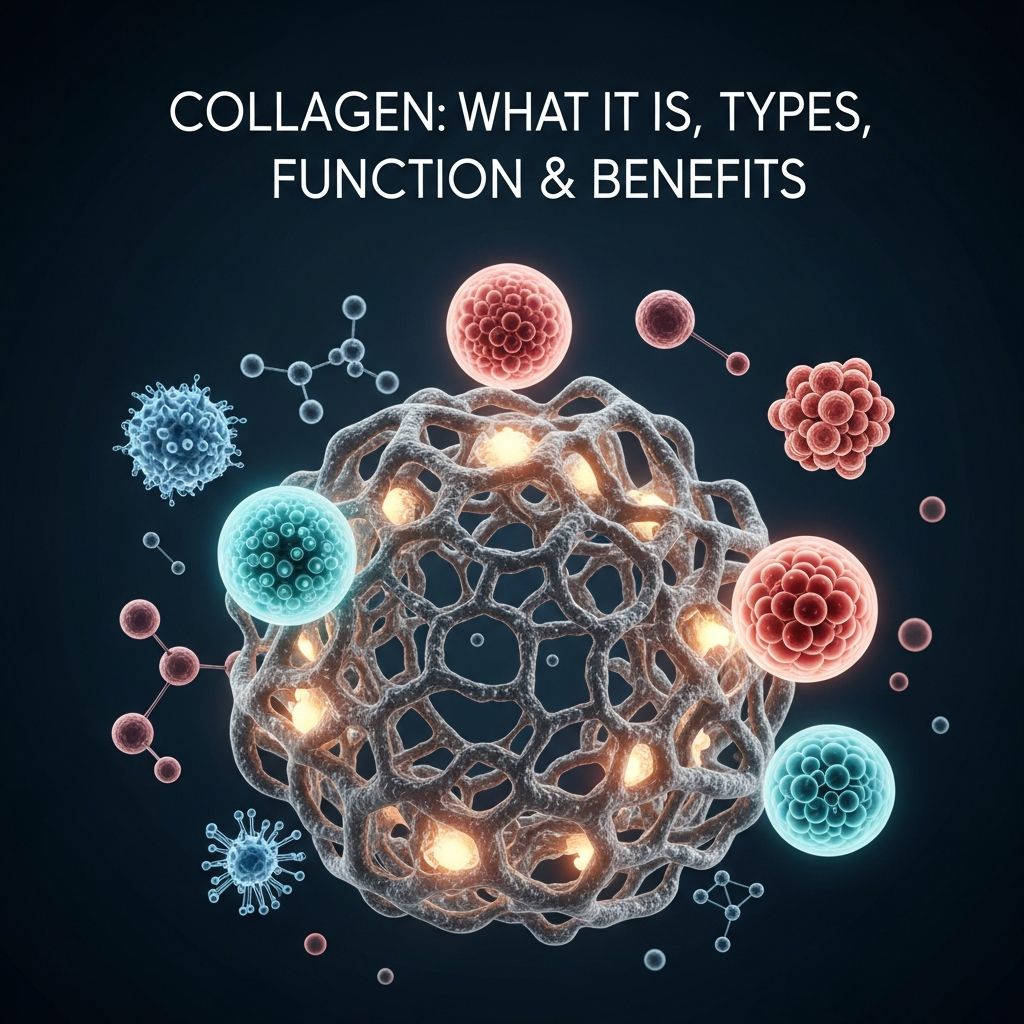
Collagen is the most abundant protein in your body, accounting for approximately 30% of your total protein content. This fibrous structural protein serves as a fundamental building block that provides structure, support, and strength to numerous tissues throughout your body. Think of collagen as the scaffolding that holds your body together, giving your skin its firmness, your bones their strength, and your joints their flexibility. It’s found in your skin, muscles, bones, tendons, ligaments, cartilage, and blood vessels, making it one of the most critical components of human physiology.
Your body naturally produces collagen by combining amino acids from protein-rich foods with vitamin C and essential minerals like zinc and copper. However, this natural production process changes as you age, leading to a gradual decline in both the quality and quantity of collagen your body can manufacture.
Types of Collagen
While your body contains at least 16 different types of collagen, the four main types account for the majority found in human tissues. Understanding these types helps explain collagen’s diverse roles in maintaining your health.
Type I Collagen
Type I collagen is the most abundant form in your body, comprising about 90% of your skin’s collagen content. This type possesses immense tensile strength and can withstand enormous forces, making it essential for maintaining skin elasticity, bone strength, and the structural integrity of tendons and ligaments. Type I collagen is particularly important for maintaining youthful skin appearance and preventing wrinkles.
Type II Collagen
Type II collagen is primarily found in cartilage and plays a crucial role in joint health. This type provides the cartilage in your joints with its ability to absorb shock and maintain flexibility. It’s especially important for people with active lifestyles or those concerned about joint degeneration.
Type III Collagen
Type III collagen is thinner and more immature than Type I, found abundantly in your skin, muscles, and blood vessels. While Type III provides less tensile strength than Type I, it works synergistically with Type I to maintain tissue elasticity and strength. The ratio of Type I to Type III collagen is critical for determining the overall quality and mechanical stability of your connective tissues.
Type IV Collagen
Type IV collagen is primarily found in the basement membranes, which serve as a foundation beneath your skin and line various organs. This type provides structural support and filtration functions, helping maintain the integrity of these vital barrier systems.
Functions of Collagen in Your Body
Collagen performs multiple critical functions that affect nearly every system in your body. Understanding these functions demonstrates why maintaining adequate collagen levels is essential for overall health and longevity.
Skin Health and Appearance
Collagen provides your skin with its firmness, elasticity, and hydration. It forms a network that supports skin cells and helps maintain moisture, resulting in smooth, plump-looking skin. As collagen production decreases with age, skin becomes thinner, drier, and more prone to wrinkles and sagging.
Bone Strength
Collagen comprises a significant portion of your bone matrix, providing flexibility and tensile strength. While minerals like calcium give bones their hardness, collagen gives them their ability to bend without breaking. This combination is essential for preventing fractures and maintaining bone health throughout your life.
Joint and Cartilage Support
Collagen maintains the structural integrity of cartilage, the smooth tissue covering bone ends in joints. It keeps joints stretchy and flexible, allowing for smooth movement and shock absorption. As collagen declines, joint flexibility decreases, increasing the likelihood of developing osteoarthritis and experiencing joint pain.
Muscle Function
Collagen in muscle tissue helps maintain muscle elasticity and strength. It provides structural support for muscle fibers and aids in muscle recovery after exercise. Adequate collagen levels contribute to maintaining muscle mass and function, particularly important as you age.
Organ and Tissue Protection
Collagen protects vital organs by forming connective tissue throughout your body. It helps maintain the integrity of blood vessel walls, supports your digestive system, and contributes to overall structural stability. Additionally, collagen plays a role in blood clotting by helping form the framework for clot formation.
Collagen Decline With Age
Your body’s collagen production naturally begins declining starting in your mid-20s. This gradual decrease accelerates with advancing age, with significant implications for your appearance and health. By age 40, you’re likely losing approximately 1% of your total body collagen per year. This decline becomes even more pronounced after menopause due to hormonal changes, which can accelerate collagen loss in women.
Several factors contribute to accelerated collagen breakdown beyond natural aging:
- Excessive sun exposure and UV radiation damage collagen fibers in skin
- Smoking reduces collagen production and accelerates its breakdown
- Alcohol consumption interferes with collagen synthesis and increases breakdown
- Poor nutrition lacking protein, vitamin C, and minerals limits collagen production
- Chronic stress and inflammation can impair collagen formation
- Lack of physical activity reduces collagen stimulation
The visible consequences of reduced collagen include wrinkles, sagging skin, reduced skin hydration, joint stiffness, weakened bones, and decreased muscle mass and elasticity.
Benefits of Collagen Supplementation
The collagen supplement market has grown substantially, projected to expand from $2.4 billion in 2024 to $3.5 billion in 2033. While supplements cannot replace the importance of a healthy lifestyle, research suggests several potential benefits when incorporated strategically.
Skin Hydration and Elasticity
One of the most studied benefits of collagen supplementation involves skin health. A 2021 meta-analysis of 19 randomized controlled trials demonstrated that hydrolyzed collagen, which has been broken down into more digestible peptides, improved skin hydration, elasticity, and reduced the appearance of wrinkles. These peptides are small enough to be absorbed through the digestive system and may accumulate in skin tissue, supporting its structure and moisture retention.
Hair and Nail Growth
Collagen provides structural support for hair follicles and nail beds. Some research suggests that collagen supplementation may improve hair thickness and growth while strengthening nails and reducing brittleness. However, more comprehensive studies are needed to fully establish these benefits.
Joint Pain Relief
Collagen peptides show promise for reducing joint pain among athletes, elderly individuals, and people with degenerative joint disease. By supporting cartilage integrity and reducing inflammation, collagen supplements may help maintain joint flexibility and ease discomfort associated with arthritis and overuse injuries. This benefit appears particularly strong for people engaged in regular physical activity or those experiencing age-related joint degeneration.
Bone and Muscle Support
Collagen supplementation may help strengthen bones and muscles by providing the structural proteins necessary for tissue maintenance and repair. This is particularly relevant for aging populations concerned about bone density loss and muscle atrophy. Some evidence suggests collagen may support exercise recovery and muscle synthesis.
How to Support Your Natural Collagen Production
Rather than relying solely on supplements, dermatologists recommend supporting your body’s natural collagen production through proven lifestyle strategies and dietary choices.
Dietary Approaches
Your body creates collagen by combining amino acids from protein-rich foods with vitamin C and minerals. Incorporating these nutrients into your diet supports natural collagen synthesis:
Protein-Rich Foods: Meat, bone broth, egg whites, and spirulina provide essential amino acids needed for collagen formation.
Vitamin C Sources: Citrus fruits, berries, bell peppers, broccoli, and leafy greens contain vitamin C, which is crucial for collagen cross-linking and stability.
Mineral-Rich Foods: Zinc and copper, found in shellfish, nuts, seeds, and legumes, are essential cofactors in collagen synthesis.
Skincare and Lifestyle Strategies
Dermatologists emphasize that protecting existing collagen is often more effective than attempting to replace lost collagen through supplements. Proven strategies include:
- Using sunscreen daily to prevent UV-related collagen damage
- Applying retinoids and vitamin C serums, which stimulate collagen production
- Avoiding smoking and limiting alcohol consumption
- Managing stress through meditation, exercise, or other relaxation techniques
- Getting adequate sleep to support tissue repair and collagen synthesis
- Regular exercise to stimulate collagen production and muscle maintenance
Collagen Supplements: What You Should Know
While collagen supplements are widely available, important considerations exist regarding their efficacy and quality. As dietary supplements, collagen products are not subject to the same rigorous Food and Drug Administration approval process required for over-the-counter and prescription medications. This means supplements can potentially contain contaminants or make unsubstantiated claims about their contents and benefits.
Many collagen supplements are expensive and contain various additives. Dermatologists note that evidence supporting their effectiveness remains limited compared to proven skincare ingredients like retinoids and vitamin C. Some experts recommend prioritizing protection of your existing collagen over expensive supplementation.
However, collagen peptides appear to carry minimal risk when taken in appropriate doses. If you choose to supplement, selecting products from reputable manufacturers and consulting with healthcare providers remains advisable.
Frequently Asked Questions
Q: At what age does collagen production significantly decline?
A: Collagen production begins declining in your mid-20s, with accelerated loss starting around age 40, when you lose approximately 1% of bodily collagen annually. Menopause further accelerates this decline in women.
Q: Can collagen supplements completely reverse wrinkles?
A: No. While collagen supplements may improve skin hydration and elasticity, they work as a complement to a comprehensive skincare routine rather than a standalone anti-aging solution. Results are modest and require consistent use alongside sun protection and proven skincare ingredients.
Q: Are collagen supplements safe?
A: Collagen peptides taken in appropriate doses appear safe for most people with minimal side effects. However, quality varies among products since supplements are not as strictly regulated as medications. Choose products from reputable manufacturers.
Q: What’s the difference between collagen supplements and collagen peptides?
A: Collagen peptides are hydrolyzed collagen that has been broken down into smaller, more digestible molecules. This form is absorbed more efficiently by your body compared to regular collagen, making peptides the preferred supplement form.
Q: Can I get enough collagen from food alone?
A: Your body synthesizes collagen from amino acids and nutrients found in foods. As you age, your body may not absorb or synthesize these nutrients as efficiently, potentially necessitating dietary adjustments or supplementation to maintain adequate collagen levels.
References
- Collagen Accounts for 30% of Body’s Protein — Cleveland Clinic. 2025. https://my.clevelandclinic.org/health/articles/23089-collagen
- Is It a Good Idea to Take Collagen Supplements? — AARP. 2024. https://www.aarp.org/health/drugs-supplements/collagen-supplements/
- Do Collagen Peptides Actually Work? — Cleveland Clinic Health. 2025. https://health.clevelandclinic.org/what-do-collagen-peptides-do
- Do Collagen Supplements Actually Work? — Cleveland Clinic News Service. 2025-10-17. https://newsroom.clevelandclinic.org/2025/10/17/do-collagen-supplements-actually-work
- 18 Foods With Collagen Boosting Benefits — Cleveland Clinic Health. 2025. https://health.clevelandclinic.org/the-best-way-you-can-get-more-collagen
- Abnormalities in Collagen Composition — National Institutes of Health. 2014. https://pmc.ncbi.nlm.nih.gov/articles/PMC4315876/
Similar Articles







Read full bio of Sneha Tete